
Clinical picture. M., a woman in her mid-thirties presenting with recurrent depressive episodes and longstanding low self-esteem, reports that positive feedback from colleagues leaves her feeling nothing, or faintly fraudulent. During a session focused on cognitive patterns, the clinician introduces the concept of disqualifying the positive and asks M. to recall a recent compliment verbatim, then to articulate, step by step, the internal moves she made immediately afterward. M. identifies a clear sequence: the compliment registered briefly, then a thought along the lines of "she was just being kind" cancelled it before it could settle. The clinician does not push for reappraisal at this stage; instead, the goal is recognition of the filter itself. M. leaves with a short self-monitoring task: to note, once daily, the exact cancelling phrase she uses and the speed at which it appears.
Disqualifying the Positive: PDF Worksheet, Tools and Exercises
A printable visual resource with concrete tools and exercises to help clinicians explain and work through the disqualifying-the-positive cognitive distortion in CBT sessions.
Clinical vignettes
Praise That Never Lands
Explaining Away a Real Win
Clinical picture. T., a man in his late twenties seen for perfectionism and social anxiety, completed a work presentation that his manager rated highly. He arrives at the next session visibly unmoved, attributing the outcome entirely to the topic being easy and the audience being undemanding. The clinician uses the informational sheet on disqualifying the positive to distinguish this habit from genuine humility, pointing out that humility does not require erasing the event. T. is asked to consider what evidence he would need, hypothetically, before a success could count, and finds he cannot specify any threshold. That observation alone shifts the tone of the session: the pattern becomes visible as a rule applied automatically, not as an accurate reading of events. Work continues the following week on what it would mean to let the fact simply stand, without elaboration in either direction.
Patients with chronic low self-esteem can describe disqualifying the positive with striking accuracy once you name it, yet walk out of the same session and dismiss the next compliment they receive within seconds. The concept lands cognitively; the mechanism does not. This PDF worksheet was designed to close that gap, giving you a visual support to make the distortion tangible during the session itself.
Use this resource with your patients
Handout, exercises and materials ready to use, right inside SessionFuel.
Why Disqualifying the Positive Resists Verbal Explanation
The core difficulty is that disqualifying the positive does not feel like a distortion to the patient. It feels like rigorous modesty, or simply like realism. When you describe it orally, the patient often agrees intellectually while the yes, but reflex continues operating undetected beneath that agreement. Unlike all-or-nothing thinking, which patients can usually catch in a concrete "always/never" statement, this distortion is quiet and plausible. "They're only being nice" sounds like reasonable social awareness, not a cognitive error.
The second obstacle is that the distortion is cumulative. A single cancelled compliment barely registers. It is the pattern across hundreds of interactions, each one explained away, that maintains a harsh self-narrative through life circumstances that should contradict it. That pattern is almost impossible to convey through description alone. It needs to be shown.
For presentations involving depression, perfectionism, social anxiety, low self-esteem, health anxiety, or OCD, this distortion is rarely absent. Naming it precisely, and early, orients the formulation considerably.
What the Worksheet Contains: A Visual Map of the Filter
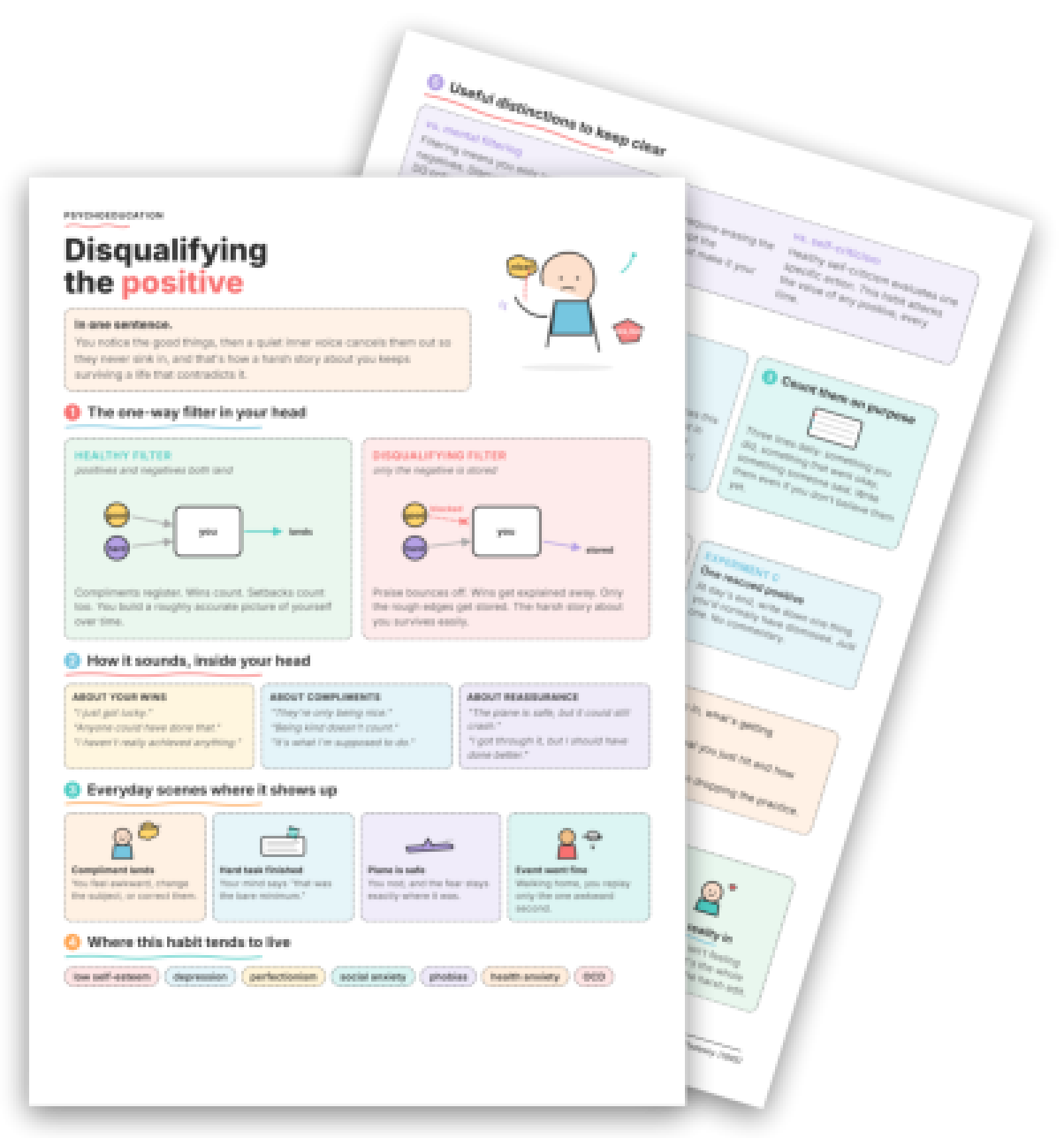
The fiche PDF is structured across nine numbered panels, each addressing a specific clinical angle. You can work through them selectively rather than linearly, depending on what is live in the session.
The first panel offers a one-sentence definition designed to be read aloud with the patient: "You notice the good things, then a quiet inner voice cancels them out so they never sink in." This shared phrasing creates an immediate common vocabulary.
Panels 1 and 2 carry the core psychoeducational weight. A two-filter diagram contrasts a healthy attentional filter (where both positives and negatives register and accumulate into a roughly accurate self-picture) against the disqualifying filter (where positives are actively blocked and only negatives are stored). The visual makes the asymmetry immediate in a way that description rarely does. You can point to the diagram and ask: "Which of these two looks more familiar?"
Panel 2 then lists verbatim internal responses across three categories: reactions to wins ("I just got lucky"), reactions to compliments ("They're only being nice"), and reactions to reassurance ("I got through it, but I should have done better"). Patients frequently recognize their own exact phrasing, which accelerates alliance and reduces defensiveness.
Panel 5 addresses a key clinical distinction that tends to generate confusion: the difference between disqualifying the positive, mental filtering as a separate cognitive distortion, genuine humility, and healthy self-criticism. Having this on paper prevents the patient from collapsing them mid-session.
The final panels move from psychoeducation into practice. Three behavioural experiments are specified (including "just say thank you" with no deflection, and "stay at the yes for ten seconds"). A daily positive log is structured as three lines per day, explicitly framed to be written even if you don't believe them yet, which preempts the rationalisation that the exercise is dishonest. Panel 8 frames discussion prompts for the session: what gets threatened when someone says something nice, how quickly the goalpost shifts when a goal is reached.
> Key point: This worksheet is a visual support that facilitates explanation during the session, not a self-directed questionnaire. Its diagrams and verbatim examples do the explanatory work alongside you, leaving the patient with a concrete reference to carry between appointments.
750+ clinical tools
A library built with and for clinicians, ready to use in session and extend between appointments.
Access all the toolsWhen and How to Introduce the Worksheet
This resource fits well from the second or third session onward, once an initial formulation is in place and you have observed the patient minimising a success or deflecting feedback. You do not need to have mapped all relevant core beliefs in advance; the fiche itself often surfaces them.
A low-threshold introduction: "I want to show you something that describes a pattern I notice a lot in people who are hard on themselves. Tell me if any of it rings a bell." This frames the material as descriptive and collaborative, not diagnostic and top-down.
Useful debrief questions after reviewing the two-filter diagram include: "Which version of the filter do you recognise in the last week?" and "What would have to change in the story you carry about yourself if the positives actually landed?" The latter question connects directly to schema-level work, particularly around defectiveness beliefs or impostor patterns.
The daily log in panel 6 pairs naturally with structured gratitude exercises and the celebrating personal successes homework. For patients actively working on accepting compliments or challenging feelings of not being good enough, the fiche provides the psychoeducational foundation that makes those exercises coherent rather than arbitrary.
One note of caution: with patients whose negative core beliefs are very rigid, the experiments in panels 7 and 8 may provoke strong schema-activation. Present them as observations to bring back into the next session, not as assignments to complete perfectly.
The worksheet does not replace the therapeutic relationship or the formulation; it makes one specific distortion legible, quickly, and leaves the patient with something to look at during the week when the yes, but reflex shows up again.
Use it with your patients
Share this tool in the mobile app and follow the work between sessions.
Sources
- Burns, D. D. (1980). Feeling Good: The New Mood Therapy. New American Library.
- Beck, A. T., Rush, A. J., Shaw, B. F., Emery, G. (1979). Cognitive Therapy of Depression. Guilford Press.
- Beck, J. S. (2011). Cognitive Behavior Therapy: Basics and Beyond (2nd ed.). Guilford Press.
Your session continues in your patients' pocket
Use with a patientYour resources, available everywhere
The handouts, exercises, programs and audios above: you choose which ones to make available to your patients, in the mobile app dedicated to them.
And far more than a library
The app goes well beyond resources, to support your patients every day:
Related categories
Explore other clinical resources by category.

Anxiety
Clinical hub for anxiety disorders: CBT and ACT worksheets, psychoeducation sheets, and exercises for assessment and treatment across the anxiety spectrum.

Mood
Evidence-based worksheets and clinical tools for mood disorders: CBT, ACT, and positive psychology resources for psychologists and therapists.

Identity
Clinical resources for self-identity work in therapy: CBT, ACT, schema tools for clinicians addressing self-concept, core beliefs, and identity disruption.

Cognition
Printable cognitive therapy worksheets and clinical tools for therapists: CBT, ACT, schema work, defusion, distortions, and belief restructuring.

Understand
Clinical hub for the therapeutic aim 'Understand': worksheets and tools to build patient insight across CBT, ACT, schema therapy and more.

Build awareness
Clinical worksheets and tools to build awareness in therapy: cognitive distortions, schemas, emotions, ACT and CBT resources for practitioners.