
Clinical picture. A patient in her late forties, referred to here as N., presented with recurrent depressive episodes and a marked negative attentional bias; she consistently filtered out neutral or positive daily events and amplified difficulties. Between the second and third sessions, the clinician introduced the daily gratitude exercise, asking N. to record three things for which she felt grateful before going to sleep each evening. N. initially reported that the task felt artificial and that nothing worth noting came to mind. By the fourth session, however, she brought her notebook and described noticing small moments, a colleague's patience, a quiet lunch break, that she would previously have overlooked entirely. The shift in her self-report was modest and tentative, yet consistent with early movement in attentional retraining.
Cultivating Positivity Through Daily Gratitude Practice
A structured gratitude exercise helping patients retrain attentional bias and build lasting positivity as between-session homework.
Clinical vignettes
Gratitude Tracking in Recurrent Depression
Engaging a Reluctant Adolescent
Clinical picture. T., a seventeen-year-old followed for generalised anxiety and low mood, was initially dismissive of structured homework, describing journaling exercises as pointless. The clinician framed the gratitude prompt not as a mood intervention but as a brief observational task, three items, no minimum length, no requirement to feel anything in particular while writing. T. completed the exercise on four of seven days and returned with entries that were terse but genuine, noting relief after finishing an assignment and enjoying a meal with his younger sibling. Progress was limited and the exercise alone did not produce measurable symptom change; it did, however, open a productive conversation about selective attention that T. had not been willing to engage with previously.
The Clinical Need: When Negativity Bias Runs the Show
Most patients arrive in therapy with an attentional system skewed toward threat. Negative events register faster, linger longer, and feel more real than neutral or positive ones. This is not character weakness; it is a well-documented cognitive default. The clinical problem is that simply telling a patient "try to notice the good things" rarely shifts anything. The instruction dissolves within hours because it lacks structure, repetition, and a concrete act of writing.
Attentional retraining toward the positive requires deliberate, repeated practice, and that practice has to happen daily, in real life, not only inside the consulting room. This is precisely where a between-session homework exercise earns its place. The Finding the Positive fiche can anchor the psychoeducation conversation during your appointment, while a structured written exercise carries the actual retraining into the patient's week. For patients whose disqualifying-the-positive distortion or mental filter keeps positive experiences from landing, the regularity of the format matters as much as the content.
Use this resource with your patients
Handout, exercises and materials ready to use, right inside SessionFuel.
What the Exercise Contains
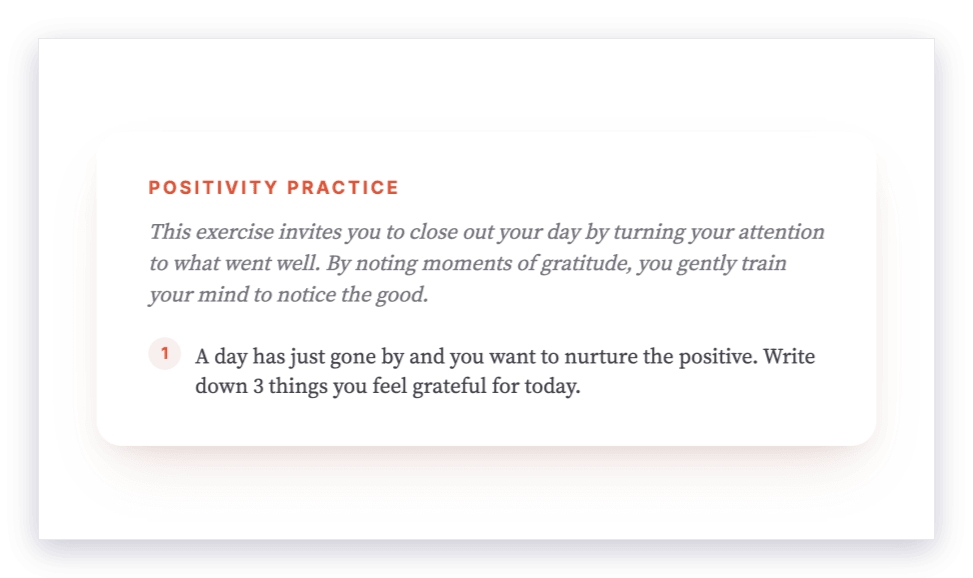
The exercise is built around a single, precisely worded question: at the end of a day, note three things for which you feel gratitude today. The simplicity is intentional. Three items is a number high enough to require genuine attentional effort (moving beyond the obvious) and low enough to remain achievable on difficult days. The word "gratitude" is chosen deliberately over "positive things" because it activates a relational and appreciative stance rather than a purely evaluative one.
That one question, delivered through a guided format the patient completes autonomously on their phone, constitutes a complete micro-intervention: a daily scanning habit, a written record, and an accumulating personal database of what holds meaning for this particular person.
The image above lists the exercise question exactly as it appears in the tool. This is a static preview only, showing the question structure. The full guided experience, including patient-facing instructions and dedicated space to write, is delivered directly to the patient through the app, not visible here.
Key insight: A single structured question, repeated consistently across days, builds attentional flexibility more reliably than any in-session discussion of positive thinking alone.
This exercise is available to patients through the mobile application that is the dedicated patient-side interface of SessionFuel: you assign it as homework from your SessionFuel account, and your patient completes it directly on their phone, on their own, between sessions.
750+ clinical tools
A library built with and for clinicians, ready to use in session and extend between appointments.
Access all the toolsIntegrating It as Between-Session Homework
This exercise suits a wide range of clinical presentations. It is particularly well-matched for patients with mild to moderate depression, where behavioral activation and celebrating small wins are already part of the work. It also fits patients in burnout, those rebuilding self-worth after chronic self-criticism, and anyone working on coping skills for depression who need a concrete daily anchor.
Introduce it by naming the mechanism: "Our brains are wired to hold onto difficulties more than good moments. This short exercise retrains that habit, a little each day." Framing it as a daily writing practice rather than a mood exercise reduces resistance from patients who distrust "positive thinking" language. Pair it with psychoeducation from the Positive Traits Checklist or Celebrating Personal Successes to build a broader positivity scaffold across the week.
When the patient returns, the material they bring back is genuinely useful. Ask which of the three items surprised them. Look for patterns across entries: recurring people, activities, or moments reveal what actually sustains this person. Note what they struggled to name on hard days, as those moments of resistance point directly to the schema or distortion worth examining next, whether that leads toward building new habits around the gratitude practice, or toward deeper work on Best Possible Self and future orientation.
Use it with your patients
Share this tool in the mobile app and follow the work between sessions.
Adaptations Worth Considering
For patients in couples therapy, the Relational Gratitude exercise extends the same logic into the relational field and pairs naturally here. For patients who complete the three items too quickly or too superficially, prompt them to write one sentence about why each item matters, adding depth without changing the structure. The exercise also dovetails cleanly with the Feeling Not Good Enough homework tool for patients whose self-criticism actively filters out positive experience before it can be named.
Your session continues in your patients' pocket
Use with a patientYour resources, available everywhere
The handouts, exercises, programs and audios above: you choose which ones to make available to your patients, in the mobile app dedicated to them.
And far more than a library
The app goes well beyond resources, to support your patients every day:
Related categories
Explore other clinical resources by category.

Anxiety
Clinical hub for anxiety disorders: CBT and ACT worksheets, psychoeducation sheets, and exercises for assessment and treatment across the anxiety spectrum.

Mood
Evidence-based worksheets and clinical tools for mood disorders: CBT, ACT, and positive psychology resources for psychologists and therapists.

Identity
Clinical resources for self-identity work in therapy: CBT, ACT, schema tools for clinicians addressing self-concept, core beliefs, and identity disruption.

Emotions
Clinical resources on emotion regulation: worksheets, coping tools, CBT, REBT, and ACT exercises for therapists working across diagnoses and age groups.

Behaviours
Clinical hub for behaviors in therapy: worksheets and tools for coping, eating disorders, CBT formulation, and maladaptive behavioral patterns.

Cognition
Printable cognitive therapy worksheets and clinical tools for therapists: CBT, ACT, schema work, defusion, distortions, and belief restructuring.