
Clinical picture. M., a woman in her mid-forties, presented eight months after the sudden death of her mother with persistent low mood, social withdrawal, and recurrent guilt whenever she experienced moments of pleasure. She described refusing invitations and avoiding her mother's favourite television programme, believing that enjoying herself signalled she had stopped loving her. The clinician introduced the informational sheet and named the two traps explicitly, which M. recognised without prompting. She spent the following session identifying the values her mother had modelled, settling on generosity and humour, and chose to cook one of her mother's recipes as a weekly gesture. At the next appointment she reported no reduction in sadness but a clear decrease in guilt, describing the meal as feeling "like she was at the table."
Maintaining the Bond Differently: PDF Worksheet, Tools and Exercises for Grief Therapy
A visual PDF worksheet and structured exercises to help patients hold continuing bonds with the deceased, without getting stuck in guilt or forced closure.
Clinical vignettes
Guilt at Laughing Again
Holding Grief and Living Forward
Clinical picture. T., a man in his early thirties, came to therapy fourteen months after losing his partner to a prolonged illness, reporting that he felt he was "betraying" her each time he made plans for the future. He had been functioning at work but had placed all personal photographs in storage and avoided mentioning her name in conversation. The clinician used the worksheet's reframe that pain had served as a bridge rather than as proof of love, and invited T. to work through the reflective steps. He identified loyalty and curiosity as values she had carried and decided to resume a language course she had encouraged him to start. He noted that naming this as a continuation of her influence, rather than a departure from grief, shifted the gesture from threatening to meaningful.
Explaining continuing bonds theory verbally in session is harder than it looks. The phrase alone, "you don't have to let them go," is just as likely to be heard as permission to stay frozen as it is to open something useful. Patients caught between drowning in grief and the guilt of laughing again need more than a reframe spoken aloud. This fiche PDF was built precisely for that impasse: a visual support that shows the third path rather than asserting it.
Use this resource with your patients
Handout, exercises and materials ready to use, right inside SessionFuel.
Why This Concept Resists Explanation Without a Visual Support
Patients navigating bereavement typically polarize around two implicit beliefs: that sustained pain proves the love was real, or that recovering means betrayal. Both positions are clinically familiar. What makes them so resistant is not a lack of insight but the moral weight attached to each. When you name this structure verbally, patients often acquiesce without any actual shift in their interpretive schema.
The guilt that surfaces when a moment of lightness returns is particularly sticky. It operates as a kind of automatic negative thought ("If I laugh again, I am forgetting them") that resists cognitive restructuring precisely because the patient experiences it as a loyalty signal, not a distortion. Sadness psychoeducation can frame the emotional landscape, and guilt work can address the self-attribution, but neither alone externalizes the structural problem clearly enough. A visual layout that places both traps side by side, with a named third path between them, does something oral explanation cannot: it gives the patient something to look at rather than believe.
What the Fiche Contains
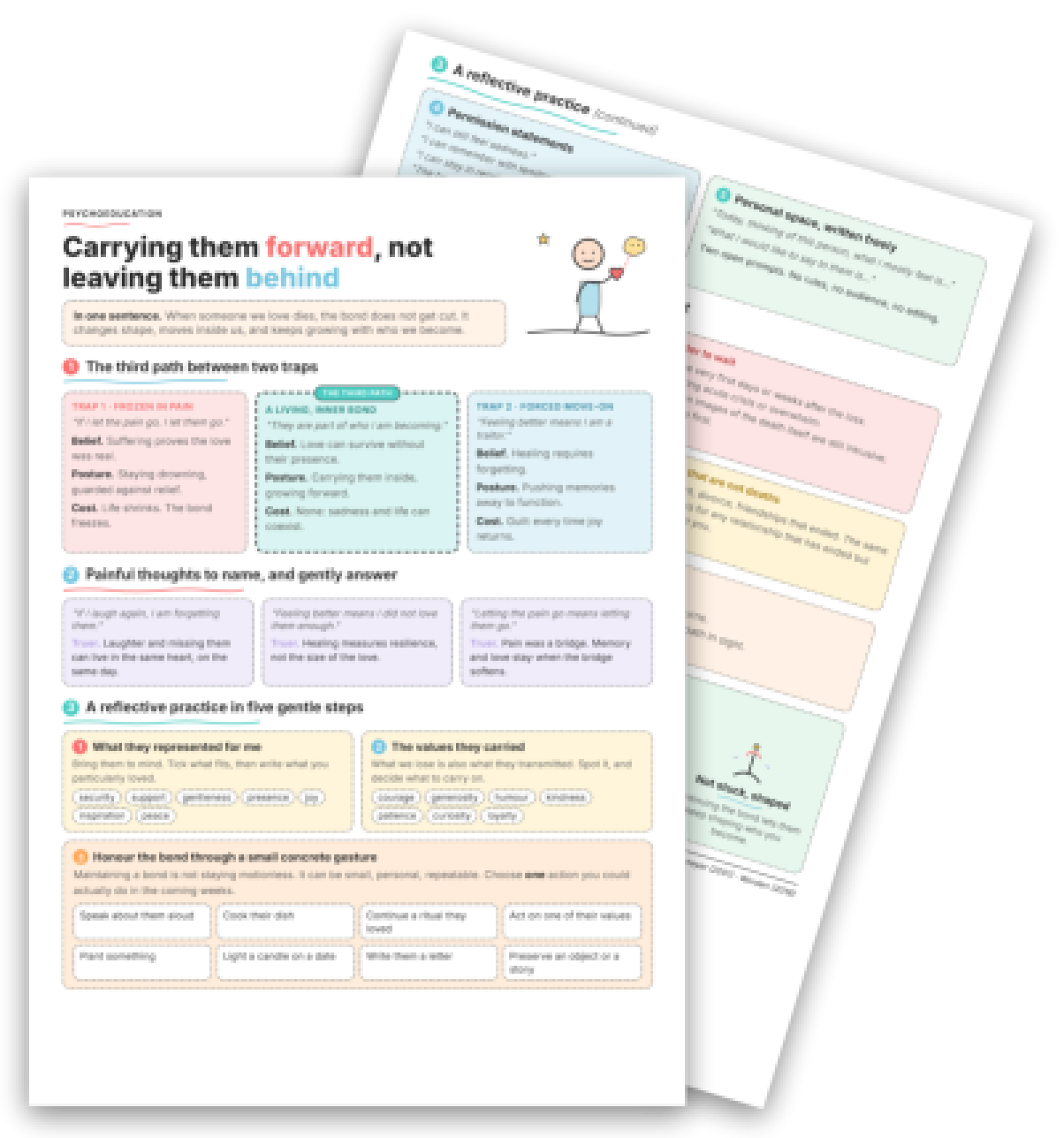
The fiche opens with a three-column schematic titled "The third path between two traps." Each column maps the underlying belief, the relational posture, and the cost. Trap 1 labels the position of suffering-as-proof-of-love; Trap 2 names forced closure and the guilt that follows every moment of recovery; the center column articulates the continuing bond position: "They are part of who I am becoming." Seeing all three laid out spatially, with the traps bracketing the middle path, changes how the conversation lands.
The second panel, "Painful thoughts to name, and gently answer," presents three grief-specific automatic thoughts alongside more accurate alternatives. These are grounded enough for direct in-session use alongside tools like the ABC model or cognitive restructuring exercises.
The core of the fiche is a five-step reflective practice. Step 1 asks the patient to identify what the person represented (security, presence, joy, inspiration). Step 2 shifts to values transmission: what did this person carry that the patient can continue to embody? Connecting grief to values clarification is clinically significant here. Step 3 proposes a concrete, repeatable gesture (cooking their dish, planting something, writing a letter), which grounds the bond in behavioral terms rather than purely internal ones. Steps 4 and 5 offer permission statements and two open free-writing prompts with no instructions attached.
The final panel covers timing: when the fiche is useful, when to wait (acute crisis, intrusive images of the death itself, the first days of loss), and how to adapt for complicated relational histories and for non-death losses like estrangement or divorce. That adaptability makes it relevant far beyond classical bereavement presentations.
> Key takeaway: This fiche is a visual psychoeducation support designed for use inside the session. It is not a homework questionnaire. The clinician presents and reads through it with the patient, using the schematic to anchor a conversation that would otherwise remain too abstract to take hold.
750+ clinical tools
A library built with and for clinicians, ready to use in session and extend between appointments.
Access all the toolsWhen and How to Introduce It
This is not a first-session resource. It fits best once the alliance thérapeutique is established and acute overwhelm has settled, typically from the third or fourth session onward, or later if presentation involves trauma reactions or PTSD features requiring stabilization first.
A low-barrier way to introduce it: "I have a one-page visual that maps out something I'd like us to look at together. A lot of people find the concept clicks differently when they can actually see the two pulls they've been caught between." Framing it as a shared looking exercise removes the pressure of it being an assignment.
After going through the schematic, the five-step practice can be started in session and left with the patient as a trace of the conversation. The guilt psychoeducation program pairs well as a follow-up when guilt about moving forward is the primary maintaining process. For patients where shame about recovering is prominent, or where death anxiety is intertwined with the loss, the fiche opens a vocabulary that subsequent sessions can build on directly.
The fiche does not replace clinical formulation or the deeper work of meaning reconstruction that follows. It makes the entry point clearer, and leaves the patient with a concrete map to return to between sessions.
Use it with your patients
Share this tool in the mobile app and follow the work between sessions.
Sources
- Klass, D., Silverman, P. R., Nickman, S. L. (1996). Continuing Bonds: New Understandings of Grief. Taylor and Francis.
- Klass, D., Steffen, E. M. (2018). Continuing Bonds in Bereavement: New Directions for Research and Practice. Routledge.
- Worden, J. W. (2018). Grief Counseling and Grief Therapy: A Handbook for the Mental Health Practitioner (5th ed.). Springer Publishing Company.
- Neimeyer, R. A. (2001). Meaning Reconstruction and the Experience of Loss. American Psychological Association.
Your session continues in your patients' pocket
Use with a patientYour resources, available everywhere
The handouts, exercises, programs and audios above: you choose which ones to make available to your patients, in the mobile app dedicated to them.
And far more than a library
The app goes well beyond resources, to support your patients every day:
Related categories
Explore other clinical resources by category.

Mood
Evidence-based worksheets and clinical tools for mood disorders: CBT, ACT, and positive psychology resources for psychologists and therapists.

Identity
Clinical resources for self-identity work in therapy: CBT, ACT, schema tools for clinicians addressing self-concept, core beliefs, and identity disruption.

Transitions
Clinical hub for life transitions: tools, worksheets and exercises to support psychosocial adjustment, role change and identity work in practice.

Understand
Clinical hub for the therapeutic aim 'Understand': worksheets and tools to build patient insight across CBT, ACT, schema therapy and more.

Build awareness
Clinical worksheets and tools to build awareness in therapy: cognitive distortions, schemas, emotions, ACT and CBT resources for practitioners.

Engage & motivate
Clinical hub: printable worksheets and exercises to build therapeutic engagement and motivation across ACT, CBT, and integrative practice. For clinicians.