
Clinical picture. T., a woman in her early forties, presented following a period of occupational burnout, reporting a pervasive sense of directionlessness once she had stepped back from work. She described her days as structurally empty and found it difficult to articulate what she actually wanted, beyond the absence of her previous overload. The clinician introduced the Future Inventory exercise, asking her to list actions she would pursue in an ideal world and to order them from most to least time-consuming. T. returned the following week with a ranked list that placed sustained creative work near the top and social commitments near the bottom, a ordering that surprised her and contradicted her stated belief that relationships were her central value. This discrepancy became a productive focus for subsequent sessions, without assuming the list represented a fixed or final picture of her priorities.
My Future Inventory: Values-Based Action Clarification
A one-question guided exercise helping patients surface their ideal-world priorities and rank them by the time they would genuinely invest in each.
Clinical vignettes
Clarifying Priorities After Burnout
Re-engaging a Depressed Adolescent
Clinical picture. M., a seventeen-year-old referred for moderate depression, struggled to respond to open questions about his goals or future, typically offering short answers or shrugging. Rather than pressing further, the clinician offered the Future Inventory as written homework, framing it as a simple ranking task rather than a therapeutic assignment. M. came back with five items, placed in a clear order, with outdoor physical activity listed first and school-related tasks last. The exercise gave the clinician concrete, patient-generated material to work with, and M. appeared more willing to discuss the list than he had been to discuss his mood directly. Subsequent sessions used the ranking to explore small, feasible steps toward the higher-priority items.
When the future feels blank or scattered
Many patients arrive knowing something is wrong with how they spend their time, yet cannot articulate what they actually want instead. Asking them verbally to "imagine an ideal life" in the room tends to produce vague, socially acceptable answers, not genuine self-disclosure. The question is abstract, the stakes feel high, and the reflective distance simply is not there.
This is exactly where values-based future projection meets a concrete clinical wall. Tools like the Exploring Values worksheet or the My Values clarification exercise can identify what a patient cares about, but they do not always surface how that patient would actually choose to spend their life if constraints disappeared. The gap between stated values and imagined time allocation is clinically rich territory, and it rarely opens under direct questioning.
Use this resource with your patients
Handout, exercises and materials ready to use, right inside SessionFuel.
What this exercise contains
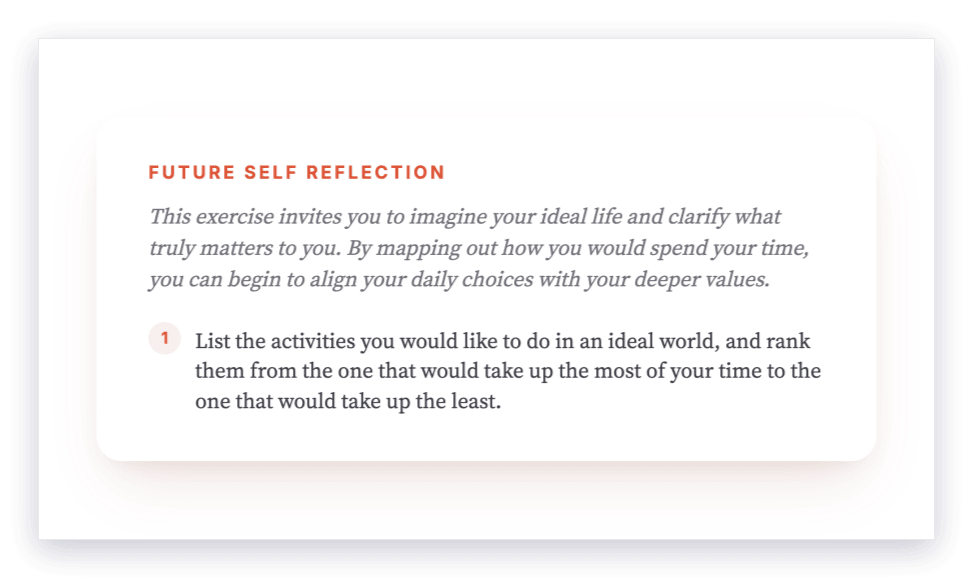
My Future Inventory is built around a single, precisely worded question. The patient is asked to list the actions they would like to carry out in an ideal world, then to order that list from the action that would occupy the most time to the one that would occupy the least.
The image above is a static preview of that question as it appears in the exercise structure. The full guided exercise, with patient-facing instructions and space to respond, is experienced by the patient autonomously in the app, not in this preview image.
The elegance of the ranking instruction is that it does the clinical work quietly. Simply listing desires is one thing. Being asked to prioritise them by time forces the patient into a concrete, imaginative commitment. The result is not a wishlist but a draft timetable for a meaningful life, and the ordering itself reveals what the patient genuinely values most, beneath the noise of obligation and habit. This makes it a natural companion to exercises like 10-Year Goal Projection or Setting 6 and 12 Month Goals, which can follow once the raw inventory exists.
This exercise is available to patients through the mobile application that is the dedicated patient-side interface of SessionFuel: you assign it directly from your SessionFuel account, and your patient completes it on their own phone, between your appointments, at their own pace.
750+ clinical tools
A library built with and for clinicians, ready to use in session and extend between appointments.
Access all the toolsHow to put it to work between sessions
My Future Inventory suits a wide range of profiles: patients in a vocational crossroads, those experiencing low motivation or anhedonia, patients who engage well with goal-setting and behavior change work, and anyone whose therapy has surfaced a gap between current life and felt meaning. It is also a useful early-phase tool before engaging with more structured work such as Life Goals Across Eight Domains or the Personal Meaning and Direction worksheet.
Introduce it plainly: tell the patient you would like them to imagine a world with no practical constraints, list what they would do, and rank those activities by how much time they would genuinely give each. No censorship, no realism filter.
When the patient returns, the ordering is your primary clinical material. What sits at the top? What is conspicuously absent compared to their current week, auditable with a tool like Current Activity Inventory? Is there tension between what they ranked first and what they feel entitled to want? The list also opens naturally onto committed action work and can feed directly into professional life assessment or work-life balance reflection when the context calls for it.
Key insight: The ranking instruction transforms a vague aspiration exercise into a concrete self-portrait of priorities, giving the clinician something specific to discuss, challenge, and build on.
Use it with your patients
Share this tool in the mobile app and follow the work between sessions.
Adaptations and articulations
For patients who feel blocked by the "ideal world" framing, a brief normalisation helps: the question is not asking for realism, only for honesty. If the list is very short or stays generic, that itself is clinically informative and worth exploring. For patients already engaged in ACT-informed work, this exercise pairs naturally with the Choice Point model or the Psychological Flexibility worksheet, as it makes values-based direction visible in a concrete, rankable form that patients can revisit across the course of therapy.
Your session continues in your patients' pocket
Use with a patientYour resources, available everywhere
The handouts, exercises, programs and audios above: you choose which ones to make available to your patients, in the mobile app dedicated to them.
And far more than a library
The app goes well beyond resources, to support your patients every day:
Related categories
Explore other clinical resources by category.

Mood
Evidence-based worksheets and clinical tools for mood disorders: CBT, ACT, and positive psychology resources for psychologists and therapists.

Identity
Clinical resources for self-identity work in therapy: CBT, ACT, schema tools for clinicians addressing self-concept, core beliefs, and identity disruption.

Behaviours
Clinical hub for behaviors in therapy: worksheets and tools for coping, eating disorders, CBT formulation, and maladaptive behavioral patterns.

Transitions
Clinical hub for life transitions: tools, worksheets and exercises to support psychosocial adjustment, role change and identity work in practice.

Engage & motivate
Clinical hub: printable worksheets and exercises to build therapeutic engagement and motivation across ACT, CBT, and integrative practice. For clinicians.

ACT
Clinical hub for Acceptance and Commitment Therapy (ACT): worksheets, exercises, programs and audio resources for practitioners using the ACT model.