
Clinical picture. R., a woman in her early forties, presented with a recurrent depressive episode and described feeling trapped in day-to-day survival, unable to identify any meaningful direction for her life. During a mid-treatment session, the clinician introduced the ten-year goals exercise, inviting R. to respond in writing to the opening prompt before the next appointment. R. returned having written, hesitantly at first, about a desire to have retrained professionally and to live closer to her extended family. The exercise surfaced values around belonging and contribution that had not appeared in earlier functional assessments, and these became explicit anchors for subsequent behavioral activation planning. Progress remained gradual, but R. reported that naming a longer horizon made short-term effort feel less arbitrary.
10-Year Goals: A Values-Based Long-Term Vision Exercise
Help patients break out of short-term tunnel vision and articulate the long-horizon aspirations that give therapy real direction and momentum.
Clinical vignettes
Reorienting a Depressed Patient Toward Long-Term Vision
Clarifying Values in Chronic Anxiety Treatment
Clinical picture. M., a man in his late twenties, was referred for generalized anxiety disorder and described his coping as almost entirely reactive, organized around avoiding discomfort rather than pursuing anything. The clinician offered the ten-year goals exercise as a structured written task, explaining that its purpose was not to produce a plan but to surface what mattered beneath the avoidance. M. initially wrote that he had no idea, then produced two sentences about wanting to be someone his younger siblings could rely on. That image became a reference point the clinician returned to when introducing exposure rationale, grounding the work in a self-authored aspiration rather than an externally imposed rationale.
Why Long-Term Projection Is Clinically Hard to Unlock
Many patients arrive in therapy locked in the immediate: managing symptoms, surviving the week, putting out the next fire. Asking them to think ahead six months already feels ambitious. Asking them to project ten years forward is a different kind of clinical move entirely, and that is precisely what makes it valuable.
Long-horizon thinking does something that no amount of symptom-focused work does on its own: it forces contact with the question of what a life is actually for. This is where values clarification work and goal-setting converge, and where many patients realize they have never genuinely asked themselves the question. The resistance is real: some patients deflect with "I can't know that far ahead," others produce a flat, socially acceptable answer. Both responses are clinically informative.
The difficulty with exploring this verbally in conversation is that the spontaneous answer tends to be shaped by the clinician's presence, patients self-censor, perform reasonableness, or simply go blank under the implicit pressure of the session. A written, autonomous reflection removes that dynamic entirely.
Use this resource with your patients
Handout, exercises and materials ready to use, right inside SessionFuel.
What the Exercise Contains
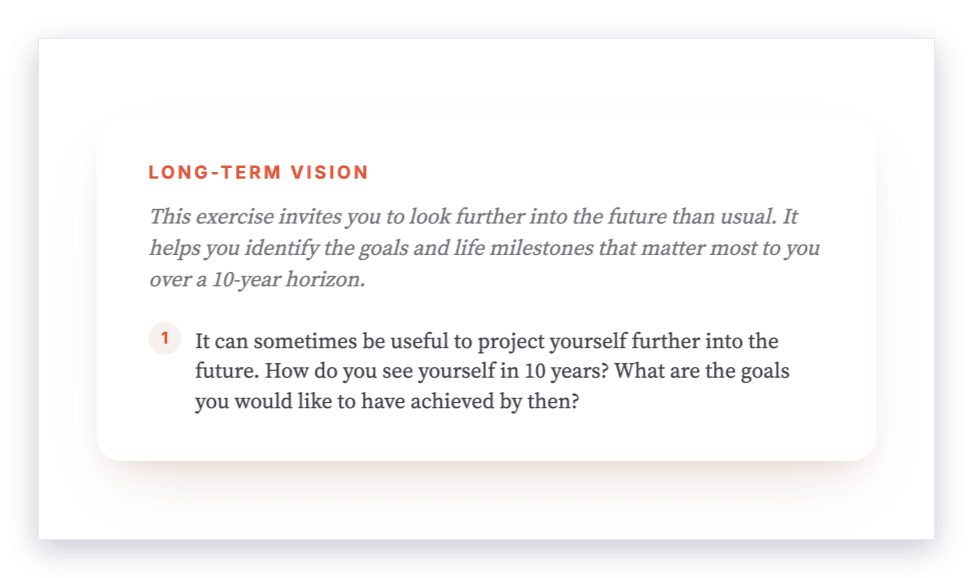
This exercise is built around a single, deliberately open prompt. The patient is invited to consider that projecting further than usual can itself be useful, then asked: How do you see yourself in 10 years? What are the goals you would want to have achieved by then?
That apparent simplicity is intentional. One open question, held over time, produces richer material than a structured checklist. It leaves room for the patient to define what counts as a goal, professional trajectory, relationships, health, personal growth, geographic change, without the clinician pre-loading the categories. This is meaningfully different from tools like Life Goals Across Eight Domains, which map goals across predefined areas. Here, the patient decides what matters enough to name.
What the patient produces is a raw, unfiltered articulation of aspiration, the kind of material that rarely surfaces in session because there is never quite enough time or distance to let it breathe. It sits naturally alongside exercises like Best Possible Self and My Future Inventory: Values-Based Action Clarification, but differs in its purely narrative, self-directed quality.
The image above lists the exercise question as a static preview. The full guided experience, with the patient-facing introduction, written response space, and the complete interactive flow, is what the patient encounters in the app on their own. That in-app experience is not visible here.
This exercise is available to patients directly through the SessionFuel patient app, the dedicated mobile interface for patients of clinicians who use SessionFuel. You assign it as between-session homework, and your patient completes it independently on their phone, in their own time.
750+ clinical tools
A library built with and for clinicians, ready to use in session and extend between appointments.
Access all the toolsHow to Assign It and What to Do With the Response
Which patients benefit most. This exercise suits patients who are past the acute phase of their work, those who are stable enough to tolerate uncertainty and reflective enough to engage with open-ended projection. It is particularly well-suited to patients working on personal meaning and direction, those navigating major life transitions, and those who repeatedly set SMART goals without ever linking them to a larger sense of direction. Patients prone to short-term crisis mode can find a 10-year horizon surprisingly liberating once invited to try it.
How to introduce it. Frame the homework as an experiment in perspective, not a planning exercise. You might say something like: "Before next time, I'd like you to sit with one question, not to produce a perfect answer, but to notice what comes up." This removes performance pressure and primes genuine reflection. It pairs well with a prior session touching on personal values or life story narrative.
How to use what they bring back. The patient's response functions as a projective mirror. Note what domains appear and which are absent, someone who lists only professional goals but says nothing about relationships has told you something. Notice the emotional register: is the future described with energy, resignation, or vagueness? Use the material to build discrepancy between the current trajectory and the stated vision, which connects directly to building discrepancy in motivational work. A ten-year answer also provides the raw material for backward-chaining: what would need to be true in five years, in one year, to be on track? That is the natural bridge to Setting 6 and 12 Month Goals and Goal-Setting and Motivation.
Key clinical insight: When a patient cannot answer this question at all, the blankness is not a failure, it is a finding. It often signals values disconnection, chronic avoidance of self-knowledge, or a depression-driven contraction of the future. That is, in itself, the clinical material to work with.
Use it with your patients
Share this tool in the mobile app and follow the work between sessions.
Articulations Worth Considering
If the patient's response stays vague or heavily hedged, the Identifying Patient Growth Axes exercise can help them first name what they want to change before they attempt to name where they want to arrive. For patients whose 10-year vision feels blocked by a specific fear, Cultivating Personal Values: A Guided Committed Action Exercise can help close the gap between what they hold dear and how they are actually living. And for patients who produce an answer driven entirely by external expectations, what they should want, the Personal Values fiche offers a useful lens to distinguish chosen from inherited goals. The 10-year frame is not a standalone tool. It is a long-view anchor that makes everything else in the work more directional.
Your session continues in your patients' pocket
Use with a patientYour resources, available everywhere
The handouts, exercises, programs and audios above: you choose which ones to make available to your patients, in the mobile app dedicated to them.
And far more than a library
The app goes well beyond resources, to support your patients every day:
Related categories
Explore other clinical resources by category.

Mood
Evidence-based worksheets and clinical tools for mood disorders: CBT, ACT, and positive psychology resources for psychologists and therapists.

Identity
Clinical resources for self-identity work in therapy: CBT, ACT, schema tools for clinicians addressing self-concept, core beliefs, and identity disruption.

Behaviours
Clinical hub for behaviors in therapy: worksheets and tools for coping, eating disorders, CBT formulation, and maladaptive behavioral patterns.

Transitions
Clinical hub for life transitions: tools, worksheets and exercises to support psychosocial adjustment, role change and identity work in practice.

Engage & motivate
Clinical hub: printable worksheets and exercises to build therapeutic engagement and motivation across ACT, CBT, and integrative practice. For clinicians.

Positive psychology
Positive psychology clinical resources for therapists: worksheets, exercises & programs on well-being, strengths, gratitude, and resilience-based practice.