
Clinical picture. M., a 34-year-old with a history of recurrent mild depression, reports persistent low energy and social withdrawal; he has repeatedly attempted to resume regular physical activity without success. The clinician introduces the Je me lance! exercise, guiding M. through each question in session: he identifies his deep motivation as wanting to feel less isolated, then specifies his goal as a 20-minute walk on Monday, Wednesday, and Friday mornings before work. When asked how he will measure progress, M. settles on logging each completed walk in his Mosaik routine tracker. By the following appointment, he reports having completed five of six planned walks, noting that tying the activity to an existing morning routine reduced the friction he had previously described.
Goal-Setting and Motivation: A Guided Clinical Exercise
A structured clinical exercise helping patients clarify their deep motivation, sharpen their objective, and anchor new behaviors in lasting routine.
Clinical vignettes
Anchoring a New Habit in Routine
Refining an Overly Broad Goal
Clinical picture. A., a 28-year-old presenting with generalized anxiety and difficulty structuring her day, comes to session stating she wants to "stress less about work," without a more defined plan. The clinician uses the Je me lance! questions to help her move from that vague intention toward a concrete behavioral target: limiting work-related messaging to one 15-minute check after dinner, with a partner present for accountability. A.'s initial goal had no measurable indicator, so together they agree that tracking the number of evenings she respected the boundary would serve as a simple progress marker. Two weeks later A. reports partial adherence, which itself opens a productive discussion about attainability and what adjustments might make the routine sustainable.
The clinical challenge: when "I want to change" stays a wish
Patients arrive with intentions. They want to exercise more, eat differently, finally start that project, or break a pattern that has held them back for years. The clinical challenge is not identifying the goal: it is converting vague resolve into durable, measurable commitment. Oral discussion in the consultation room can produce real insight, yet that insight rarely survives the first obstacle, because the patient never had to write down why the goal matters, exactly when they will work on it, or how they will know they are making progress.
This is where a structured written exercise earns its place. The act of answering precise questions, on paper, in one's own words, forces concretization that conversation alone rarely achieves. It also shifts ownership: the patient is no longer passively receiving a suggestion but actively constructing a personal plan. Tools such as the SMART Goals PDF Worksheet or the Setting Life Goals worksheet offer excellent visual scaffolding, but they are typically used as psychoeducation supports. This exercise goes further by asking the patient to do the cognitive work themselves, autonomously, before the next appointment.
Use this resource with your patients
Handout, exercises and materials ready to use, right inside SessionFuel.
What the exercise contains
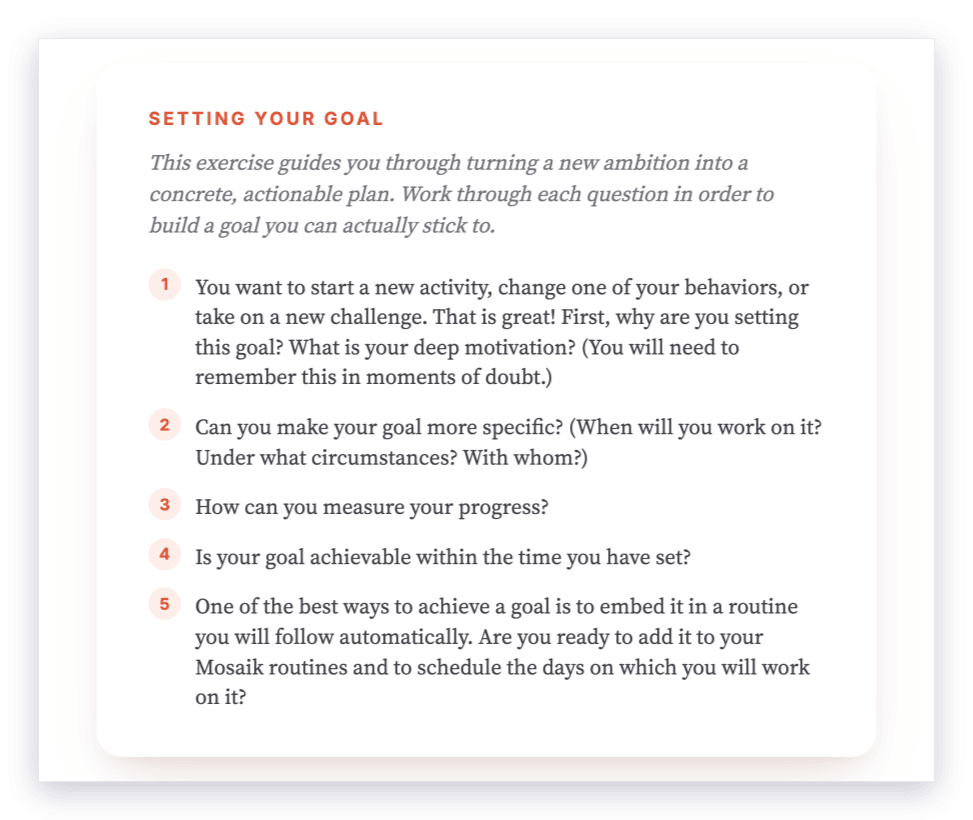
Je me lance! is a five-question guided exercise built around the full arc of behavior-change initiation. The image above lists each question in order.
This image is a static preview of the question list only. The full guided experience, including patient-facing instructions and space to write answers, is accessed by the patient directly in the app, not in this image.
The exercise opens by asking the patient to name their deep motivation: not the surface-level objective, but the underlying reason that will sustain them through doubt. Question two tightens the goal by prompting the patient to specify timing, circumstances, and social context, moves that mirror the precision work familiar from goal-setting across eight life domains. Question three turns to measurable progress, giving the patient a concrete yardstick rather than a subjective sense of success or failure. Question four invites an honest appraisal of attainability within the available time, a check that helps prevent the discouragement common to overly ambitious plans. The fifth and final question asks whether the patient is ready to embed the goal in a daily routine, linking commitment to automaticity rather than relying on willpower alone, an approach developed in detail in the Healthy Habit Plan worksheet and the Building New Habits resource.
This exercise is available to patients through the mobile patient app of SessionFuel: once you assign it, your patient receives it directly on their phone and completes all five questions on their own, at their own pace, between appointments.
750+ clinical tools
A library built with and for clinicians, ready to use in session and extend between appointments.
Access all the toolsIntegrating the exercise as between-session homework
Which patients benefit most. This exercise suits any patient embarking on a concrete behavioral change: starting a physical activity, modifying an eating pattern, tackling procrastination, or working on identifying their growth axes. It is particularly valuable when a patient has expressed motivation verbally but has not yet translated it into action. Patients struggling with motivation loss or ambivalence may need to pair this with a decisional balance exploration first.
How to introduce it. Assign the exercise at the end of a session in which the patient has named a concrete desire to change. Frame it simply: "Between now and our next appointment, I would like you to answer these five questions about your goal. Take your time. Your answers will be the starting point for our next conversation." The patient then completes the exercise between sessions, autonomously, in the app.
How to use what the patient brings back. The written answers create a shared document. At the next appointment, look together at the motivation stated in question one: it becomes a reference point every time the patient hits resistance. The specificity and measurability answers (questions two and three) allow you to track progress concretely, much as the Weekly Behavioral Review exercise does over time. If the attainability check (question four) reveals an unrealistic plan, you can readjust collaboratively. And the routine commitment in question five opens a direct conversation about habit architecture, which you can deepen with resources on setting medium and long-term goals or celebrating personal successes as the patient progresses.
Key insight: The real clinical value of this exercise is not the answers themselves but the process of producing them. When a patient writes down their deep motivation in their own words, they are building an internal anchor that no verbal instruction can fully replicate.
Use it with your patients
Share this tool in the mobile app and follow the work between sessions.
Articulation and adaptations
For patients where identity and values are central to the change attempt, consider pairing this exercise with Cultivating Personal Values or the My Values clarification exercise beforehand. For patients prone to setting goals that quickly collapse under perfectionism, the Growth Mindset worksheet can frame productive imperfection before they begin. The five questions scale naturally across clinical presentations: they are as relevant for a patient beginning a professional transition as for one rebuilding structure after depression, making Je me lance! a genuinely versatile tool in any behavior-change-oriented practice.
Your session continues in your patients' pocket
Use with a patientYour resources, available everywhere
The handouts, exercises, programs and audios above: you choose which ones to make available to your patients, in the mobile app dedicated to them.
And far more than a library
The app goes well beyond resources, to support your patients every day:
Related categories
Explore other clinical resources by category.

Mood
Evidence-based worksheets and clinical tools for mood disorders: CBT, ACT, and positive psychology resources for psychologists and therapists.

Identity
Clinical resources for self-identity work in therapy: CBT, ACT, schema tools for clinicians addressing self-concept, core beliefs, and identity disruption.

Behaviours
Clinical hub for behaviors in therapy: worksheets and tools for coping, eating disorders, CBT formulation, and maladaptive behavioral patterns.

Transitions
Clinical hub for life transitions: tools, worksheets and exercises to support psychosocial adjustment, role change and identity work in practice.

Cognition
Printable cognitive therapy worksheets and clinical tools for therapists: CBT, ACT, schema work, defusion, distortions, and belief restructuring.

Engage & motivate
Clinical hub: printable worksheets and exercises to build therapeutic engagement and motivation across ACT, CBT, and integrative practice. For clinicians.