
Clinical picture. T., a man in his late thirties, presented with persistent social withdrawal and a diffuse sense of stagnation following a professional setback. He reported wanting to change but struggled to articulate what, specifically, needed to shift. The clinician introduced the five-question exercise as a between-session task, framing it as a way to move from vague dissatisfaction toward workable targets. T. returned the following week having identified two recurring emotional states he found intolerable, one avoidance pattern in professional interactions, and a single concrete action he felt ready to attempt. The exercise did not resolve his difficulties, but it gave the subsequent session a clear starting point rather than an open-ended exploration.
Mapping Personal Growth Areas: A Guided Clinical Exercise
A structured five-question homework exercise helping patients clarify which emotions, behaviors, and situations they want to change, and plan concrete first steps.
Clinical vignettes
Clarifying Priorities in Chronic Avoidance
First Steps After a Mood Episode
Clinical picture. M., a woman in her mid-forties with a history of recurrent depressive episodes, was in a partial-remission phase and expressed a wish to work on relapse prevention. She had difficulty translating that wish into specific goals, often cycling through the same broad concerns each session. The clinician assigned the structured exercise, noting that questions four and five in particular ask the patient to name actions and resources rather than problems. M. completed the sheet at home and identified three situations she wanted to handle differently, along with one reliable support person she had not thought to involve. Her responses shifted the clinical focus from symptom monitoring toward behavioral planning, which she found more engaging at that stage of treatment.
The clinical need: when "I want to change" stays vague
Many patients arrive knowing something needs to shift. They feel it. What they cannot yet do is name it precisely enough to work with it. Vague dissatisfaction is not the same as a workable clinical target, and the gap between the two is where progress stalls.
Asking a patient directly, "What do you want to change?" in conversation often produces either a flood of undifferentiated complaints or a blank. The emotional and behavioral dimensions stay tangled together. Cognitive distortions, avoidance patterns, and overwhelming situations share the same psychological airspace, making it hard to know where to start. This exercise separates those dimensions and gives each one its own space.
For patients early in a change process, this kind of structured self-inquiry does something that a verbal exchange cannot replicate: it slows cognition down, forces specificity, and produces a written record the clinician can actually work from. It complements the Stages of Change framework naturally, helping patients who are contemplating or preparing to name exactly what they are preparing for.
Use this resource with your patients
Handout, exercises and materials ready to use, right inside SessionFuel.
What the exercise contains
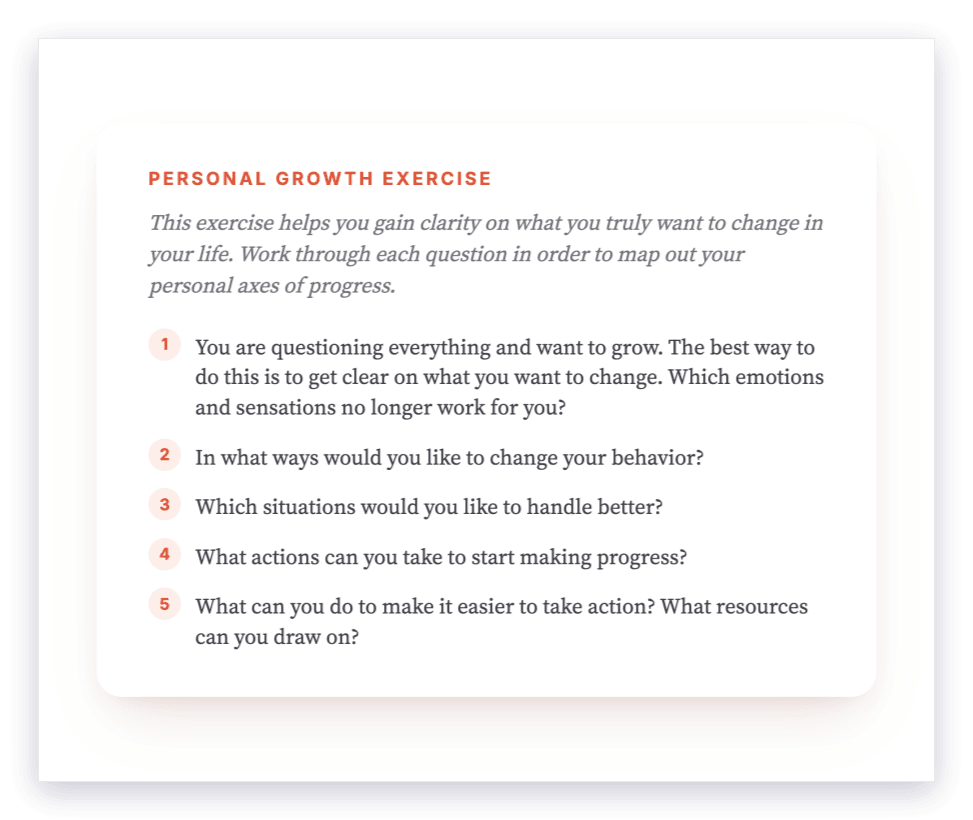
The tool guides patients through five sequenced questions, moving from emotional experience to behavioral intention to situational challenge to concrete action planning and finally to resource mobilization.
The first question anchors the work in felt experience: which emotions and physical sensations are no longer acceptable? This is a sharper entry point than a general complaint. It connects naturally to the basic emotions vocabulary patients may already be building, and to the behavior, emotion, underlying need lens if the work goes deeper.
The second and third questions separate two things patients often conflate: how they want to behave differently (internal, volitional) versus which external situations they want to handle better (contextual, relational). That distinction matters for case formulation.
The fourth question shifts gear toward concrete action: not "what do you wish were different" but "what can you actually do to start moving." The fifth builds the scaffolding: what would make action easier, and which personal or social resources are already available? Patients who tend toward procrastination or motivational dips benefit particularly from this final step, which externalizes the enablers of change rather than relying on willpower alone.
The image above lists the five questions in order with a brief orienting intro. This is a static preview only. The full guided exercise, including patient-facing instructions and the space to write responses, is what the patient actually works through autonomously in the app; that experience is not captured here.
Key insight: The exercise's power lies in its sequencing: emotional awareness feeds into behavioral intention, which feeds into situational mapping, which feeds into a concrete, resource-backed action plan. No step is optional.
This exercise is available to patients through the mobile application that is the dedicated patient-side interface of SessionFuel: the clinician assigns it directly from their SessionFuel account, and the patient then completes it on their own phone, between two sessions, at their own pace.
750+ clinical tools
A library built with and for clinicians, ready to use in session and extend between appointments.
Access all the toolsUse it with your patients
Share this tool in the mobile app and follow the work between sessions.
Integrating it as between-session homework
Assign this exercise after an initial session where some form of dissatisfaction or desire for change has emerged, but before the work has crystallized into specific goals. It suits patients who are motivated but not yet directed, as well as those who report feeling stuck across multiple life areas simultaneously.
To introduce it, a simple framing works well: "Before our next session, I'd like you to spend some time with a few questions. There's no right answer. What matters is that you're honest with yourself." Patients who are building a growth mindset or working on values clarification will recognize the spirit immediately.
When the patient returns, the written responses become primary clinical material. Read question 1 alongside the emotional vocabulary the patient has been building. Compare question 2 (behavioral intention) with question 3 (situational difficulty): mismatches between what they want to do and where they feel blocked are productive clinical starting points. Questions 4 and 5 connect directly to tools like SMART goals, 6- and 12-month goal setting, or building new habits, giving the next phase of work a concrete foundation.
For patients with a broader planning horizon, the output pairs well with 10-year goals or the Life Goals Across Eight Domains worksheet. For those whose resources feel thin, strengths exploration or protective factors work naturally as the next step.
The exercise is deliberately simple. That simplicity is what makes it clinically portable across presentations, from burnout to low confidence to post-crisis rebuilding, without requiring adaptation.
Your session continues in your patients' pocket
Use with a patientYour resources, available everywhere
The handouts, exercises, programs and audios above: you choose which ones to make available to your patients, in the mobile app dedicated to them.
And far more than a library
The app goes well beyond resources, to support your patients every day:
Related categories
Explore other clinical resources by category.

Identity
Clinical resources for self-identity work in therapy: CBT, ACT, schema tools for clinicians addressing self-concept, core beliefs, and identity disruption.

Emotions
Clinical resources on emotion regulation: worksheets, coping tools, CBT, REBT, and ACT exercises for therapists working across diagnoses and age groups.

Build awareness
Clinical worksheets and tools to build awareness in therapy: cognitive distortions, schemas, emotions, ACT and CBT resources for practitioners.

Engage & motivate
Clinical hub: printable worksheets and exercises to build therapeutic engagement and motivation across ACT, CBT, and integrative practice. For clinicians.

Motivational interviewing
Clinical hub for Motivational Interviewing resources: worksheets, exercises and programs to support MI-based behaviour change work in your practice.

Solution-focused
Clinical hub for Solution Focused Therapy resources: worksheets, exercises and programs for goal-oriented, strengths-based practice across individual and couple work.