
Clinical picture. R., a woman in her late twenties, presented with a two-year history of bulimia nervosa, describing her binge-purge cycles as "random" and attributing them to poor self-discipline. During a psychoeducation session, the clinician introduced the informational sheet and walked through the self-worth pie diagram. R. paused at the image of a single slice consuming the rest, then said, quietly, that she had not realised her job, friendships and hobbies had gradually stopped feeling like they counted. The clinician used this recognition to introduce the idea that restriction was maintaining, not resolving, the cycle, and that the bingeing was a predictable biological and psychological rebound rather than a character failing. R. left with the sheet and returned the following week having annotated it, which opened a more detailed functional analysis of her rules around evening eating.
Transdiagnostic CBT Model of Eating Disorders: PDF Worksheet, Tools and Exercises
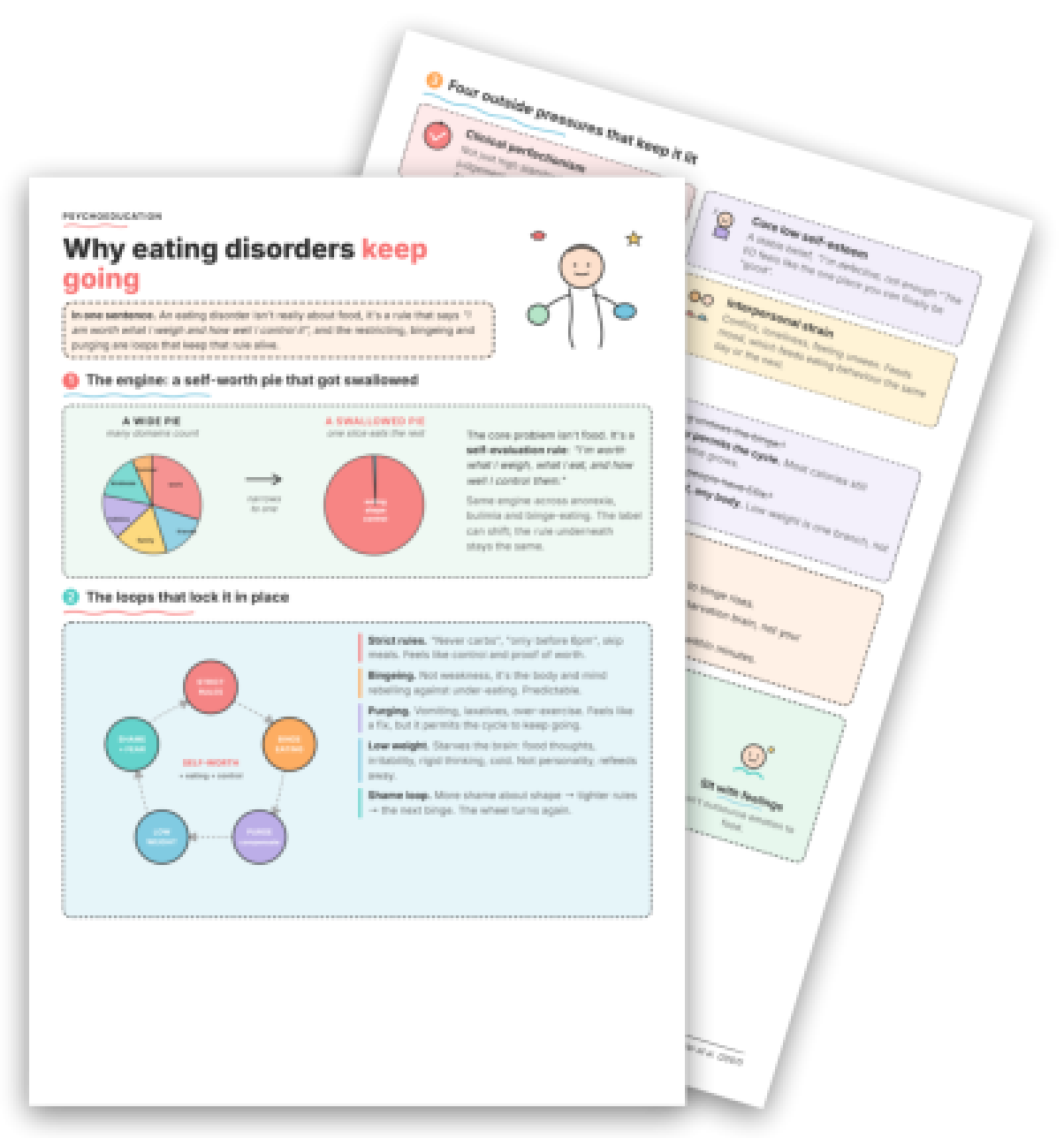
A visual fiche PDF presenting Fairburn's transdiagnostic engine, maintenance loops, and four outside pressures for anorexia, bulimia, and binge-eating disorder in one session-ready psychoeducation tool.
Clinical vignettes
Self-Worth Narrowing in Bulimia Nervosa
Mood Intolerance Maintaining Restriction
Clinical picture. T., a man in his mid-thirties with a diagnosis of anorexia nervosa, restrictive subtype, had engaged in several previous treatment episodes without sustained progress. He described restriction as the only reliable way to feel "clean and in order" when work stress escalated. Using the informational sheet in session, the clinician drew his attention to the section on mood intolerance as a maintaining factor, framing restriction not as control but as an affect-regulation strategy that had displaced other coping. T. was sceptical at first, noting that he rarely felt emotionally distressed. Over two subsequent sessions, tracking daily mood alongside eating behaviour revealed a consistent pattern: restriction intensified on days following interpersonal conflict with his manager. The shared transdiagnostic framework gave both clinician and patient a common language for targeting mood intolerance directly, rather than focusing solely on nutritional rehabilitation.
Explaining Fairburn's transdiagnostic model verbally rarely lands cleanly. Patients nod at the idea that food is "not really the issue," then leave the session still believing the solution is more control. This fiche PDF gives you a visual scaffold to make the core mechanism legible in the room, in a single session, across diagnostic presentations.
Use this resource with your patients
Handout, exercises and materials ready to use, right inside SessionFuel.
Why the Transdiagnostic Model Resists Verbal Explanation
The central difficulty is counterintuitive framing. Patients enter treatment organising themselves around restriction, weight, and shape as solutions. To hear that control is the symptom, not the cure requires dismantling a schema that has been functional, ego-syntonic, and identity-sustaining, often for years. Said once, it lands as paradox. Shown visually, it becomes something a patient can return to between sessions.
A second resistance point is the transdiagnostic nature of the model itself. Many patients with anorexia nervosa have already accumulated diagnostic labels and struggle to see how the same underlying engine drives bulimia or binge eating disorder. The fiche addresses this explicitly: "Same engine across anorexia, bulimia and binge-eating. The label can shift; the rule underneath stays the same." That sentence, displayed visually, cuts through a great deal of diagnostic self-identification that can otherwise stall the formulation phase.
Finally, the starvation loop remains systematically underestimated. Patients attribute cognitive rigidity, food preoccupation, and irritability to personality rather than semi-starvation. Without a clear visual to point to, this psychoeducation rarely sticks. For the neurobiological dimension, you may want to pair this fiche with the dedicated Starvation Syndrome resource.
What the Fiche Contains: A Visual Engine for the Whole Cycle
The fiche PDF is built around four numbered panels, each tackling a distinct layer of the model.
Panel 1 introduces the self-worth pie, a visual showing a "wide pie" with multiple domains (work, friends, hobbies, humour, kindness) narrowing to a single slice that "eats the rest: eating, shape, control." This diagram does something an oral explanation cannot: it shows the architecture of overcrowding without requiring the patient to hold an abstraction in mind. It grounds the formulation in a spatial metaphor that patients recall and reference between sessions.
Panel 2 maps the maintenance loops: strict rules, bingeing, purging, low weight, and shame, arranged in a circular diagram that makes the self-perpetuating logic immediately visible. The panel names each loop plainly. "Bingeing: not weakness, it's the body and mind rebelling against under-eating. Predictable." For patients who carry significant shame around loss-of-control eating, this reframe, delivered visually in the room, carries more de-stigmatising weight than a verbal statement alone.
Panel 3 names four outside pressures: clinical perfectionism (linked directly to the CBT model of perfectionism), core low self-esteem, mood intolerance, and interpersonal strain. Each is described in one or two clinical sentences, making this panel directly usable when building the individual case formulation. Mood intolerance, in particular, opens a natural pathway toward DBT-informed work on emotion regulation.
Panel 4 presents four myth-reframe pairs (e.g., "Purging undoes the binge" corrected to "It mainly permits the cycle") alongside session discussion prompts and four concrete behavioural anchors: regular eating, widening the pie, gradual rule-dropping, and affect tolerance. These tools connect naturally to work on adaptive versus maladaptive coping and to the relationship between eating and energy levels.
> Key takeaway: the fiche is a visual support that facilitates psychoeducation in session; it is not a self-completion questionnaire. You use it to point, to pause, to invite the patient's reaction to a diagram, then you debrief. The patient leaves with a concrete reference, not a homework burden.
750+ clinical tools
A library built with and for clinicians, ready to use in session and extend between appointments.
Access all the toolsWhen and How to Introduce the Fiche in Session
This fiche sits best in the early-to-mid formulation phase, once sufficient alliance is established and an initial symptom picture is in place. Introducing it before a patient feels understood risks it landing as a lecture; waiting too long means weeks of oral explanation that the diagram could compress into twenty minutes.
A low-pressure entry: "I'd like to show you a diagram that captures something I think is relevant to what you've described. I'm curious what fits and what doesn't." This positions the fiche as a hypothesis to test rather than a verdict to accept, which is especially important with patients whose perfectionism makes anything framed as "the truth" feel like an evaluation.
For patients with comorbid perfectionism and eating pathology, Panel 3 deserves extended attention. The "one biscuit at 4pm → day ruined → binge" sequence in the perfectionism section often produces the most recognition, and the most productive rupture of the "control is safety" belief.
One practical limit: the fiche assumes a CBT-informed framework. In presentations with significant trauma, structural dissociation, or severe core low self-esteem, it functions better as a partial reference than as the primary psychoeducation vehicle. Use it to establish shared vocabulary, then let more individually tailored work carry the formulation further.
The fiche does not replace clinical judgement or a full CBT model of anorexia nervosa formulation; it gives both clinician and patient a shared visual language to work from, faster.
Use it with your patients
Share this tool in the mobile app and follow the work between sessions.
Sources
- Fairburn, C. G. (2008). Cognitive Behavior Therapy and Eating Disorders. Guilford Press.
- National Institute for Health and Care Excellence (NICE) (2017). Eating Disorders: Recognition and Treatment (NG69).
Your session continues in your patients' pocket
Use with a patientYour resources, available everywhere
The handouts, exercises, programs and audios above: you choose which ones to make available to your patients, in the mobile app dedicated to them.
And far more than a library
The app goes well beyond resources, to support your patients every day:
Related categories
Explore other clinical resources by category.

Identity
Clinical resources for self-identity work in therapy: CBT, ACT, schema tools for clinicians addressing self-concept, core beliefs, and identity disruption.

Emotions
Clinical resources on emotion regulation: worksheets, coping tools, CBT, REBT, and ACT exercises for therapists working across diagnoses and age groups.

Behaviours
Clinical hub for behaviors in therapy: worksheets and tools for coping, eating disorders, CBT formulation, and maladaptive behavioral patterns.

Understand
Clinical hub for the therapeutic aim 'Understand': worksheets and tools to build patient insight across CBT, ACT, schema therapy and more.

Build awareness
Clinical worksheets and tools to build awareness in therapy: cognitive distortions, schemas, emotions, ACT and CBT resources for practitioners.

CBT
CBT worksheets, cognitive restructuring exercises & behavioral tools for clinicians. Evidence-based resources for every phase of cognitive behavioral therapy.