
Clinical picture. R., a woman in her late twenties, presented for outpatient treatment of a restricting-purging pattern. She described herself as having "no willpower" because she experienced near-nightly loss-of-control eating after keeping intake very low through the day. The clinician introduced the Starvation Syndrome handout in session three, walking through the Minnesota study data and the five symptom clusters. R. read the reframe panel aloud and paused at "biological rebound to deprivation"; she said it was the first time the binge urges felt like information rather than a character flaw. By the following session she had begun eating breakfast consistently, and reported the evening episodes had reduced in frequency, though dietary rehabilitation remained ongoing.
Starvation Syndrome: PDF Worksheet, Tools and Exercises for Clinical Practice
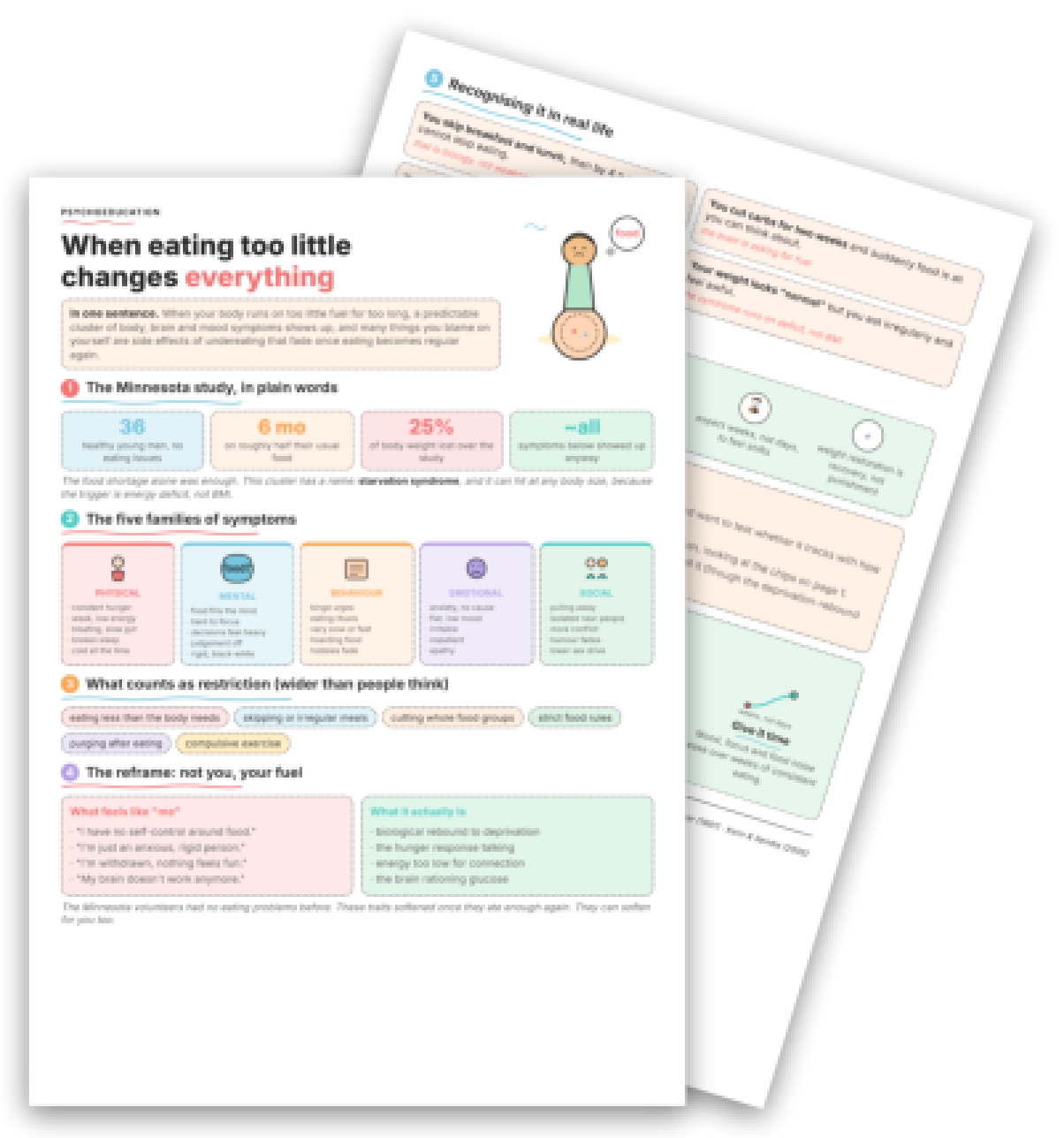
A visual psychoeducation handout to help clinicians explain starvation syndrome in session, reframe restriction-driven symptoms, and give patients a concrete reference to carry forward.
Clinical vignettes
Reframing "No Self-Control" in Outpatient Care
Addressing Cognitive Fog in a Male Patient
Clinical picture. T., a man in his early forties, was referred following a sports physician's concern about compulsive exercise and markedly low energy intake. He minimised restriction but reported that his concentration had collapsed and that he had withdrawn from friends, both of which he attributed to work stress. The clinician used the handout to map T.'s reported symptoms onto the mental and social columns, noting that "brain rationing glucose" paralleled his description of decisions feeling effortful and humour fading. T. was sceptical but found the Minnesota data credible precisely because the volunteers had no prior eating difficulties. Linking his symptoms to an energy deficit rather than a stress response opened a conversation about meal structure that had previously stalled.
Patients living with chronic restriction often arrive having organized their entire self-concept around its symptoms: they call themselves anxious, rigid, withdrawn, incapable of self-control around food. Dismantling those attributions with words alone is slow, contested work. This fiche PDF gives you a visual scaffold to make the case in one session rather than five.
Use this resource with your patients
Handout, exercises and materials ready to use, right inside SessionFuel.
Why Starvation Syndrome Resists Oral Explanation
The core clinical difficulty is misattribution. A patient who has been undereating for months has already assimilated the consequences, including cognitive rigidity, flat affect that reads as depression, social withdrawal, and intrusive food preoccupation, into their identity. Naming these as physiological effects of energy deficit sounds, at first, like a therapeutic reframe they can simply choose not to believe.
The fiche shifts that dynamic by anchoring the argument in the Minnesota Study: 36 healthy volunteers with no prior eating issues, six months on roughly half their usual intake, virtually all symptoms emerging anyway. The data converts a contested hypothesis into a demonstrated biological mechanism. That shift, from "I believe your symptoms are caused by restriction" to "here is what happened to 36 people who had no eating problems," does something different in the room than an oral summary can.
Clinicians working with anorexia nervosa, bulimia nervosa, or binge eating disorder will recognize the presentation. The fiche is equally useful for patients who fall short of full diagnostic criteria: chronic dieters, athletes in an energy gap, and patients whose restriction has gone undetected in standard intake.
What the Handout Contains
Six panels build the psychoeducation progressively.
- The Minnesota Study numbers: 36 men, six months, 25% body weight lost, with the summary line "the food shortage alone was enough" directly pre-empting the patient's inevitable "but that's different for me."
- Five families of symptoms: physical, mental, behavioural, emotional, and social, laid out in five visual columns. The layout is the argument: seeing social withdrawal, food preoccupation, binge urges, and anxiety sitting side by side under one mechanism is more persuasive than hearing them listed.
- A broader definition of restriction: the panel explicitly includes irregular meals, cutting food groups, purging, and compulsive exercise alongside caloric undereating. This widens recognition well beyond what patients typically consider "real" restriction, and connects directly to formulation work in the CBT model of bulimia and the cognitive-behavioral model of anorexia.
- A two-column reframe table: "What feels like me" versus "What it actually is." The mappings are specific: "I have no self-control around food" becomes biological rebound to deprivation; "I'm just an anxious, rigid person" becomes the hunger response. This is the panel patients re-read between sessions.
- A recovery roadmap: the 3+3 structure (three meals plus two to three snacks every three to four hours), the instruction to eat on schedule rather than wait for hunger, and an honest timeframe, "expect weeks, not days, to feel shifts."
> Key point: the fiche is a visual support that facilitates the explanation in session, not a questionnaire to send home alone. The reframe table and the five-family symptom layout do cognitive work during the consultation that an oral account cannot replicate. The patient leaves with a printed reference, not a homework task.
750+ clinical tools
A library built with and for clinicians, ready to use in session and extend between appointments.
Access all the toolsWhen and How to Introduce It
The fiche fits naturally once you have a working formulation and the patient has described their symptom picture in their own words. Introducing it too early forecloses the anamnèse. A clean entry point is the second or third session, framed as: "I want to show you something that might explain several things you have described. I'm curious what you make of it."
For patients with low self-esteem organized tightly around eating behavior, the reframe table is particularly activating. Watch for the moment a patient reads "biological rebound to deprivation" and goes quiet; that pause is worth slowing down for. The handout pairs well with Eating and Your Energy Levels when more granular physiological psychoeducation is needed, and with the body stress response handout when compulsive movement is part of the picture.
One genuine limit: patients in acute medical compromise require dietetic input before psychoeducation. The fiche supports the therapeutic frame; it does not replace the nutritional assessment.
The handout does not ask the patient to change anything yet. It asks them to consider a different attribution for symptoms they already have. That is precisely where alliance is built.
Use it with your patients
Share this tool in the mobile app and follow the work between sessions.
Sources
- Keys, A., Brozek, J., Henschel, A., Mickelsen, O., & Taylor, H. L. (1950). The Biology of Human Starvation (2 vols.). University of Minnesota Press.
- Centre for Clinical Interventions (CCI), Western Australia. What is Starvation Syndrome.
- Fairburn, C. G. (2008). Cognitive Behavior Therapy and Eating Disorders. Guilford Press.
- Waller, G., Cordery, H., Corstorphine, E., Hinrichsen, H., Lawson, R., Mountford, V., & Russell, K. (2007). Cognitive Behavioral Therapy for Eating Disorders: A Comprehensive Treatment Guide. Cambridge University Press.
Your session continues in your patients' pocket
Use with a patientYour resources, available everywhere
The handouts, exercises, programs and audios above: you choose which ones to make available to your patients, in the mobile app dedicated to them.
And far more than a library
The app goes well beyond resources, to support your patients every day:
Related categories
Explore other clinical resources by category.

Behaviours
Clinical hub for behaviors in therapy: worksheets and tools for coping, eating disorders, CBT formulation, and maladaptive behavioral patterns.

Understand
Clinical hub for the therapeutic aim 'Understand': worksheets and tools to build patient insight across CBT, ACT, schema therapy and more.

CBT
CBT worksheets, cognitive restructuring exercises & behavioral tools for clinicians. Evidence-based resources for every phase of cognitive behavioral therapy.

Anxiety
Clinical hub for anxiety disorders: CBT and ACT worksheets, psychoeducation sheets, and exercises for assessment and treatment across the anxiety spectrum.

Trauma
Clinical hub on trauma and PTSD: assessment, differential diagnosis, treatment phases, and printable resources for practitioners. 155 chars.

Mood
Evidence-based worksheets and clinical tools for mood disorders: CBT, ACT, and positive psychology resources for psychologists and therapists.