
Clinical picture. A woman in her late forties, referred to here as M., presented for couples consultation after her husband's depressive episode had strained their relationship over several months. She described escalating frustration: she had tried motivational encouragement, suggested lifestyle changes, and eventually reduced contact out of exhaustion, each attempt leaving her husband more withdrawn. The clinician introduced the psychoeducational sheet during a solo session, walking through the distinction between fixing behaviours and presence-based support. M. identified several patterns she recognized as inadvertently shame-inducing and expressed relief that the framework normalized her confusion rather than framing her conduct as harmful intent. Over the following weeks she reported shifting toward brief, low-demand check-ins, and her husband began re-engaging with outpatient care he had previously declined.
Supporting Someone with Depression: PDF Worksheet, Tools and Exercises
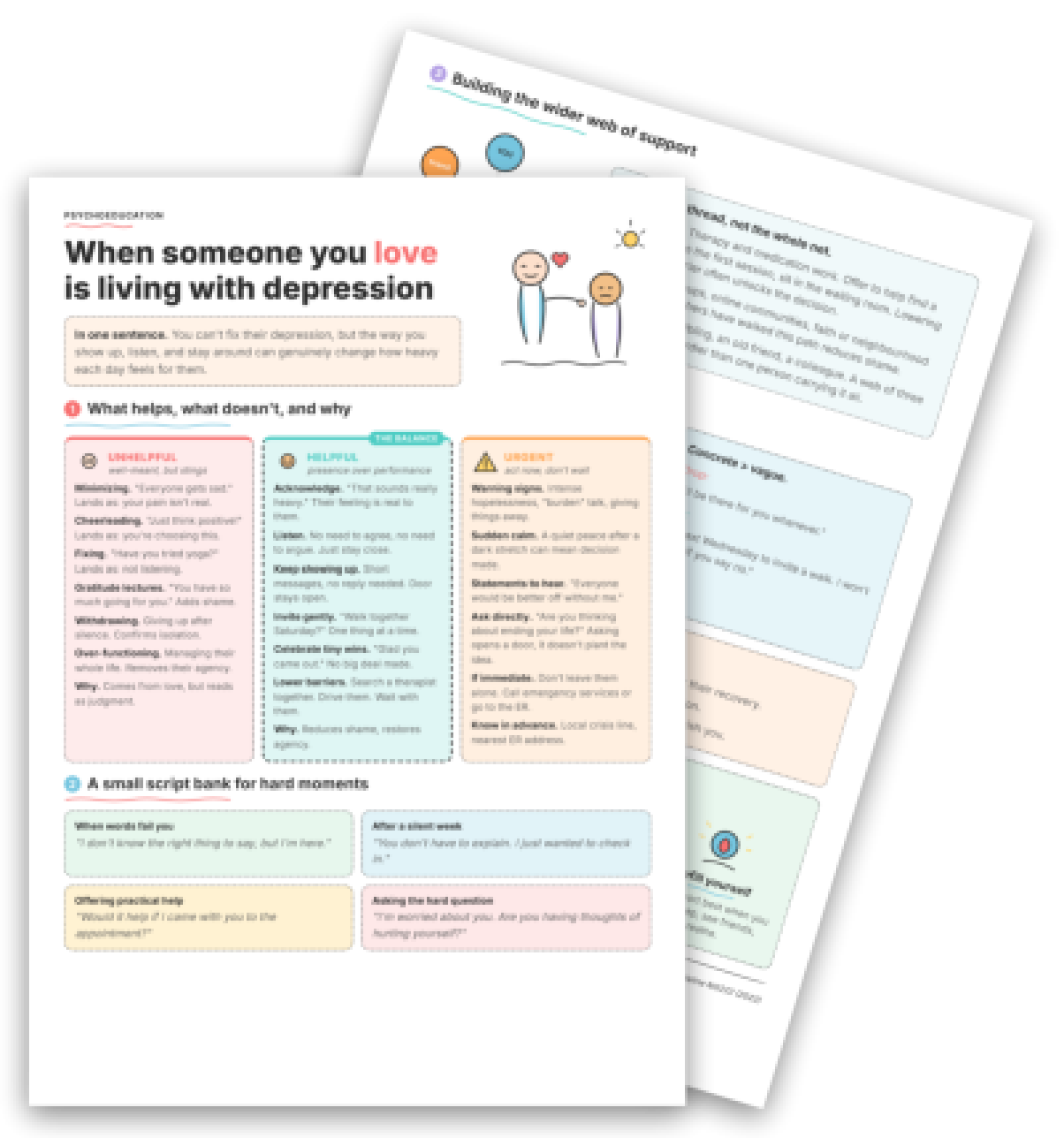
A printable psychoeducation fiche, tools and exercises to help clinicians explain what genuinely helps a depressed loved one, versus what backfires.
Clinical vignettes
A Partner Learning to Stay Present
An Adult Son Navigating Safety Concerns
Clinical picture. T., a man in his early thirties, contacted a psychologist after noticing that his father, who had a longstanding depressive disorder, had begun giving away personal belongings and describing himself as a burden to the family. T. was uncertain whether to act and feared that asking directly about suicidal ideation might worsen the situation. The clinician shared the informational sheet and spent time on the section addressing warning signs and the evidence that direct questioning does not plant ideation. T. practised phrasing the question aloud before speaking with his father that evening. His father disclosed passive suicidal thinking, and T. was able to accompany him to the emergency department the same night, having already noted the local crisis line number as the sheet recommended.
A significant share of your patients come to you not as the person with depression, but as the person trying to support one. Parents, partners, adult children, and close friends often arrive carrying a confused mix of guilt, exhaustion, and well-meant strategies that are quietly making things worse. Explaining, in words alone, why cheerleading and problem-solving tend to backfire is harder than it looks. This fiche PDF gives you a structured visual to work through together.
Use this resource with your patients
Handout, exercises and materials ready to use, right inside SessionFuel.
Why the supporter's role is so hard to explain in session
The core difficulty is that unhelpful behaviors typically come from love. Minimizing ("everyone gets sad"), cheerleading ("just think positive"), and over-functioning all feel, to the supporter, like active caring. Pointing out that they are counterproductive without a clear visual contrast tends to land as criticism and shuts the conversation down.
The other sticking point is suicidal risk. Supporters frequently know something is wrong but hesitate to ask directly, fearing they will plant the idea. That hesitation can be lethal. Laying out the rationale for direct questioning in a written format, one the supporter can reread at home, carries more weight than an oral explanation that evaporates between sessions.
If you are working with the depressed individual themselves, you will find tools for understanding the depression maintenance cycle and behavioral activation exercises useful companions to this fiche.
What does the fiche contain, and why does the visual layout matter?
The fiche is organized into four panels that you walk through with the supporter during the session; it is a support visuel for psychoeducation, not a questionnaire the person fills in alone.
- Panel 1: What helps, what doesn't, and why. A side-by-side contrast labels six unhelpful moves (minimizing, cheerleading, fixing, gratitude lectures, withdrawing, over-functioning) against six helpful ones (acknowledging, listening, keeping showing up, gentle invitations, celebrating small wins, lowering logistical barriers). The fiche makes the underlying logic visible: "Comes from love, but reads as judgment" versus "Reduces shame, restores agency." That framing is far harder to convey in words alone.
- Panel 2: A script bank. Four ready phrases for the moments when words fail, including the direct suicidality question: "I'm worried about you. Are you having thoughts of hurting yourself?" Printed language the supporter can rehearse removes some of the paralysis.
- Panel 3: Building the wider web of support. A diagram places the loved one at the centre, with the supporter, therapist, GP, peer group, family, and friends each as distinct threads. The visual makes the key message concrete: "You are one thread, not the whole net." This directly addresses the isolation and over-responsibility that bring many supporters into your office.
- Panel 4: Taking care of yourself too. Covers sleep, social connection, and the reframe: "My role is to support. Their role is to recover. These are not the same job." A closing "To discuss in session" checklist names three moments worth bringing back to you.
The active listening tools and the social support fiche pair well here if you want to extend the work.
> Key takeaway: This fiche is a visual support that facilitates the explanation of the supporter's role during the session itself. It gives the supporter a concrete reference to take home, not a homework assignment to complete alone.
750+ clinical tools
A library built with and for clinicians, ready to use in session and extend between appointments.
Access all the toolsWhen and how to introduce the fiche
This resource fits naturally with supporters who are already engaged but stuck: a partner who has started managing the depressed person's whole life, a parent who keeps sending motivational messages that go unanswered, anyone who says "I don't know what to do." You can introduce it as early as the first or second dedicated session.
A useful framing: "I'd like to look at something with you that maps out what research suggests actually helps, because some of the instinctive moves turn out to work against what you're trying to do." That positions the fiche as information, not critique.
When debriefing, pay attention to which items in the "unhelpful" column produce recognition or shame, and which items in the "helpful" column feel genuinely feasible. The suicidality panel deserves its own moment: rehearse the direct question out loud, not just as reading. Supporters who have already benefited from psychoeducation about depression itself will engage with this fiche faster. For parent supporters of a younger person, the child and adolescent depression program for parents addresses age-specific dynamics the fiche does not cover.
One limit worth naming: the fiche describes the supporter role in unipolar depression contexts. If your patient's loved one is living with a more complex presentation, the "lowering barriers to therapy" section remains useful, but the risk panel will need verbal augmentation.
The fiche does not replace the clinical frame. It makes the explanation faster, more precise, and leaves the supporter with something they can return to on the hardest days.
Use it with your patients
Share this tool in the mobile app and follow the work between sessions.
Sources
- National Institute of Mental Health (NIMH). Depression. U.S. Department of Health and Human Services.
- National Alliance on Mental Illness (NAMI). Supporting Recovery. NAMI.
- Mental Health First Aid Australia. Mental Health First Aid Guidelines. Mental Health First Aid Australia.
Your session continues in your patients' pocket
Use with a patientYour resources, available everywhere
The handouts, exercises, programs and audios above: you choose which ones to make available to your patients, in the mobile app dedicated to them.
And far more than a library
The app goes well beyond resources, to support your patients every day:
Related categories
Explore other clinical resources by category.

Mood
Evidence-based worksheets and clinical tools for mood disorders: CBT, ACT, and positive psychology resources for psychologists and therapists.

Behaviours
Clinical hub for behaviors in therapy: worksheets and tools for coping, eating disorders, CBT formulation, and maladaptive behavioral patterns.

Relationships
Clinical worksheets and tools on relational functioning: attachment, schemas, assertiveness, and communication skills for therapists. Printable PDF resources.

Understand
Clinical hub for the therapeutic aim 'Understand': worksheets and tools to build patient insight across CBT, ACT, schema therapy and more.

Build skills
Skill-building resources for clinicians: printable worksheets and exercises for coping, assertiveness, and communication skills training in therapy.

CBT
CBT worksheets, cognitive restructuring exercises & behavioral tools for clinicians. Evidence-based resources for every phase of cognitive behavioral therapy.