
Clinical picture. M., a 34-year-old project manager, presented with a years-long pattern of rehearsing presentations word for word, avoiding eye contact during team meetings, and keeping a glass in hand to conceal trembling. He did not identify as avoidant because he attended every meeting; the distress had simply migrated into safety behaviours. Using a brief psychoeducational sheet on social anxiety, the clinician mapped his routine onto the maintenance cycle, highlighting how rehearsal and grip-the-glass tactics kept his attention locked inward and prevented any disconfirming experience. M. recognised, with some surprise, that he had never once learned whether the disaster he anticipated would actually occur. This reframe shifted the initial treatment focus from exposure scheduling to first identifying and loosening the safety behaviours that were sustaining the loop.
Social Anxiety Disorder: PDF Worksheet, Tools and Exercises for Clinicians
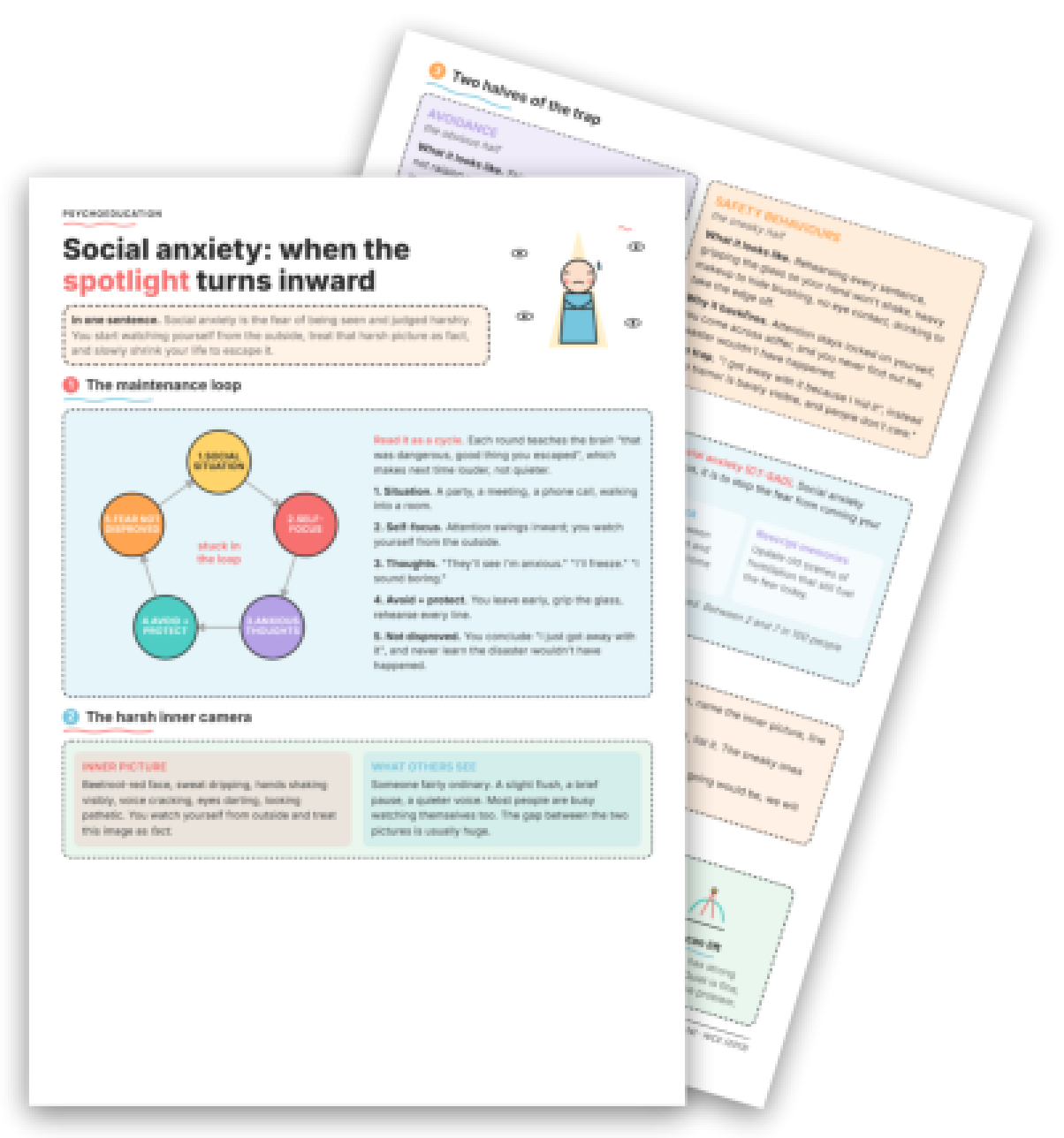
A visual psychoeducation fiche PDF helping clinicians explain the Clark & Wells maintenance cycle, the inner camera distortion, and safety behaviours in a single session.
Clinical vignettes
Safety Behaviours Masking the Core Fear
The Gap Between Inner and Outer Image
Clinical picture. T., a 27-year-old postgraduate student, described leaving seminars early and submitting work by email rather than discussing it in person, consistently explaining this as a reasonable preference for written communication. During a third session, the clinician introduced the psychoeducational concept of the harsh inner camera, asking T. to describe in detail the image she held of herself mid-conversation. The picture she produced, beetroot-red face, voice cracking, visibly shaking hands, was markedly more severe than anything peers or supervisors had ever noted. Sitting with that gap, without any pressure to dispute it immediately, prompted T. to begin questioning whether her self-focused image was evidence or assumption. Subsequent sessions used this distinction as a reference point when planning behavioural experiments.
Explaining social anxiety disorder to patients orally rarely lands the way it should. They nod when you mention self-focused attention, then leave the session still convinced their face turns beetroot-red in full view of everyone. This fiche PDF gives you a visual scaffold to make the mechanism concrete, session by session, without spending 20 minutes drawing diagrams on a whiteboard.
Use this resource with your patients
Handout, exercises and materials ready to use, right inside SessionFuel.
Why Social Anxiety's Core Mechanisms Resist Verbal Explanation
The clinical challenge is specific. Social anxiety disorder is not primarily about objective performance deficits. It is driven by a set of interlocking cognitive and attentional processes: self-focused attention, a distorted internal observer, and the paradoxical role of avoidance and safety behaviours in perpetuating fear. Patients grasp the first part easily enough. What consistently slips past them is the maintenance loop, the idea that the very strategies that feel protective, rehearsing every sentence, gripping their glass, leaving early, are precisely what prevent disconfirmation of the feared catastrophe.
Without a visual reference, this distinction stays abstract. The patient walks out understanding, at best, that they "worry too much in social situations." They do not see how each round of the cycle actively teaches the brain that the situation was dangerous. The Clark & Wells (1995) model, the theoretical backbone of CT-SAD, captures this perfectly, but translating it into spoken language during a session leaves too much work for the patient's imagination. A printed support visuel does that work instead.
This is also a presentation where recognizing social anxiety disorder early matters: the gap between symptom onset and first treatment contact is notoriously long, partly because patients rationalise the pattern rather than naming it.
What the Fiche Contains: A Visual Map of the Maintenance Cycle
The fiche is structured across six panels, each targeting a specific clinical concept. The maintenance loop is rendered as a five-step diagram: situation → self-focus → anxious thoughts → avoid and protect → fear not disproved. The key clinical phrase is explicit: "Each round teaches the brain 'that was dangerous, good thing you escaped', which makes next time louder, not quieter." Placing this diagram in front of a patient does what an oral explanation cannot: it shows the circularity at a glance and names the step most patients never consciously articulate, step 5, the absence of disconfirmation.
The harsh inner camera panel is particularly powerful for case formulation work. It contrasts the patient's inner picture ("beetroot-red face, sweat dripping, hands shaking visibly") with what others actually observe ("someone fairly ordinary, a slight flush, a brief pause"). This is the visual argument for video feedback as a CT-SAD technique and, for many patients, the first time the perceptual gap is made explicit rather than merely asserted.
The two halves of the trap section separates avoidance (the obvious half) from safety behaviours (the sneaky half). This distinction is clinically critical and chronically under-identified. The fiche names concrete examples: rehearsing sentences, gripping the glass, heavy makeup, avoiding eye contact. It then traces the mechanism: "Attention stays locked on yourself, you come across stiffer, and you never find out the disaster wouldn't have happened." Pair this panel with the social anxiety safety behaviours worksheet for a more granular audit of the patient's individual repertoire.
The final panels cover what helps (CT-SAD, attention shift, dropping props, video feedback, imagery rescripting) and a structured "to discuss in session" block with three prompts that the patient can carry away as between-session self-monitoring tasks.
> Key takeaway: This fiche is a visual support that facilitates explanation in session, not a self-directed questionnaire. You walk through it with the patient. They leave with a printed reference that names the cycle they are already caught in.
750+ clinical tools
A library built with and for clinicians, ready to use in session and extend between appointments.
Access all the toolsHow to Introduce the Fiche in Session
The fiche fits naturally from the second or third session, once the presenting complaint is established and a preliminary formulation is taking shape. For patients who have tried to manage symptoms alone for years, it is worth framing it directly: "I want to show you a diagram that maps exactly what has been keeping this going. Let's go through it together." Resist handing it over at the start; use the maintenance loop panel as the anchor point and build the conversation around it before moving to the inner camera section.
For patients with prominent fear of appearing anxious, linger on the inner picture versus outer reality panel. For those where avoidance is the dominant coping strategy, the two-halves-of-the-trap section deserves extended discussion. The session prompts on the last panel translate directly into between-session homework: ask the patient to note one moment of self-focused attention and the inner picture it triggered.
The fiche integrates smoothly into a broader treatment plan. The Social Anxiety Blueprint provides the session-by-session roadmap; the stages of social anxiety resource helps patients locate themselves on the recovery arc; and the social anxiety interpersonal program extends the work into relationships and assertive communication once the core model is understood.
One practical limit: patients with marked shame or elevated self-criticism may initially resist the inner camera panel, reading it as confirmation of their defectiveness rather than an explanation of a cognitive distortion. In those cases, introduce the maintenance loop first and return to the inner picture comparison once the alliance allows it. The fiche does not replace the formulation conversation; it makes that conversation more precise, and leaves the patient with a durable visual reference they can return to between sessions.
Use it with your patients
Share this tool in the mobile app and follow the work between sessions.
Sources
- Clark, D. M., & Wells, A. (1995). A Cognitive Model of Social Phobia. Guilford Press.
- National Institute for Health and Care Excellence (NICE) (2013). Social Anxiety Disorder: Recognition, Assessment and Treatment (CG159).
- American Psychiatric Association (2013). Diagnostic and Statistical Manual of Mental Disorders, Fifth Edition (DSM-5). American Psychiatric Association.
Your session continues in your patients' pocket
Use with a patientYour resources, available everywhere
The handouts, exercises, programs and audios above: you choose which ones to make available to your patients, in the mobile app dedicated to them.
And far more than a library
The app goes well beyond resources, to support your patients every day:
Related categories
Explore other clinical resources by category.
Anxiety
Clinical hub for anxiety disorders: CBT and ACT worksheets, psychoeducation sheets, and exercises for assessment and treatment across the anxiety spectrum.

Understand
Clinical hub for the therapeutic aim 'Understand': worksheets and tools to build patient insight across CBT, ACT, schema therapy and more.

CBT
CBT worksheets, cognitive restructuring exercises & behavioral tools for clinicians. Evidence-based resources for every phase of cognitive behavioral therapy.

Trauma
Clinical hub on trauma and PTSD: assessment, differential diagnosis, treatment phases, and printable resources for practitioners. 155 chars.

Mood
Evidence-based worksheets and clinical tools for mood disorders: CBT, ACT, and positive psychology resources for psychologists and therapists.

Identity
Clinical resources for self-identity work in therapy: CBT, ACT, schema tools for clinicians addressing self-concept, core beliefs, and identity disruption.