
Clinical picture. A., a man in his mid-fifties, was referred eight weeks after a prolonged ICU admission for septic shock requiring mechanical ventilation. He presented with sleep-onset nightmares, hypervigilance to beeping sounds, and marked shame about memories he described as "crazy" involving staff appearing to attack him. He had not disclosed these to his medical team, believing they indicated psychiatric fragility rather than illness. The clinician introduced the informational sheet on ICU and PTSD, walking through the delirium and hallucination sections and normalising such experiences as neurobiologically driven rather than character-based. By the session's end A. was able to name the memories as trauma memories, which reduced his avoidance of discussing them and opened a workable therapeutic frame.
Critical Care and PTSD: PDF Worksheet, Tools and Exercises
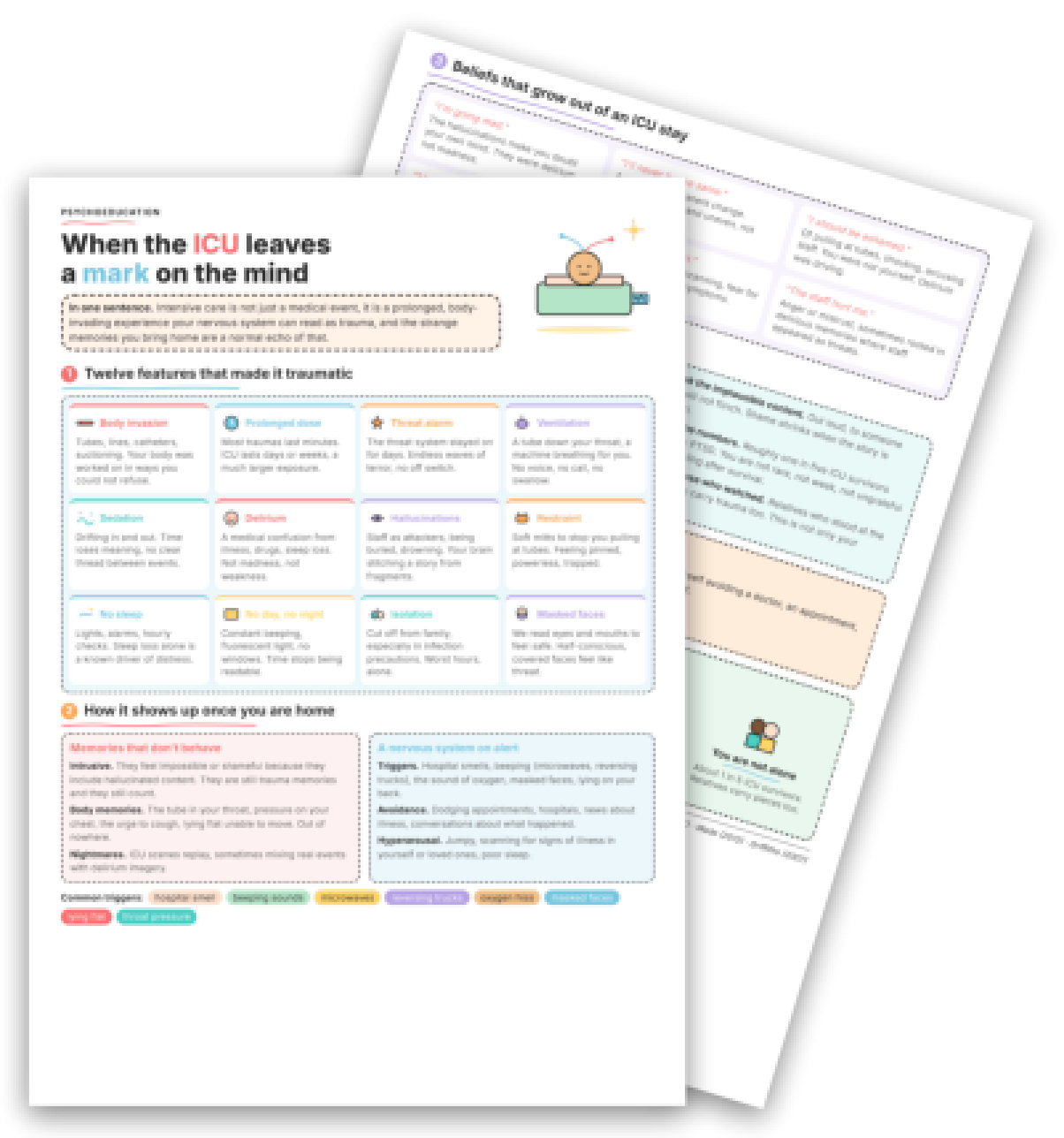
A printable psychoeducation fiche to help ICU survivors name, understand, and begin processing the traumatic imprint of critical illness, a concrete clinical support for use in session.
Clinical vignettes
Delirium Memories Mistaken for Weakness
Somatic Triggers After Ventilation
Clinical picture. C., a woman in her early forties, presented three months post-ICU with a pattern she found difficult to explain: a choking sensation and urge to cough that arose without warning during ordinary daily activities, accompanied by brief dissociative episodes. She had been reluctant to seek help, attributing the sensations to a residual physical problem rather than a psychological one. Using the psychoeducation sheet, the clinician highlighted the section on body memories and prolonged ventilation, framing the intrusive sensations as conditioned somatic responses consistent with post-traumatic re-experiencing. C. reported that having a clinical label for the phenomenon reduced her secondary anxiety about the symptoms, and she engaged more readily with subsequent grounding work.
ICU survivors arrive in your consulting room with fragmented, often hallucinatory memories they cannot explain, and frequently will not disclose. The gap between what happened medically and what their nervous system encoded makes standard PTSD psychoeducation feel irrelevant or wrong-fitting to them. This fiche PDF bridges that gap: a structured visual support you use directly in session to name the ICU experience as trauma and make the symptom picture legible.
Use this resource with your patients
Handout, exercises and materials ready to use, right inside SessionFuel.
Why ICU-Related PTSD Is So Hard to Explain Verbally
Post-critical care PTSD sits at an awkward intersection. The patient does not identify as a trauma survivor in the conventional sense, they were passive, sedated, often amnesic. They walked out alive. The gratitude narrative collides with intrusive re-experiencing, and many patients assume that struggling after survival signals ingratitude, weakness, or incipient psychosis.
What makes oral explanation particularly resistant is delirium content. Hallucinations of staff as attackers, of being buried or drowned, are common sequelae of sedation, sleep deprivation, and critical illness, yet patients carry them as private, shameful material. Without a framework that names delirium explicitly, they rarely volunteer this content, and the clinician has no entry point. You may see what looks like health anxiety and hypervigilance or generalised avoidance without understanding the ICU-specific substrate beneath it.
The same applies to body memories: throat pressure, the urge to cough, the sensation of lying immobilised. These somatic intrusions confuse patients who assume physical symptoms must have a current medical cause. The activation of the autonomic nervous system in response to beeping sounds or oxygen hiss reads to them as a new health crisis, not a common trauma reaction.
What the Fiche Contains: A Visual Map of the ICU Experience
The fiche is organised into four panels, each targeting a different layer of the clinical picture.
- Panel 1: "Twelve features that made it traumatic" lists the specific elements of critical care that function as traumatic stressors: "Tubes, lines, catheters, suctioning. Your body was worked on in ways you could not refuse." Body invasion, prolonged exposure, ventilation, restraint, delirium, isolation, and masked faces are each named and briefly explained. Having these rendered visually, in a printed list, removes the burden from the patient of having to articulate what was distressing and why.
- Panel 2: "How it shows up once you are home" maps intrusive memories, body memories, nightmares, and hyperarousal, with a dedicated box listing common triggers (hospital smell, beeping sounds, microwave tones, reversing trucks, oxygen hiss, lying flat). Seeing their specific triggers named in print frequently produces immediate recognition and visible relief.
- Panel 3: "Beliefs that grow out of an ICU stay" addresses the six most clinically significant post-ICU cognitions: "I'm going mad," "I should be ashamed," "The staff hurt me." This panel is particularly useful for externalising the shame around delirium behaviour and for opening work on the negative core beliefs that crystallise around the experience.
- Panel 4: "What helps you make sense of it" offers concrete reorientation strategies, naming the delirium, rebuilding the timeline through ICU diaries and family accounts, reading body memories as memories, and closes with a "To discuss in session" block that functions as a ready-made debrief agenda.
> Key point: this fiche is a visual support that facilitates the explanation of ICU trauma in session, it is not a self-completion questionnaire. You guide the patient through it; they leave with a concrete reference that does not depend on recall of your words alone.
750+ clinical tools
A library built with and for clinicians, ready to use in session and extend between appointments.
Access all the toolsWhen and How to Introduce the Fiche
This resource fits best in early-to-middle phase work, once the therapeutic alliance is solid enough for the patient to engage with the traumatic content without dissociating. Introducing it too early, before the patient names any ICU distress themselves, risks feeling prescriptive; introducing it after several sessions of symptom mapping is usually the right moment.
For patients whose presentation includes PTSD symptoms following a hospital admission, you might open with: "A lot of what you are describing follows a very recognisable pattern for people who have been through intensive care, I have something that sets it out clearly; let's look at it together." This frames the fiche as psychoeducation, not pathology-assignment.
Use Panel 1 to validate the multi-layered nature of the exposure before any symptom work. Use Panel 3 to externalise cognitive distortions around shame and madness before moving toward restructuring. The "To discuss in session" prompts in Panel 4 are worth reading aloud together and can anchor the debrief: they cue the patient to bring hallucinatory content, appointment avoidance, and shame-based rumination into the next session explicitly.
A note on limits: if delirium memories are highly destabilising and the patient has no narrative continuity around the ICU stay, consider whether EMDR or a stabilisation phase takes precedence before this level of psychoeducation. The fiche assumes a basic capacity to tolerate the material in verbal form. For relatives who witnessed the ICU stay, the resource applies directly, Panel 4 names this explicitly: "Relatives who stood at the bedside can carry trauma too." Consider offering the fiche to family members as a shared framework, particularly when exposure work and coping strategy building are planned for the system, not only the identified patient.
The fiche does not replace formulation or protocol. It makes the explanation faster, more precise, and, for a population that has often been told they should simply be grateful to be alive, more legitimate.
Use it with your patients
Share this tool in the mobile app and follow the work between sessions.
Sources
- Righy, C., Rosa, R. G., da Silva, R. T. A., Kochhann, R., Migliavaca, C. B., Robinson, C. C., Teche, S. P., Teixeira, C., Bozza, F. A., Falavigna, M. (2019). Prevalence of post-traumatic stress disorder symptoms in adult critical care survivors: a systematic review and meta-analysis. Critical Care.
- Jones, C., Backman, C., Capuzzo, M., Egerod, I., Flaatten, H., Granja, C., Rylander, C., Griffiths, R. D. (2010). Intensive care diaries reduce new onset post traumatic stress disorder following critical illness: a randomised, controlled trial. Critical Care.
- Kross, E. K., Engelberg, R. A., Gries, C. J., Nielsen, E. L., Zatzick, D., Curtis, J. R. (2014). Posttraumatic stress disorder among survivors of critical illness: creation of a conceptual model addressing identification, prevention, and management. Intensive Care Medicine.
Your session continues in your patients' pocket
Use with a patientYour resources, available everywhere
The handouts, exercises, programs and audios above: you choose which ones to make available to your patients, in the mobile app dedicated to them.
And far more than a library
The app goes well beyond resources, to support your patients every day:
Related categories
Explore other clinical resources by category.

Anxiety
Clinical hub for anxiety disorders: CBT and ACT worksheets, psychoeducation sheets, and exercises for assessment and treatment across the anxiety spectrum.
Trauma
Clinical hub on trauma and PTSD: assessment, differential diagnosis, treatment phases, and printable resources for practitioners. 155 chars.

Understand
Clinical hub for the therapeutic aim 'Understand': worksheets and tools to build patient insight across CBT, ACT, schema therapy and more.

CBT
CBT worksheets, cognitive restructuring exercises & behavioral tools for clinicians. Evidence-based resources for every phase of cognitive behavioral therapy.

Mood
Evidence-based worksheets and clinical tools for mood disorders: CBT, ACT, and positive psychology resources for psychologists and therapists.

Identity
Clinical resources for self-identity work in therapy: CBT, ACT, schema tools for clinicians addressing self-concept, core beliefs, and identity disruption.