
Clinical picture. A woman in her late thirties, referred as "M.", presented with longstanding sleep disruption, hypervigilance, and a pattern of cancelling social commitments after a road traffic collision two years prior. She described her symptoms as "random" and expressed frustration that she could not predict or control them. In the first session, the clinician used the four-cluster diagram from the psychoeducation sheet to walk through how intrusions, arousal, avoidance, and negative beliefs maintain one another. M. paused at the avoidance panel and said, quietly, that she had not realised her calendar had been shrinking. This shared conceptual map gave both clinician and patient a working language before any trauma-focused work was introduced.
What Is TF-CBT? PDF Worksheet, Tools and Exercises for Clinical Practice
A printable psychoeducation tool helping clinicians explain the trauma symptom loop, the four therapy phases, and treatment rationale clearly and efficiently in session.
Clinical vignettes
Naming the Loop Before Processing Begins
Distinguishing Memory from Re-Experiencing
Clinical picture. "T.", a man in his mid-twenties, was referred following a single-incident assault and reported that he had avoided seeking help for months because he believed revisiting the event in therapy would make things worse. Early in assessment, the clinician introduced the distinction between remembering and re-experiencing drawn from the informational sheet, explaining that controlled, graded processing differs from the involuntary flooding he had been experiencing. T. found this reframe relevant enough to ask to keep a copy of the sheet. His attendance through the subsequent stabilisation phase was consistent, and he raised the document again when discussing his reservations about the trauma-narrative component, which allowed the clinician to address his concerns with concrete information rather than reassurance alone.
Explaining the TF-CBT rationale verbally in early trauma work runs into a predictable wall: the four-symptom cluster and the phased model collapse into abstraction the moment they are spoken aloud. This fiche PDF gives you a structured visual scaffold to walk through the model with the patient in session, rather than narrating it from memory and hoping the pieces land.
Use this resource with your patients
Handout, exercises and materials ready to use, right inside SessionFuel.
Why TF-CBT concepts resist verbal explanation
The core difficulty is not the content itself but the interaction between content and patient state. A patient sitting in hypervigilance, with active avoidance of anything trauma-adjacent, is neurobiologically poorly positioned to absorb a monologue. The four-cluster feedback loop, intrusions, hyperarousal, avoidance, negative beliefs, is clinically accurate, but spoken aloud it sounds like a list. What the patient needs to grasp is the mechanism: intrusions spike arousal, arousal drives avoidance, avoidance prevents memory consolidation, the intrusions return. That circularity is hard to hold in working memory without a visual anchor.
A second sticking point is the distinction between trauma and PTSD, and between remembering and re-experiencing. These distinctions matter enormously for understanding PTSD's maintenance processes and for the treatment rationale, but patients routinely conflate them. Without a visual support, fifteen minutes of verbal clarification can be replaced by three minutes of reading together.
What the fiche contains: a phased visual model
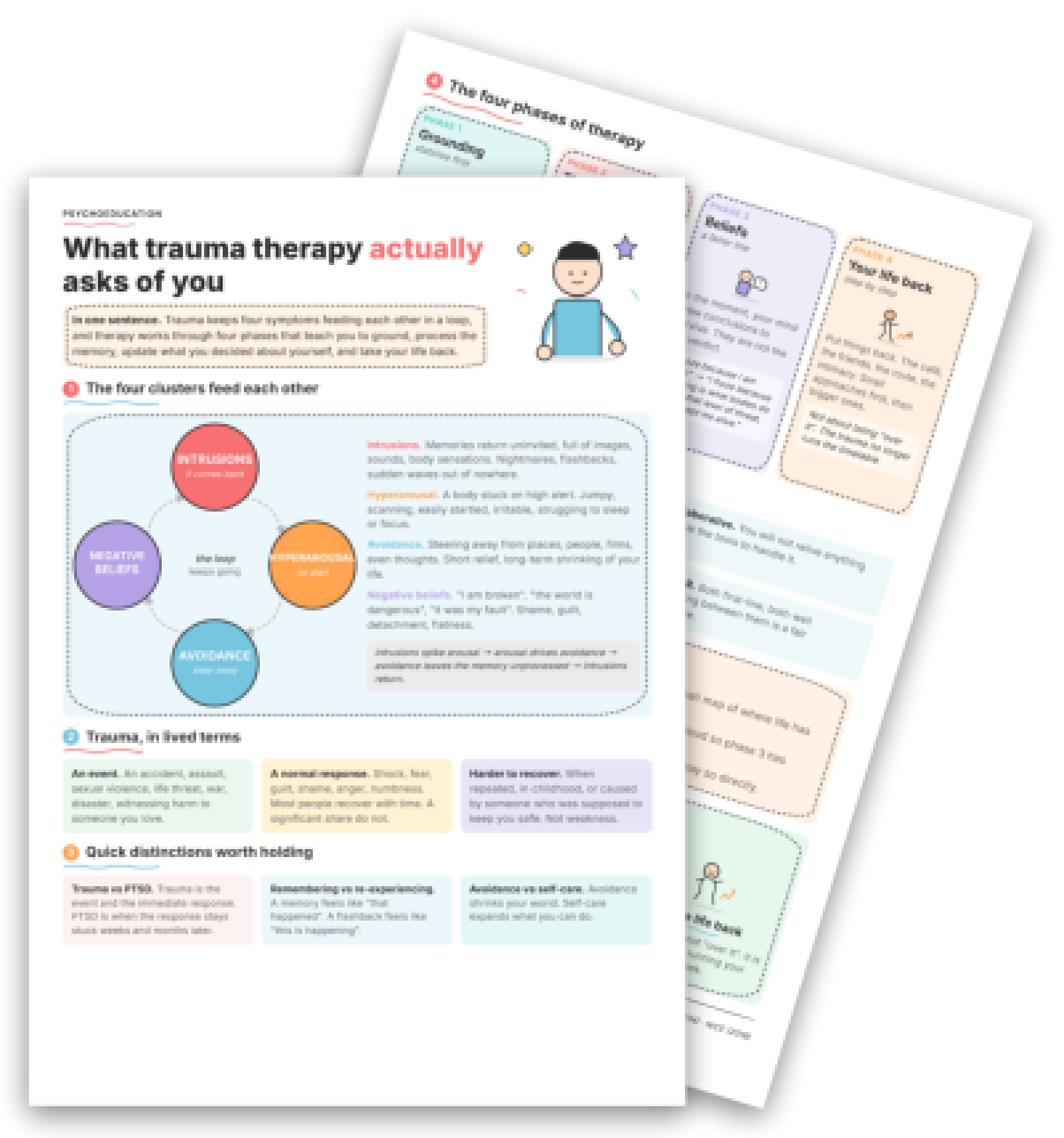
The fiche is organised across five numbered panels, and its value is precisely its visual sequencing. Panel 1 presents the four-cluster loop as an explicit labelled diagram, making the maintenance mechanism visible rather than stated. Panels 2 and 3 introduce trauma in lived terms and three quick distinctions worth holding, trauma vs. PTSD, remembering vs. re-experiencing, avoidance vs. self-care, each framed concisely enough to read aloud together.
Panel 4 is the therapeutic core: four named phases with brief functional descriptors. Phase 1 (grounding) is framed as building the anchor before approaching the memory, directly countering the patient's fear that the work will flood them. Phase 2 describes the exposure rationale in plain terms: "going through it lets your mind file it as past, not as happening now." Phase 3 addresses belief revision with concrete language: "I froze because I am weak" becomes "I froze because freezing is what bodies do under that level of threat." Phase 4 is framed around restoration of life domains, not symptom elimination: "the trauma no longer runs the timetable."
Panel 5 covers pre-engagement expectations, including pacing as a collaborative process and a brief mention of the comparative evidence base for TF-CBT and EMDR. The closing "To discuss in session" block gives the patient three concrete prompts: avoidance routes that have shrunk their life, recurring negative beliefs, and pacing feedback.
> Key point: This fiche is a visual psychoeducation support you use alongside the patient in session to explain the TF-CBT model; it is not a self-assessment questionnaire and is not designed to be completed independently.
750+ clinical tools
A library built with and for clinicians, ready to use in session and extend between appointments.
Access all the toolsWhen and how to introduce the fiche in session
This resource fits best in sessions 2 or 3, once initial anamnesis is complete and a working alliance is established. At that point you need to introduce the treatment model without the introduction itself becoming a destabilising event.
Place the fiche between you and the patient while walking through Panel 1, and ask them to point to whichever cluster feels most present right now. That small gesture shifts the dynamic from passive listening to active engagement, and the patient's immediate response yields formulation material. Someone pointing first to avoidance is signalling something clinically different from someone drawn to negative beliefs or to the hyperarousal cluster.
For patients with complex trauma or dissociative features, slow down at Panel 4. The phased model itself can feel overwhelming if the patient has a history of fragmented prior treatment. Emphasise that Phase 1 is not a preliminary hurdle to get through: it is the clinical foundation. The grounding techniques menu makes a natural companion once Phase 1 work begins, and pairing the fiche with a structured sensory grounding exercise gives the patient a concrete tool to take away from the same session.
Debrief the fiche at the start of the following session. Ask which panel raised the most questions, and whether the "To discuss in session" prompts surfaced material the patient had not yet named. Responses frequently accelerate the formulation process. The fiche is not a substitute for the Ehlers and Clark PTSD model in case formulation, nor for the structured PTSD therapy blueprint in treatment planning, it is the explanatory layer that makes both frameworks legible to the patient from the first time you name them. The habituation curve and the then vs. now discrimination work that follow later in treatment will already have a conceptual home in the patient's mind.
Use it with your patients
Share this tool in the mobile app and follow the work between sessions.
Sources
- Cohen, J. A., Mannarino, A. P., & Deblinger, E. (2017). Treating Trauma and Traumatic Grief in Children and Adolescents (2nd ed.). Guilford Press.
- TF-CBT National Therapist Certification Program. TF-CBT: Trauma-Focused Cognitive Behavioral Therapy - Official Program Website.
- Medical University of South Carolina (2018). TF-CBTWeb 2.0: Online Training Course for Trauma-Focused Cognitive-Behavioral Therapy.
- Mannarino, A. P., & Cohen, J. A.. Clinician's Corner: Trauma-Focused Cognitive Behavioral Therapy (TF-CBT). International Society for Traumatic Stress Studies (ISTSS).
Your session continues in your patients' pocket
Use with a patientYour resources, available everywhere
The handouts, exercises, programs and audios above: you choose which ones to make available to your patients, in the mobile app dedicated to them.
And far more than a library
The app goes well beyond resources, to support your patients every day:
Related categories
Explore other clinical resources by category.

Trauma
Clinical hub on trauma and PTSD: assessment, differential diagnosis, treatment phases, and printable resources for practitioners. 155 chars.

Understand
Clinical hub for the therapeutic aim 'Understand': worksheets and tools to build patient insight across CBT, ACT, schema therapy and more.

CBT
CBT worksheets, cognitive restructuring exercises & behavioral tools for clinicians. Evidence-based resources for every phase of cognitive behavioral therapy.
Anxiety
Clinical hub for anxiety disorders: CBT and ACT worksheets, psychoeducation sheets, and exercises for assessment and treatment across the anxiety spectrum.

Mood
Evidence-based worksheets and clinical tools for mood disorders: CBT, ACT, and positive psychology resources for psychologists and therapists.

Identity
Clinical resources for self-identity work in therapy: CBT, ACT, schema tools for clinicians addressing self-concept, core beliefs, and identity disruption.