
Clinical picture. T., a woman in her late thirties, presented eight months after a serious road accident with frequent intrusive re-experiencing triggered by the sound of braking vehicles. In session, her therapist introduced the Then vs. Now discrimination exercise after she described a trigger episode that had occurred on her commute that week. Together they worked through all seven sensory channels: T. noted the current season, the colour of the therapy room walls, the feel of the chair fabric, the smell of coffee from the waiting area, and confirmed aloud that she now knew how the accident had ended and where the exits were. By the end of the exercise her reported distress had reduced from a 7 to a 3 on a 0 to 10 scale, and she was able to name the single similarity, a sudden high-pitched sound, that had misfired the alarm. She agreed to use a pocket-sized version of the seven-channel checklist between sessions when similar triggers arose.
Stimulus Discrimination (Then vs. Now): PDF Worksheet, Tools and Exercises
A visual PDF worksheet, practical tools, and in-session exercises to help patients teach their nervous system that the past danger is over.
Clinical vignettes
Seven Channels After a Road Accident
Grounding a Domestic-Violence Trigger
Clinical picture. M., a man in his mid-forties with a history of prolonged domestic violence, reported that raised voices in neighbouring apartments reliably pulled him back into a visceral sense of present danger, even years after leaving the situation. His clinician introduced the Then vs. Now framework as a structured self-anchoring step to use at home, explaining that his alarm system was misfiling a past memory as a current threat rather than signalling actual danger. In the following session M. described applying the body channel for the first time: he had reminded himself that he was now physically larger and living alone, with a locked door and a phone within reach. He reported that the comparison did not erase the distress immediately but gave him a concrete task to perform rather than leaving him frozen. Over three weeks of practice the duration of his triggered states shortened noticeably, which he attributed to having something deliberate to do with the seven steps.
Many patients with PTSD arrive at stimulus discrimination intellectually ready: they can name their triggers, they understand the alarm metaphor, and they genuinely believe the threat is past. What they cannot do is get their body to agree. Bridging that gap in session, reliably, is precisely what this fiche PDF is designed for.
Use this resource with your patients
Handout, exercises and materials ready to use, right inside SessionFuel.
Why Stimulus Discrimination Resists Verbal Explanation
The core difficulty is not conceptual, it is somatic. Once a cue activates the trauma network, verbal reassurance lands on a system that is not currently processing language in the usual way. Telling a patient "that smell is not dangerous" rarely shifts their physiological state, because the alarm is organised around perceptual similarity, not propositional logic. As the Ehlers & Clark (2000) model captures in the Ehlers & Clark PTSD Model, trauma memories lack the contextual coding that marks them as past events; the properties of trauma memories mean they misfire as present-tense alarms.
What clinicians need in that moment is a structured, concrete contrast: THEN versus NOW, across every sense the original encoding used. Explaining this at the whiteboard or in conversation rarely sticks. A structured visual does, because it externalises the comparison rather than leaving the patient to generate it under activation.
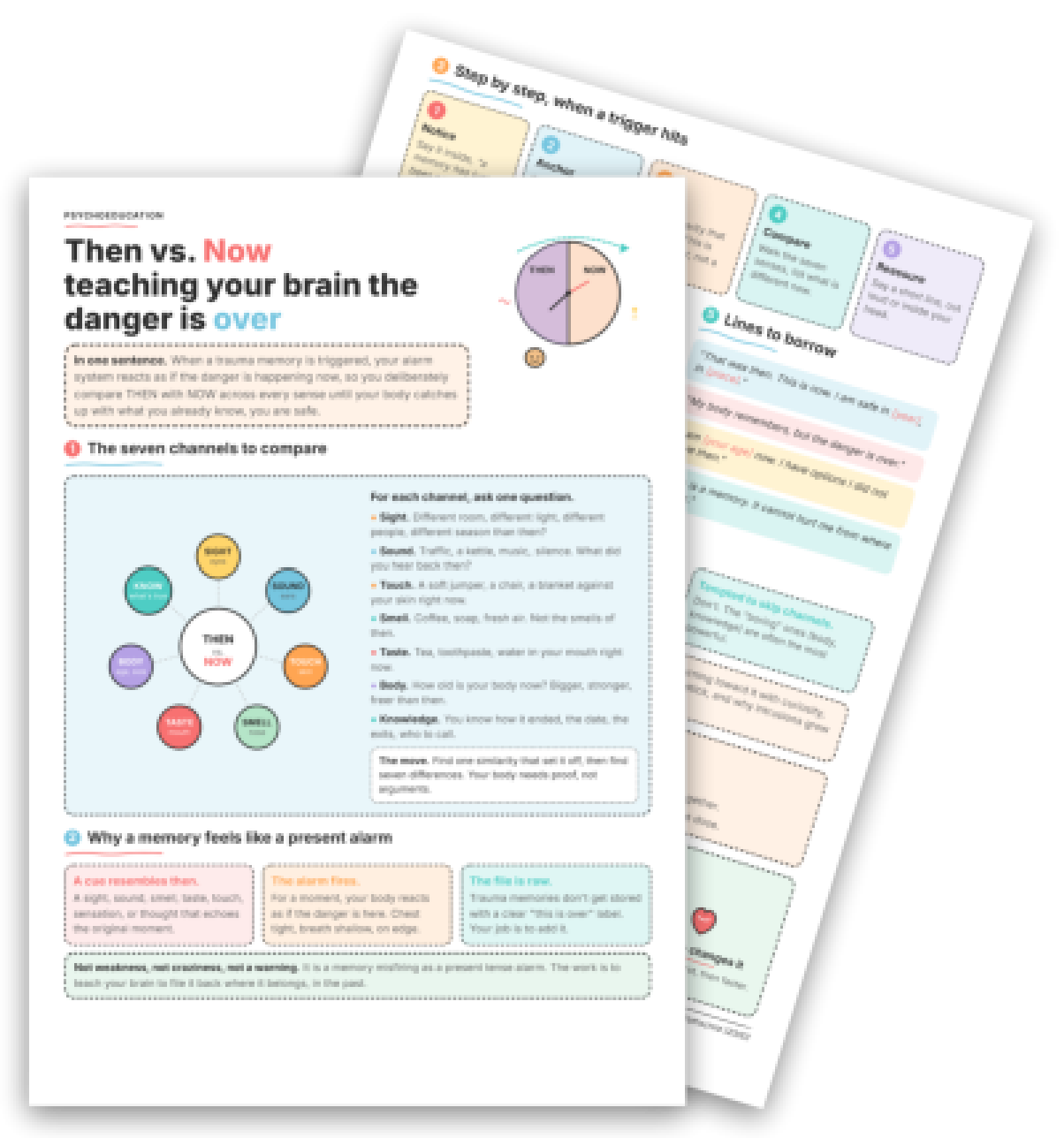
What the Fiche Contains: Seven Channels, One Visual Frame
The fiche PDF is built around a clear oppositional layout: THEN on one side, NOW on the other, with seven perceptual channels running between them. Those channels are Sight, Sound, Touch, Smell, Taste, Body (age and size), and Knowledge (what the patient now knows about how it ended, the date, the exits, who to call). For each channel, the fiche provides a concrete orienting question, "Different room, different light, different people, different season than then?" for sight; "How old is your body now? Bigger, stronger, freer than then?" for body.
A five-step protocol follows: Notice, Anchor, Spot, Compare, Reassure, each framed in plain action language. The fiche then shows a worked example (a smell trigger on a bus), a set of ready-made reassurance lines patients can borrow ("That was then. This is now. I am safe in [year], in [place]."), and a section on common pitfalls: what to do when the patient is too activated to find any differences, what to do when dissociation interrupts, and why the apparently "boring" channels (body, knowledge) are often the most effective.
> Key takeaway: The fiche is a visual support that facilitates the explanation of stimulus discrimination in session. It is not homework to complete alone; it is a structured comparison tool the clinician works through with the patient, leaving them a concrete reference they can return to independently when a trigger hits between appointments.
The "To discuss in session" prompts at the bottom anchor the debrief: which channel felt hardest, what stopped the patient at step 4, whether the exercise increased activation rather than reducing it.
750+ clinical tools
A library built with and for clinicians, ready to use in session and extend between appointments.
Access all the toolsWhen and How to Introduce It
This fiche sits naturally after an initial psychoeducation pass on how the nervous system responds to threat and how trauma memories are stored differently. Timing matters: introduce it when the patient has named at least one specific trigger and tolerates a moderate level of activation in session, not at the height of acute distress. For patients with complex PTSD, where triggers are more diffuse and activation more volatile, you may want to ensure solid grounding skills are in place first, so the patient has a reliable exit route if the comparison exercise overshoots.
A simple introduction: "I'd like to show you a tool that makes this comparison systematic rather than relying on you to generate it from scratch when your body is already alarmed." You can run through the worked example together before asking the patient to apply it to their own trigger. Debrief using the three "To discuss in session" questions; pay particular attention to patients who report increased activation after the exercise, as dose and channel selection may need adjusting.
The fiche pairs naturally with identifying and monitoring triggers, with sensory grounding exercises for over-activated moments, and, in EMDR-informed work, with the distinction between negative and positive cognitions captured in the EMDR Negative and Positive Cognitions resource. Used consistently, it gives patients a portable, repeatable procedure for filing the memory back where it belongs.
Use it with your patients
Share this tool in the mobile app and follow the work between sessions.
Sources
- Ehlers, A., Clark, D. M., Hackmann, A., McManus, F., & Fennell, M. (2005). Cognitive therapy for post-traumatic stress disorder: Development and evaluation. Behaviour Research and Therapy, 43(4), 413-431.
- OxCADAT (University of Oxford). PTSD Therapy Materials: Stimulus Discrimination (Trigger Discrimination) resources including Then vs. Now information sheets.
Your session continues in your patients' pocket
Use with a patientYour resources, available everywhere
The handouts, exercises, programs and audios above: you choose which ones to make available to your patients, in the mobile app dedicated to them.
And far more than a library
The app goes well beyond resources, to support your patients every day:
Related categories
Explore other clinical resources by category.
Trauma
Clinical hub on trauma and PTSD: assessment, differential diagnosis, treatment phases, and printable resources for practitioners. 155 chars.

Build awareness
Clinical worksheets and tools to build awareness in therapy: cognitive distortions, schemas, emotions, ACT and CBT resources for practitioners.

Regulate
Clinical resources for emotion regulation: worksheets, ACT exercises, and psychoeducation tools for affect regulation across diagnoses. For clinicians.

Process trauma
Clinical resources to process trauma: worksheets, psychoeducation, and exercises for trauma-focused practitioners working with PTSD and complex presentations.
Repair & soothe
Clinical resources for the repair and soothe therapeutic aim: worksheets, exercises and tools to build self-compassion, reduce shame and restore emotional safety.

CBT
CBT worksheets, cognitive restructuring exercises & behavioral tools for clinicians. Evidence-based resources for every phase of cognitive behavioral therapy.