
Clinical picture. M., a man in his late thirties referred after a road traffic incident, presented with recurrent intrusions and marked hypervigilance following an earlier combat deployment; he had not connected the two episodes. During a psychoeducation session, the clinician used the amygdala/hippocampus framework to explain why a car backfiring on his commute produced a full-body alarm response with no accompanying sense of "this is a memory." M. recognised immediately that what he had labelled a panic attack was in fact a sensory fragment replaying without a time tag. He left the session able to name the process, which reduced some of the secondary shame around "losing control," and agreed to keep a brief trigger log before the next appointment.
PTSD and Memory: PDF Worksheet, Tools and Exercises for Clinical Practice
A visual psychoeducation fiche PDF helping clinicians explain why traumatic memories replay as present-tense, with grounding tools and exercises for session use.
Clinical vignettes
Backfire Trigger in a Combat Veteran
Smell-Triggered Intrusion in Assault Survivor
Clinical picture. T., a woman in her mid-twenties, described being overwhelmed in a supermarket by the smell of a particular cleaning product; she reported feeling "back there" for several seconds before regaining her bearings, and had been avoiding shopping since. The clinician introduced the informational sheet to illustrate how an unfiled sensory fragment, stored without place or time labels, can be pulled forward by a single cue and experienced as present-tense threat. T. noted that understanding the librarian being "offline" during the assault made the intrusion feel less like a sign she was "going mad." The psychoeducation framed the next phase of work, in which the pair began to explore grounding strategies to support the hippocampus in re-tagging the memory as past.
Explaining to a patient why a trauma memory floods back with full sensory force, years after the event, is one of the harder moments in early trauma work. The oral explanation tends to land as abstract neuroscience, or worse, the patient hears it as a verdict on their mental state. This fiche PDF provides a visual support that does the explanatory heavy lifting in session, grounding the neurobiological model in plain language without losing clinical precision.
Use this resource with your patients
Handout, exercises and materials ready to use, right inside SessionFuel.
Why "it feels like now" is so hard to explain at the intake stage
The core difficulty is that patients arrive with a felt experience they cannot account for: a flashback is not remembering, it is reliving. When you describe the amygdala, hippocampus relationship verbally, most patients nod and retain very little. What they are actually trying to understand is why their body responds to a car backfire as if the threat were present.
The mechanism, as described in Ehlers and Clark's cognitive model and consolidated by van der Kolk's work on how trauma disrupts normal memory encoding, involves a failure of contextual tagging under extreme stress. The hippocampus (responsible for filing memories with time and place labels) goes briefly offline during peak sympathetic activation, leaving fragments stored without a "this is past" marker. Without that marker, the fight-flight-freeze response re-activates on cue. Explaining this sequence at the whiteboard, without a visual anchor, rarely makes it stick.
What the fiche contains, and what the visual layout adds
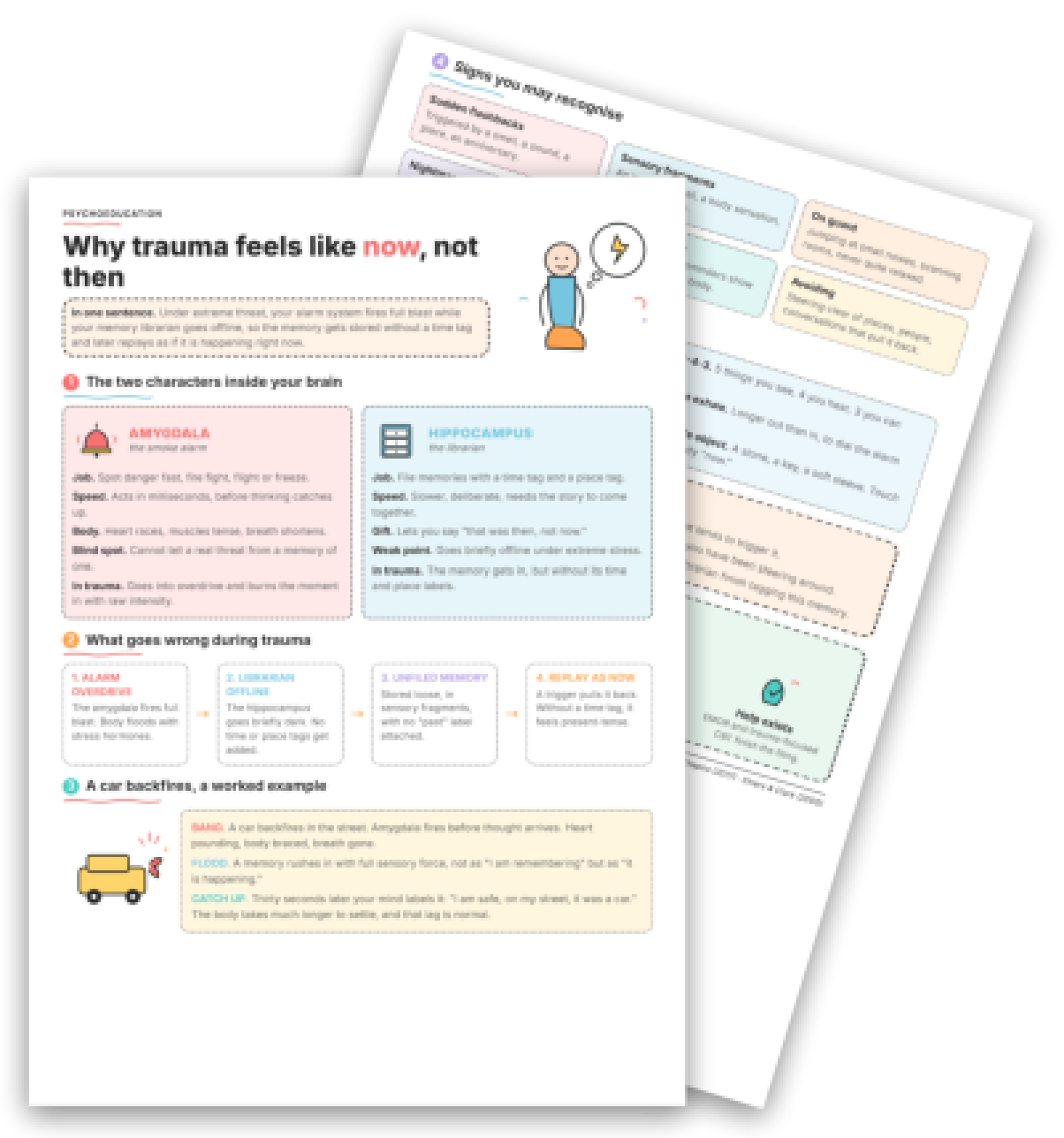
The fiche PDF structures the explanation across five sections that you can walk through together with the patient, panel by panel.
The opening section frames the neurobiological split through two characters: the amygdala (the smoke alarm, acting in milliseconds before thought arrives) and the hippocampus (the librarian, slower, responsible for the time tag that lets you say "that was then, not now"). The side-by-side layout makes the functional contrast visible in a way that a verbal description simply does not.
Section two traces the four-step breakdown: alarm overdrive, librarian offline, unfiled memory stored in sensory fragments, and replay without a past label. A worked example follows, using a car backfiring: "A memory rushes in with full sensory force, not as 'I am remembering' but as 'it is happening.'" Patients consistently respond to this example, because it names their experience precisely.
Sections four and five shift from explanation to recognition and regulation. The fiche lists six symptom clusters (flashbacks, sensory fragments, hypervigilance, nightmares, dissociation, avoidance) that you can use to map which presentations the patient recognises, and then six grounding techniques framed as tools the patient can use immediately when a flashback hits. The 5-4-3 sensory grounding technique appears explicitly, alongside orienting strategies such as naming the date and feeling feet on the floor.
The closing section, "To discuss in session," contains three prompts you can use directly as a structured debrief, including an invitation to ask "which approach (EMDR, trauma-focused CBT, other) could help the librarian finish tagging this memory", which naturally opens the treatment-planning conversation.
> Key takeaway: this fiche is a visual support that facilitates the explanation of traumatic memory encoding in session; it is not a questionnaire the patient completes alone, but a shared reference you work through together to establish a common language before trauma processing begins.
750+ clinical tools
A library built with and for clinicians, ready to use in session and extend between appointments.
Access all the toolsWhen and how to introduce the fiche
The optimal moment is session two or three, once the initial anamnesis is complete and a working alliance is forming, but before you introduce exposure-based or EMDR-oriented work. Patients who feel confused or ashamed by their symptoms respond particularly well. You can introduce it with something like: "I'd like to show you a diagram that explains what your brain was actually doing during the trauma, and why certain things keep pulling you back."
For patients presenting with prominent avoidance (steering clear of places, people, or conversations that trigger recall), the fiche pairs usefully with identifying and mapping triggers and with the Common Reactions to Trauma sheet to normalise the full symptom picture. For those already familiar with the Ehlers and Clark framework, you can move quickly through sections one and two and spend more time on the grounding menu in section five.
One limit to note: patients with significant dissociative presentations may find the sensory-fragment section activating. With that profile, keep the session paced and co-regulate actively rather than letting the patient read the fiche independently between appointments.
The autonomic nervous system sheet and the fight-flight-freeze response fiche complement this resource if you want to go deeper into physiological regulation; the PTSD symptoms checklist and the Ehlers and Clark PTSD model provide clinical detail for the formulation phase. Together, these tools build the psychoeducational scaffolding that makes trauma processing work less threatening and more collaborative.
The fiche does not replace the therapeutic frame; it gives the patient a concrete, portable account of what happened in their brain, which is often the first moment the shame begins to lift.
Use it with your patients
Share this tool in the mobile app and follow the work between sessions.
Sources
- van der Kolk, B. (2014). The Body Keeps the Score: Brain, Mind, and Body in the Healing of Trauma. Viking.
- Maddox, S. A., Hartmann, J., Ross, R. A., Ressler, K. J. (2019). Emotional Memory in Post-traumatic Stress Disorder: A Systematic PRISMA Review of Controlled Studies. Frontiers in Psychology, 10, 303.
- American Psychological Association (2017). Clinical Practice Guideline for the Treatment of Posttraumatic Stress Disorder (PTSD) in Adults.
Your session continues in your patients' pocket
Use with a patientYour resources, available everywhere
The handouts, exercises, programs and audios above: you choose which ones to make available to your patients, in the mobile app dedicated to them.
And far more than a library
The app goes well beyond resources, to support your patients every day:
Related categories
Explore other clinical resources by category.

Trauma
Clinical hub on trauma and PTSD: assessment, differential diagnosis, treatment phases, and printable resources for practitioners. 155 chars.

Understand
Clinical hub for the therapeutic aim 'Understand': worksheets and tools to build patient insight across CBT, ACT, schema therapy and more.

CBT
CBT worksheets, cognitive restructuring exercises & behavioral tools for clinicians. Evidence-based resources for every phase of cognitive behavioral therapy.

EMDR
Clinical hub for EMDR therapy resources: worksheets, stabilisation tools, and guided audio for all 8 phases of trauma reprocessing. For trained clinicians.

Anxiety
Clinical hub for anxiety disorders: CBT and ACT worksheets, psychoeducation sheets, and exercises for assessment and treatment across the anxiety spectrum.

Mood
Evidence-based worksheets and clinical tools for mood disorders: CBT, ACT, and positive psychology resources for psychologists and therapists.