
Clinical picture. A, a woman in her late thirties, was referred following a road traffic collision eighteen months prior. She reported distressing intrusive images and recurrent nightmares, yet was unable to give a coherent verbal account of the event; she described this inability as proof that she was "making it up" or "going crazy." The clinician introduced the psychoeducation sheet on trauma memory properties and walked through the contrast between ordinary and trauma memory, pausing on the concepts of fragmentation and vivid unchanging recall. A identified five of the seven properties as matching her own experience, and noted with visible relief that the sheet explained why she could describe the texture of the steering wheel in precise detail while having no memory of how she left the vehicle. By the following session she reported less self-blame about her gaps in recall, which opened space for more direct engagement with imagery work.
Properties of Trauma Memories: PDF Worksheet, Tools and Exercises
A visual PDF worksheet and clinical tools to help patients understand why trauma memories behave differently, and to reduce shame and confusion in the room.
Clinical vignettes
Naming Fragments Reduces Shame
Nowness Concept Anchors Grounding Work
Clinical picture. M, a man in his mid-forties with a history of childhood physical abuse, presented with frequent episodes in which environmental cues, such as a particular tone of voice or the smell of cigarette smoke, triggered intense autonomic arousal he could not link to any conscious memory. He had concluded these reactions were signs of a personality problem rather than trauma responses. The clinician used the informational sheet to introduce the property of "nowness," explaining that trauma memory lacks the temporal tag that marks ordinary recollection as past. M ticked the sensory and involuntary properties as particularly recognisable and was able to reframe his cue-triggered reactions as fragments replaying without narrative context rather than as evidence of instability. This reframe supported his willingness to practise sensory grounding techniques, as he now understood what the grounding was intended to interrupt.
Explaining trauma memory to a patient at the oral level rarely lands cleanly. The patient nods, then returns the following week still convinced their memory is "broken," "lying," or evidence that they are somehow defective. This PDF worksheet on the properties of trauma memories gives you a concrete visual support to use in session, one that replaces a five-minute verbal monologue with a structure the patient can follow, hold, and take home.
Use this resource with your patients
Handout, exercises and materials ready to use, right inside SessionFuel.
Why Trauma Memory Is So Hard to Explain Verbally
The central clinical difficulty is that trauma memory violates the patient's intuitive model of how memory works. Most patients carry an implicit assumption that all memory functions like a coherent narrative: a beginning, a middle, an end, softening over time. When their own trauma material shows up fragmented, wordless, intensity-unchanged after years, or suddenly present-tense in the middle of a Tuesday afternoon, they interpret this discrepancy as pathology, weakness, or fabrication.
Secondary shame compounds the picture. Patients who doubt whether their intrusive thoughts and images are "real enough," or who wake at 3am with a scene they did not invite, often carry the silent belief that a healthy person would have moved on by now. The PTSD symptom cluster is then amplified not just by the original material but by the patient's catastrophic interpretation of having it at all.
An oral explanation of peritraumatic encoding, context-memory dissociation, or the Ehlers and Clark appraisal model (see the Ehlers & Clark PTSD model worksheet) is accurate but abstract. Without a visual anchor, the concepts fade between sessions.
What the Fiche Contains: A Visual Structure for In-Session Psychoeducation
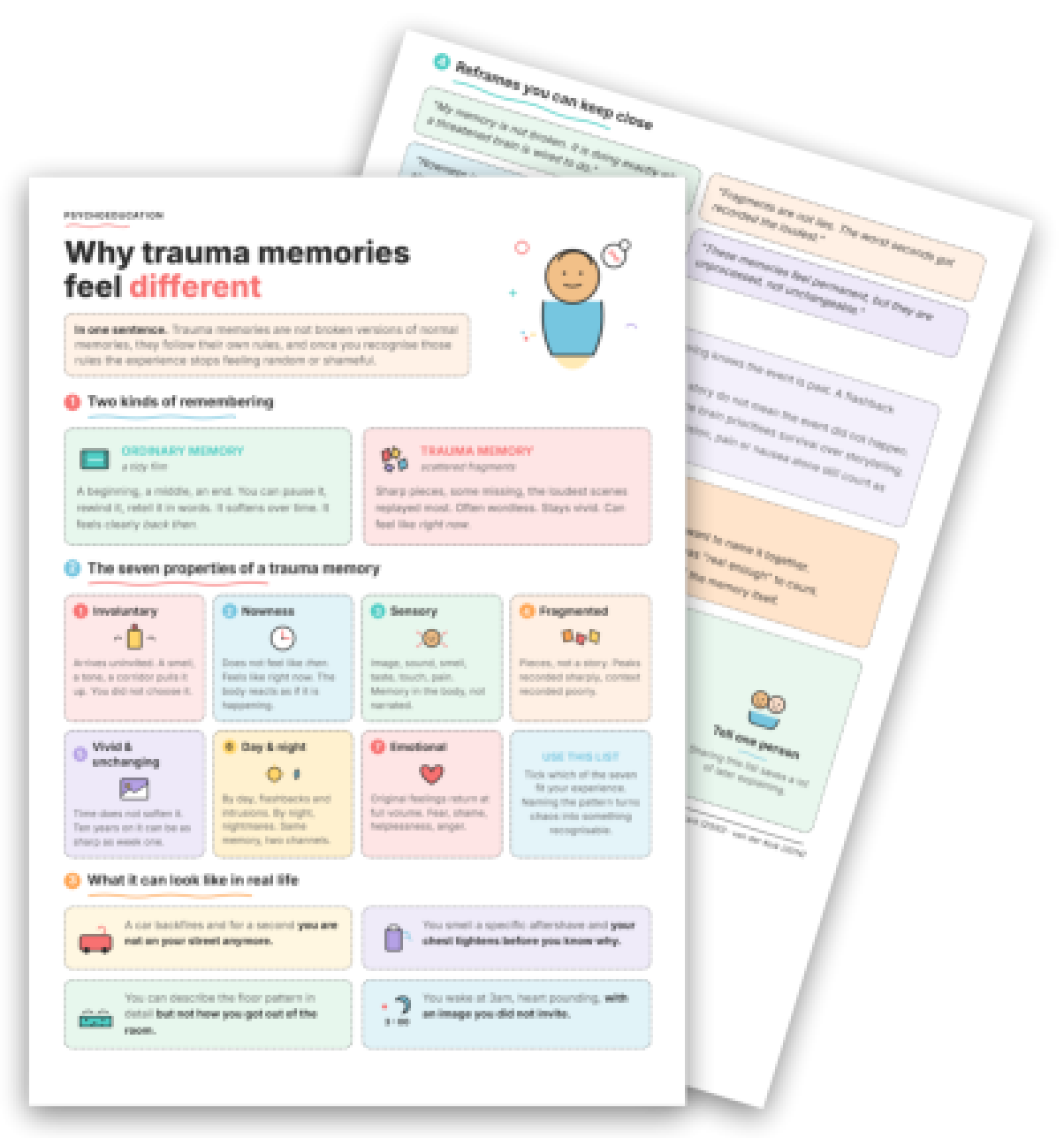
The fiche opens with a direct side-by-side contrast: ordinary memory described as "a tidy film" (linear, verbal, softening over time, clearly back then) set against trauma memory as "scattered fragments" (sharp pieces, some missing, the loudest scenes replayed most, often wordless, feels like right now). This single visual panel does in ten seconds what a paragraph of explanation cannot: it externalises the patient's experience and names it as different, not broken.
The core of the fiche is a labelled list of seven properties: Involuntary, Nowness, Sensory, Fragmented, Vivid & unchanging, Day & night, and Emotional. Each is defined in two or three words. The patient is invited to tick which of the seven fit their experience, which shifts the encounter from abstract psychoeducation to active recognition. Naming, as the fiche states directly, "turns chaos into something recognisable."
The fiche also includes a panel of four reframes, worded to be kept close: among them, "Nowness is a trick of timing. The event is over, my alarm system has not been told yet", which maps neatly onto the fight-flight-freeze response and the autonomic nervous system dysregulation you may already be addressing. A common confusions panel directly tackles the flashback-versus-remembering distinction, the fragmented-memory-versus-false-memory conflation, and the possibility of body memories with no visual content, all frequent sources of distress and misattribution in trauma work. Finally, three "To discuss in session" prompts give you a ready-made debrief scaffold.
> Key takeaway: The fiche is a visual support that facilitates the explanation of trauma memory properties in session. It is not a self-administered questionnaire; the clinician guides the patient through it, using the side-by-side panels and the seven-property list to build a shared vocabulary before handing it over as a concrete reference.
750+ clinical tools
A library built with and for clinicians, ready to use in session and extend between appointments.
Access all the toolsWhen and How to Introduce This Fiche
Timing. The fiche fits naturally in the psychoeducation phase, typically sessions two to four, once a working alliance is established and you have completed your initial formulation. It is particularly well-placed immediately before beginning exposure work, EMDR (EMDR cognitions worksheet), or schema-focused processing, where the patient's cooperation depends on them understanding why memory material behaves as it does.
Patient profiles. Prioritise it for patients who express shame about having flashbacks or nightmares, patients who doubt the validity of their own experience because of memory gaps, those presenting with common trauma reactions they cannot explain, and any patient who has read that "real" trauma memories should be complete. It is also useful with patients whose trauma history emerged after a critical illness stay (see Critical Care and PTSD) and who have no prior frame for intrusive re-experiencing.
How to frame it. You might introduce it with something like: "Before we go further, I want to show you something that explains why your memory of this period works the way it does. It's not a test; just a map." Work through the side-by-side panel aloud, pause at the seven properties for the patient to self-identify, and spend time on the common confusions panel if secondary shame is prominent. Pair it, where relevant, with grounding techniques or nervous system regulation tools for patients destabilised by the recognition itself.
One limit worth naming. Patients with active dissociative presentations may find the Nowness and Sensory panels activating. Introduce the fiche more slowly with this group, one panel per session if needed, and keep sensory grounding resources within reach throughout.
The fiche does not replace careful formulation or the therapeutic frame; it makes a genuinely complex neurocognitive concept visible, speeding up the shared understanding that exposure and processing work depend on.
Use it with your patients
Share this tool in the mobile app and follow the work between sessions.
Sources
- Brewin, C. R., Dalgleish, T., & Joseph, S. (1996). A dual representation theory of posttraumatic stress disorder. Psychological Review.
- Ehlers, A., & Clark, D. M. (2000). A cognitive model of posttraumatic stress disorder. Behaviour Research and Therapy.
- van der Kolk, B. A. (2014). The Body Keeps the Score: Brain, Mind, and Body in the Healing of Trauma. Viking.
- Brewin, C. R. (2018). Memory and Forgetting. Current Psychiatry Reports.
Your session continues in your patients' pocket
Use with a patientYour resources, available everywhere
The handouts, exercises, programs and audios above: you choose which ones to make available to your patients, in the mobile app dedicated to them.
And far more than a library
The app goes well beyond resources, to support your patients every day:
Related categories
Explore other clinical resources by category.

Trauma
Clinical hub on trauma and PTSD: assessment, differential diagnosis, treatment phases, and printable resources for practitioners. 155 chars.

Understand
Clinical hub for the therapeutic aim 'Understand': worksheets and tools to build patient insight across CBT, ACT, schema therapy and more.

CBT
CBT worksheets, cognitive restructuring exercises & behavioral tools for clinicians. Evidence-based resources for every phase of cognitive behavioral therapy.

EMDR
Clinical hub for EMDR therapy resources: worksheets, stabilisation tools, and guided audio for all 8 phases of trauma reprocessing. For trained clinicians.

Anxiety
Clinical hub for anxiety disorders: CBT and ACT worksheets, psychoeducation sheets, and exercises for assessment and treatment across the anxiety spectrum.

Mood
Evidence-based worksheets and clinical tools for mood disorders: CBT, ACT, and positive psychology resources for psychologists and therapists.