
Clinical picture. J., a man in his late thirties, presented with recurrent intrusive images and somatic arousal tied to a road traffic collision three years prior. He had read about EMDR online and arrived openly doubtful, describing the bilateral stimulation component as "something that sounds made up." The clinician used the informational sheet to walk through the distinction between a stuck and a digested memory, anchoring the explanation in J.'s own reported experience: the way the incident still felt present-tense in his chest rather than clearly located in the past. Reviewing the eight-phase structure visibly reduced his apprehension; he noted that knowing there was a preparation phase before any memory work made him willing to proceed. He agreed to a first history-taking session, which he attended.
What Is EMDR Therapy? PDF Worksheet, Tools and Exercises
A printable PDF worksheet, tools and exercises to explain EMDR's rationale, phases, and bilateral stimulation to patients before processing begins.
Clinical vignettes
Introducing EMDR to a Skeptical Patient
Normalising Bilateral Stimulation Mid-Treatment
Clinical picture. R., a woman in her mid-forties with a complex trauma history, had begun EMDR and was progressing through the desensitisation phase when she expressed discomfort with the eye-movement sets, worried she was "doing it wrong" because she sometimes shifted to an unrelated memory rather than staying on the target. The clinician returned briefly to the informational sheet's description of bilateral stimulation, specifically the point that whatever arises between sets is valid and that there is no correct response. Reframing her associative jumps as part of the processing rather than errors shifted her stance noticeably within that session. She continued with reduced self-monitoring, and distress ratings on the target memory dropped over the following two sets.
Patients referred for EMDR frequently arrive with secondhand accounts: "Is it just waving fingers in front of your face?" Explaining bilateral stimulation, the eight-phase protocol, and the rationale for memory reconsolidation in a first conversation is a heavy lift, and a confusing introduction can undermine buy-in before processing has even begun. This fiche PDF gives you a concrete visual anchor to make that explanation land cleanly, in session, where it matters.
Use this resource with your patients
Handout, exercises and materials ready to use, right inside SessionFuel.
Why EMDR Is Difficult to Explain Without a Visual Support
The core difficulty is not the conceptual complexity of EMDR itself. It is the mismatch between what the procedure looks like and what it is actually doing. Bilateral stimulation looks unusual. The eight-phase structure is sequential in ways that are hard to convey in linear speech. And the central clinical insight, that a memory can feel simultaneously "in the past" and yet still trigger a full somatic response right now, sits at the edge of what most patients can grasp without something to look at.
Patients living with fragmented trauma memories often have no working framework for why past events still dysregulate them physiologically. Tools like the Ehlers and Clark PTSD model and the PTSD and Memory worksheet address the maintenance mechanisms; this fiche addresses the treatment rationale, in accessible terms, at the moment the patient most needs it.
There is also a predictable cluster of pre-treatment fears: being hypnotised, losing control, being flooded, or "nothing coming up." Addressing these proactively, before they surface as mid-session resistance, shortens the preparation phase substantially.
What the Fiche Contains: a Session-Ready Visual Guide to EMDR
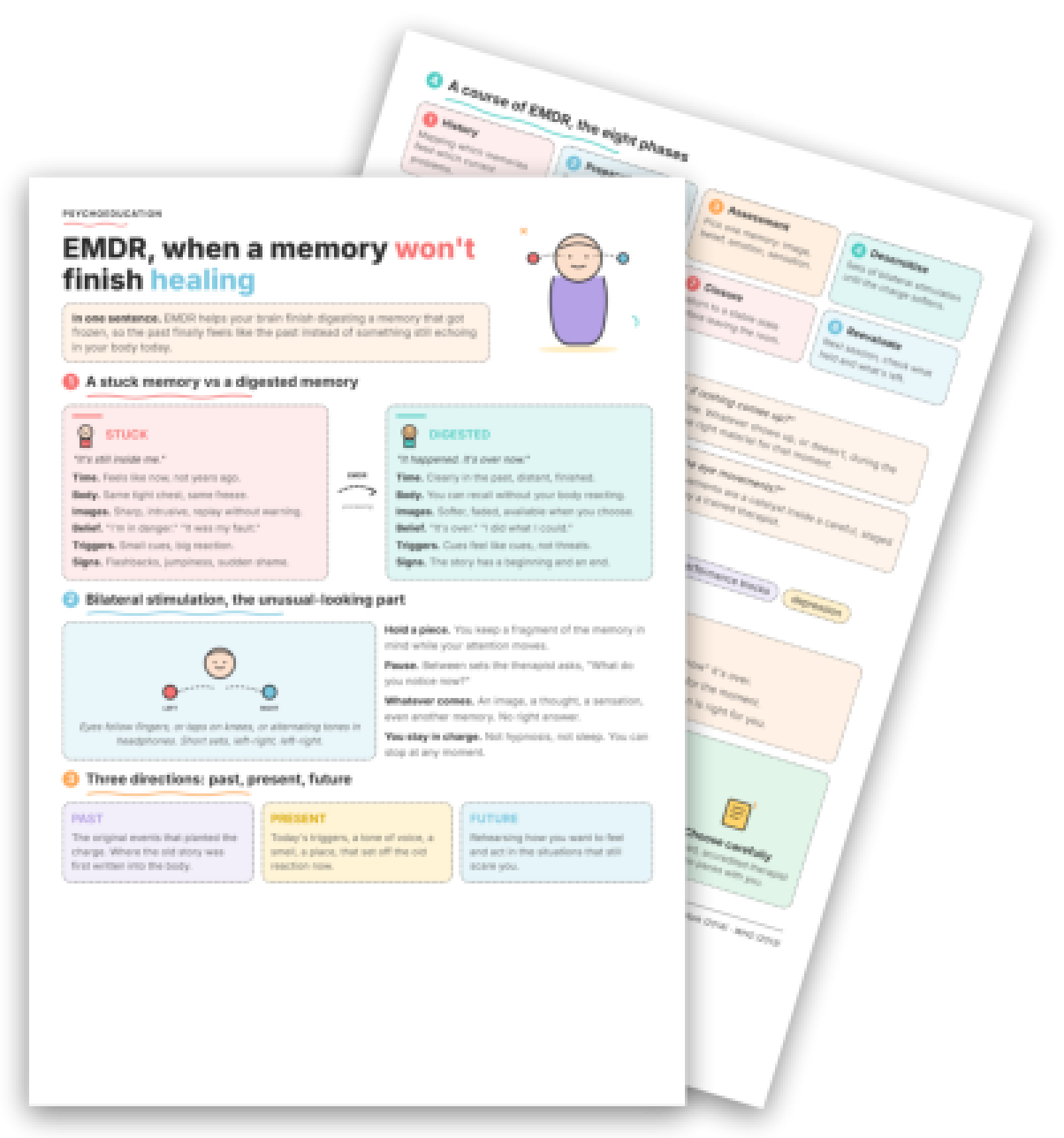
The fiche opens with a one-sentence framing designed to be read aloud: "EMDR helps your brain finish digesting a memory that got frozen, so the past finally feels like the past instead of something still echoing in your body today." That single line often prompts the first genuine nod of recognition from a patient who has struggled to name their own experience for years.
The visual centrepiece (panel 1) is a side-by-side STUCK / DIGESTED comparison across six parallel dimensions: time, body, images, belief, triggers, and signs. Where a stuck memory produces "same tight chest, same freeze," a digested memory produces "you can recall without your body reacting." The layout holds both states simultaneously on the page, so the patient can locate themselves in the left column and see the right column as a concrete, reachable destination. No oral explanation does that as efficiently.
Panel 2 normalises bilateral stimulation step by step, including the explicit reassurance that the patient stays in charge and can stop at any moment. Panel 3 introduces the three processing directions (past, present, future), which is particularly clarifying for patients who wonder why today's triggers are targeted, not only the original event. Panel 4 maps all eight phases of the standard protocol in sequence, providing a roadmap that counters the fear of an open-ended, uncontrollable procedure. You can use this panel alongside the Therapy Blueprint for PTSD to show the patient exactly where they are in the overall care plan.
Panel 5 answers the four most common pre-treatment worries directly and concisely. Panel 6 lists the range of presentations EMDR addresses beyond single-event trauma: anxiety, phobias, panic, OCD, depression, grief, and chronic pain. This is clinically useful for patients referred from settings that framed EMDR as exclusively a PTSD intervention.
> Key takeaway: The fiche is a visual support that facilitates the explanation of EMDR in session. It is not a questionnaire the patient completes alone. It is a shared reference the clinician works through with the patient to make a complex, often misunderstood protocol legible before the first processing session begins.
750+ clinical tools
A library built with and for clinicians, ready to use in session and extend between appointments.
Access all the toolsWhen and How to Introduce It
The fiche sits most naturally in phase 2 of the standard protocol (preparation), after history-taking and trauma mapping and before formal assessment of the target memory. A simple introduction: "Before we start the actual processing, I'd like to walk through what EMDR looks like in practice so nothing feels surprising."
For patients with complex PTSD or dissociative features, spend extra time on panels 2 and 4. The explicit pacing structure, with preparation named as a distinct phase that precedes processing, directly counters fears of being overwhelmed. Pairing this with the grounding techniques menu and a fight-flight-freeze psychoeducation sheet reinforces the stabilisation rationale before any bilateral stimulation begins.
For patients presenting with anxiety, phobia, or OCD alongside trauma, panel 6 is worth dwelling on. You can cross-reference the EMDR Negative and Positive Cognitions worksheet to begin orienting the patient toward the assessment phase vocabulary. The stimulus discrimination tool (then vs. now) complements panel 1 well if the patient needs more work on contextualising intrusive reactions before processing.
A useful debrief question after reviewing the fiche together: "Which column did you recognise yourself in?" The answer tells you a great deal about readiness to engage with active processing.
One practical limit: the fiche does not address EMDR contraindications, including active psychosis, severe dissociation, or insufficient stabilisation. That clinical judgement stays yours. The fiche handles the rationale; you handle the timing.
Use it with your patients
Share this tool in the mobile app and follow the work between sessions.
Sources
- Shapiro, F. (2018). Eye Movement Desensitization and Reprocessing (EMDR) Therapy: Basic Principles, Protocols, and Procedures (3rd ed.). Guilford Press.
- Shapiro, F., Forrest, M. S. (1997). EMDR: The Breakthrough Therapy for Overcoming Anxiety, Stress, and Trauma. Basic Books.
- World Health Organization (WHO) (2013). Guidelines for the Management of Conditions Specifically Related to Stress. World Health Organization.
- EMDR International Association (EMDRIA). What Is EMDR Therapy?.
- Farrell, D., Keenan, P. (2021). The Structure of EMDR Therapy: A Guide for the Therapist. Frontiers in Psychology, 12, 660753.
Your session continues in your patients' pocket
Use with a patientYour resources, available everywhere
The handouts, exercises, programs and audios above: you choose which ones to make available to your patients, in the mobile app dedicated to them.
And far more than a library
The app goes well beyond resources, to support your patients every day:
Related categories
Explore other clinical resources by category.

Trauma
Clinical hub on trauma and PTSD: assessment, differential diagnosis, treatment phases, and printable resources for practitioners. 155 chars.

Understand
Clinical hub for the therapeutic aim 'Understand': worksheets and tools to build patient insight across CBT, ACT, schema therapy and more.

Process trauma
Clinical resources to process trauma: worksheets, psychoeducation, and exercises for trauma-focused practitioners working with PTSD and complex presentations.

EMDR
Clinical hub for EMDR therapy resources: worksheets, stabilisation tools, and guided audio for all 8 phases of trauma reprocessing. For trained clinicians.

Anxiety
Clinical hub for anxiety disorders: CBT and ACT worksheets, psychoeducation sheets, and exercises for assessment and treatment across the anxiety spectrum.

Mood
Evidence-based worksheets and clinical tools for mood disorders: CBT, ACT, and positive psychology resources for psychologists and therapists.