
Clinical picture. A., a woman in her late thirties, presented with recurrent intrusive images following a road traffic collision three years prior. She had avoided driving entirely and reported that the smell of petrol reliably triggered a flood of fear she described as feeling "right now, not back then." Her therapist introduced the informational sheet during a preparatory session, framing EMDR as a way to help the brain complete a filing process that had stalled at the moment of overwhelm. A. found the distinction between an ordinary memory and a stuck one useful; she noted, unprompted, that her other memories of that period felt "finished" while the collision did not. This shared language gave the pair a workable starting point for the assessment phase that followed.
EMDR: PDF Handout, Tools and Exercises for Clinical Practice
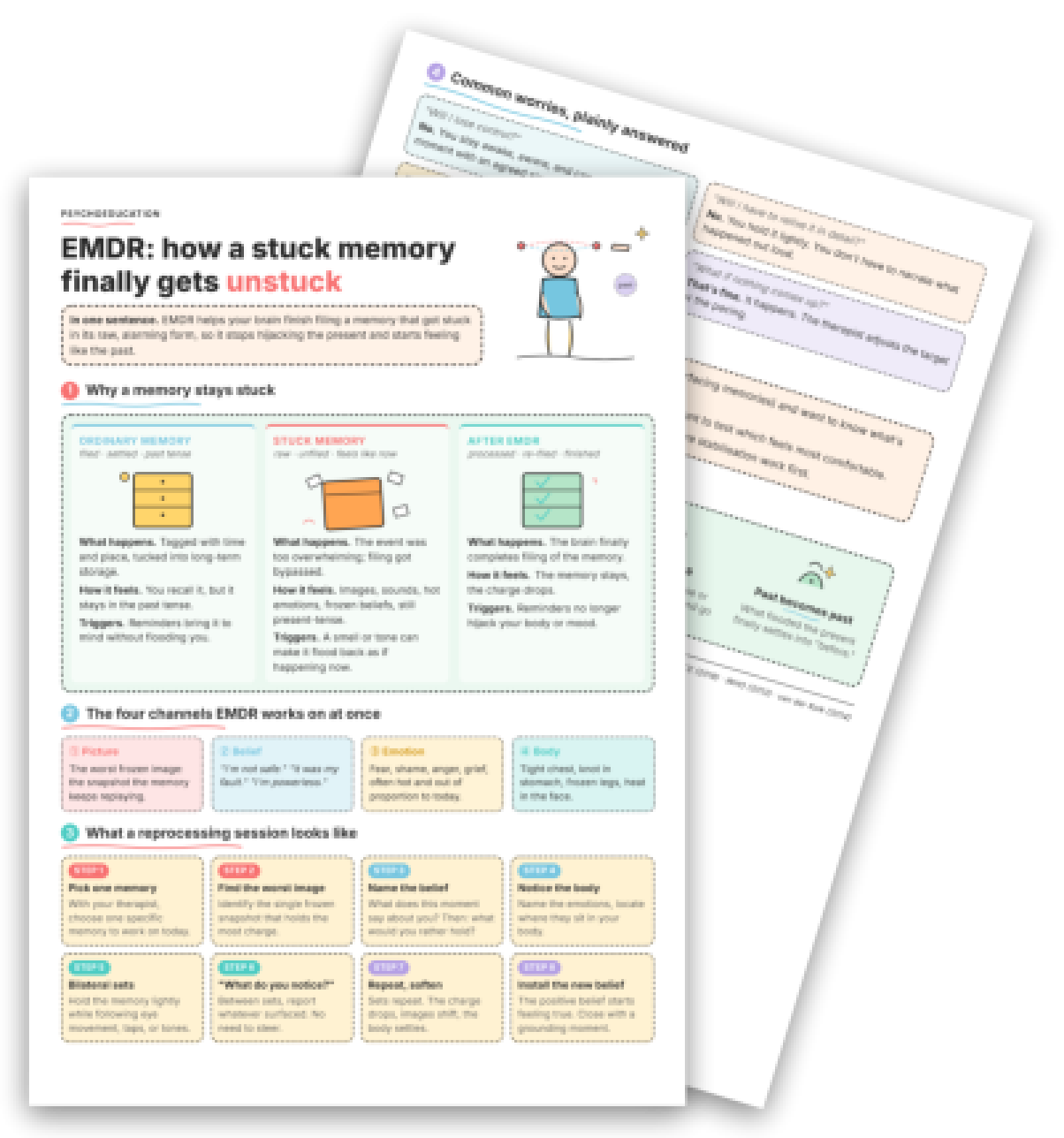
A visual PDF handout clinicians can use in session to explain the stuck memory model, four processing channels, and 8-step reprocessing structure before bilateral work begins.
Clinical vignettes
Introducing EMDR to a Reluctant Patient
Orienting a Sceptical Referral to the Model
Clinical picture. M., a man in his mid-fifties, was referred by his psychiatrist after partial response to medication for PTSD symptoms rooted in occupational trauma. He arrived at the first session describing the proposed treatment as "waving your fingers at someone," and was openly doubtful. The therapist used the informational sheet to walk through the four channels, specifically the simultaneous involvement of image, belief, body sensation, and emotion, before any bilateral stimulation was introduced. M. recognised, through the body-sensation section, that his chronic jaw tension appeared exclusively when a particular supervisory voice came to mind. His scepticism did not resolve immediately, but he agreed to proceed to the assessment phase, having at least a structural map of what the work would involve.
EMDR is among the most robustly validated trauma interventions available, yet it consistently produces one of the highest pre-treatment dropout rates. Patients agree to start, then cancel before the first bilateral set. The mechanism rarely makes sense from a verbal description alone. This fiche PDF gives you a structured visual support to make the model legible in session, before reprocessing begins.
Use this resource with your patients
Handout, exercises and materials ready to use, right inside SessionFuel.
Why EMDR's mechanism resists verbal explanation
The clinical difficulty isn't the protocol. It's the memory model. Patients typically arrive carrying two competing misconceptions: that EMDR requires detailed verbal narration of the trauma, or that the eye movements will erase the memory entirely. Both misunderstandings generate avoidance before treatment starts, and both are almost impossible to correct without a concrete frame to point to.
The deeper problem is that the adaptive information processing model requires patients to grasp why an unprocessed memory behaves differently from an ordinary recollection: why a smell, a posture, or a tone of voice can flood the body as if the event were still unfolding. Without a visual scaffold, that explanation stays abstract. Patients nod. The implicit fear of losing control in session remains intact.
Resources such as Common Reactions to Trauma and How Your Past Affects Your Present help contextualize the clinical picture, but EMDR's mechanism itself needs its own anchor. That is precisely what this handout provides.
What the fiche contains: a visual scaffold for the session
The fiche is organized across six clearly labelled panels, each targeting a specific sticking point.
Panel 1 presents a three-state memory model in a side-by-side comparison: ordinary memory ("filed, settled, past tense"), stuck memory ("raw, unfiled, feels like now"), and post-EMDR memory ("processed, re-filed, finished"). Identical sub-categories appear across all three columns (what happens, how it feels, triggers), so the contrast is immediate and structural. No verbal explanation achieves that clarity as efficiently.
Panel 2 names the four channels EMDR targets simultaneously: the worst frozen image, the negative cognition (with examples: "I'm not safe," "I was powerless"), the associated emotion, and the body sensation. This prepares patients for the interweaving of somatic and cognitive material they will encounter in the assessment phase, and maps directly onto your prompts. Clinicians already using the EMDR Negative and Positive Cognitions resource will find the two fiches complement each other closely.
Panel 3 presents the 8-step session structure as a numbered visual sequence, from choosing the target memory to installing the positive cognition. Panel 4 addresses the four most common patient worries plainly: loss of control, having to narrate in detail, erasure, and nothing surfacing. Panel 5 lists three concrete discussion points for the patient to raise, including a preference for taps or tones over eye movements, and a request to add stabilization work before reprocessing begins. Panel 6 closes with four short principles: "Awake, in charge," "Filing, not erasing," "Just notice," "Past becomes past."
> Key point: This fiche is a visual support designed for use in session, not a self-guided questionnaire. You walk the patient through each panel before reprocessing begins, building shared vocabulary and neutralizing anticipatory distress. The patient takes the sheet home as a reference point they can return to between sessions.
750+ clinical tools
A library built with and for clinicians, ready to use in session and extend between appointments.
Access all the toolsWhen and how to introduce the fiche in session
Propose it at the psychoeducation stage, typically in the second or third session, after completing the anamnesis and establishing the treatment rationale. For patients identified through a PTSD symptoms checklist or presenting with complex PTSD features, walking through the three-state model early reduces the dropout risk substantially.
A workable introduction: "Before we do anything with eye movements, I'd like to look at this sheet together. It explains what happens in the brain when a memory gets stuck, and what EMDR actually does about it. It'll make what we do in session much more predictable." Nothing in that framing labels the patient as disordered.
Debrief by asking which panel raised questions and whether the loss-of-control worry resonates. If stabilization needs are high, Panel 5 provides a natural entry point for discussing a more gradual approach. For practitioners drawing on the Ehlers and Clark PTSD model, using stimulus discrimination techniques, or integrating material on the properties of trauma memories, the three-state visual on this fiche maps cleanly onto each of those frameworks.
Patients who revisit the sheet after processing begins can locate their experience in the model independently, including between-session waves of vivid dreams or surfacing memories. Paired with grounding techniques and the PTSD linen cupboard metaphor, it builds a progressively richer psychoeducative frame across the full course of treatment. The fiche does not replace clinical judgment about readiness for reprocessing; it makes the decision to proceed genuinely informed.
Use it with your patients
Share this tool in the mobile app and follow the work between sessions.
Sources
- Shapiro, F. (2018). Eye Movement Desensitization and Reprocessing (EMDR) Therapy: Basic Principles, Protocols, and Procedures (3rd ed.). Guilford Press.
- World Health Organization (WHO) (2013). Guidelines for the Management of Conditions Specifically Related to Stress. WHO.
- Chen, Y. R., Hung, K. W., Tsai, J. C., Chu, H., Chung, M. H., Chen, S. R., Liao, Y. M., Ou, K. L., Chang, Y. C., & Chou, K. R. (2014). Efficacy of Eye-Movement Desensitization and Reprocessing for Patients with Posttraumatic-Stress Disorder: A Meta-Analysis of Randomized Controlled Trials. PLOS ONE, 9(8), e103676.
- Rydberg, J. A., Virgitti, L., & Tarquinio, C. (2024). Bolstering the Adaptive Information Processing Model: A Narrative Review. Frontiers in Psychiatry, 15, 1374274.
- Russell, M. C., & Shapiro, F. (2021). Eye Movement Desensitization and Reprocessing (EMDR) Therapy (Theories of Psychotherapy Series). American Psychological Association.
Your session continues in your patients' pocket
Use with a patientYour resources, available everywhere
The handouts, exercises, programs and audios above: you choose which ones to make available to your patients, in the mobile app dedicated to them.
And far more than a library
The app goes well beyond resources, to support your patients every day:
Related categories
Explore other clinical resources by category.

Anxiety
Clinical hub for anxiety disorders: CBT and ACT worksheets, psychoeducation sheets, and exercises for assessment and treatment across the anxiety spectrum.

Trauma
Clinical hub on trauma and PTSD: assessment, differential diagnosis, treatment phases, and printable resources for practitioners. 155 chars.

Mood
Evidence-based worksheets and clinical tools for mood disorders: CBT, ACT, and positive psychology resources for psychologists and therapists.

Understand
Clinical hub for the therapeutic aim 'Understand': worksheets and tools to build patient insight across CBT, ACT, schema therapy and more.

EMDR
Clinical hub for EMDR therapy resources: worksheets, stabilisation tools, and guided audio for all 8 phases of trauma reprocessing. For trained clinicians.

Identity
Clinical resources for self-identity work in therapy: CBT, ACT, schema tools for clinicians addressing self-concept, core beliefs, and identity disruption.