
Clinical picture. A, a man in his late thirties, presented with intrusive re-experiencing and persistent shame following a road traffic collision two years prior. He described sudden surges of panic in car parks, which he attributed to "losing his mind," and had been avoiding all driving since the event. The clinician introduced the Ehlers and Clark informational sheet midway through the second session, walking through the four-part loop and pausing at the "negative meanings" box to ask which labels A applied to his own reactions. A identified "I'm broken" and "My panic proves I can't cope" as beliefs he held daily, and acknowledged for the first time that these appraisals were sustaining the alarm rather than reflecting a fixed truth about him. By the end of the session he reported modest relief, less from any technique than from understanding why avoidance had not helped over two years.
Ehlers & Clark PTSD Model: PDF Worksheet, Tools and Exercises
A visual PDF worksheet on the Ehlers & Clark cognitive model of PTSD: tools and exercises to explain why trauma stays present-tense and how to break the maintenance loop in session.
Clinical vignettes
Naming the Loop in Session
Distinguishing Then from Now
Clinical picture. M, a woman in her mid-fifties, had survived a workplace assault eight months earlier and reported recurrent nightmares alongside a sense that she "kept living the day again" whenever she smelled a particular cleaning product. She had tried to suppress intrusive images and interpreted their persistence as evidence she was permanently damaged. Using the sheet's distinction between ordinary and trauma memory storage, the clinician explained why suppression prevented the memory from acquiring a "that was then" label, rather than erasing it. M connected this directly to her own experience, noting that pushing images away made the next intrusion feel more vivid and urgent. This reframe shifted her stated goal from stopping the memories to understanding what the memory still needed in order to update.
Explaining to a patient why a flashback feels like it is happening now rather than then is one of the more demanding psychoeducation tasks in trauma-focused work. The verbal explanation rarely lands cleanly on its own. This fiche PDF on the Ehlers & Clark Cognitive Model of PTSD gives you a structured visual to anchor that explanation in session, panel by panel, without losing the patient in abstraction.
Use this resource with your patients
Handout, exercises and materials ready to use, right inside SessionFuel.
Why the Ehlers & Clark model is so hard to convey verbally
The core mechanism in Ehlers & Clark (2000), the interplay between fragmented trauma memory, negative appraisals, and dysfunctional coping strategies, is familiar to any trauma-trained clinician. What resists is the patient's capacity to grasp why the loop persists. Most patients understand, cognitively, that the trauma belongs to the past. What they cannot reconcile is why their nervous system still acts as though it doesn't. Without a shared vocabulary and a clear diagram, the explanation tends to feel abstract or, worse, inadvertently confirms the catastrophic belief that something is permanently wrong with them.
Safety behaviors are the other persistent sticking point. Patients report that avoidance feels adaptive, even necessary. A spoken explanation that suppression and hypervigilant scanning maintain the threat signal often lands as counterintuitive. A diagram that traces the feedback arrow from coping straight back into current threat is considerably more persuasive.
What the fiche contains and why the visual layout matters
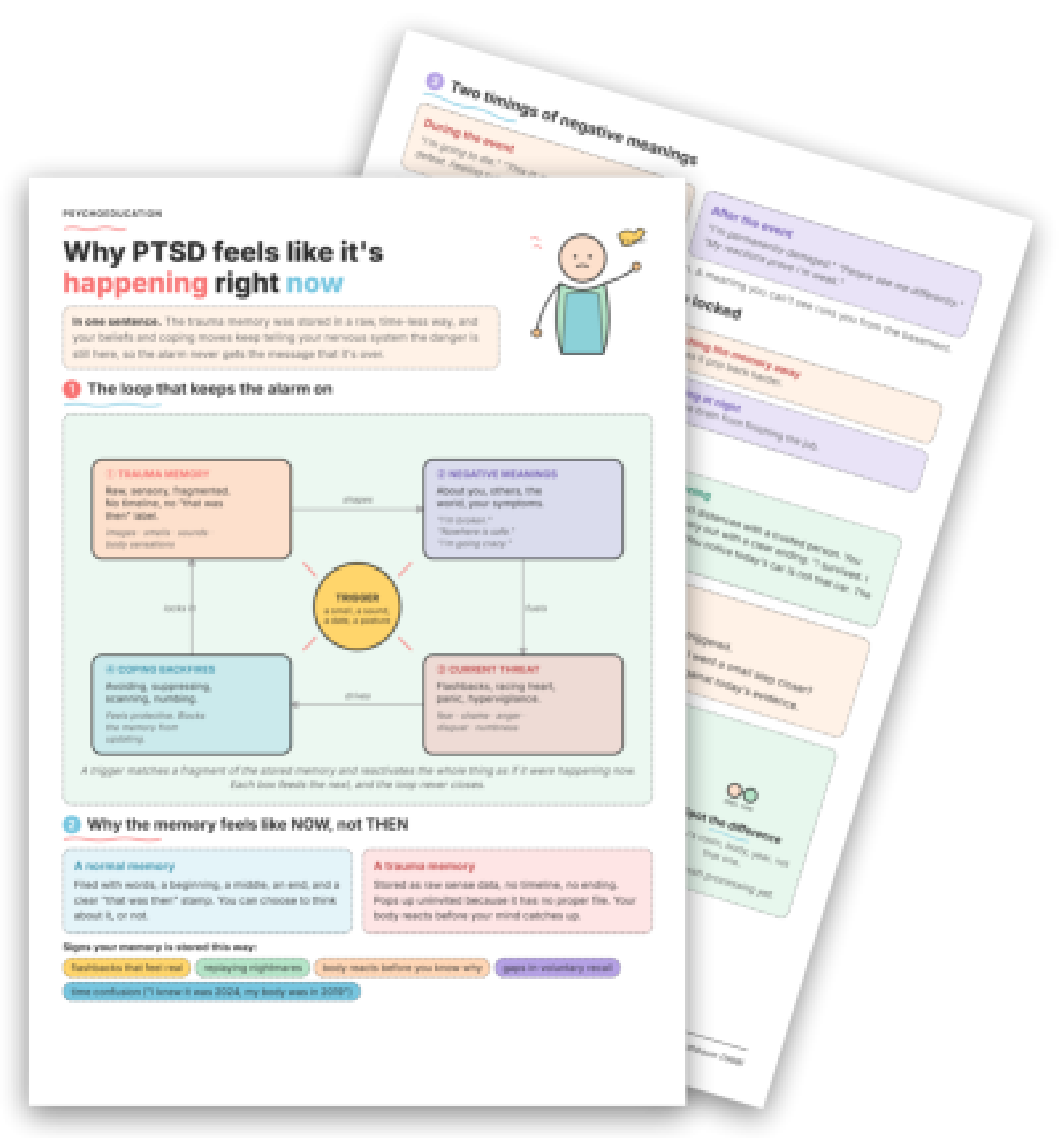
The printable opens with a one-sentence psychoeducation anchor: "The trauma memory was stored in a raw, time-less way, and your beliefs and coping moves keep telling your nervous system the danger is still here." That framing gives patients a conceptual foothold before any diagram appears.
The structural core is a four-box loop covering the model's key nodes: Trauma Memory (raw, sensory, fragmented, no "that was then" timestamp), Negative Meanings (e.g., "I'm broken," "Nowhere is safe"), Current Threat (flashbacks, hypervigilance, somatic arousal), and Coping Backfires (avoidance, suppression, safety scanning). Labelled arrows show how each element shapes, fuels, drives, and locks in the next, allowing patients to trace the loop visually rather than holding four dynamic constructs in working memory at once.
A second panel places a normal memory beside a trauma memory in direct comparison: filed with a timeline and an ending versus stored as raw sense data without closure. Five concrete signs of traumatic encoding follow, including "time confusion: I knew it was 2024, my body was in 2019," which many patients recognise immediately and find deeply normalising. A third panel separates peritraumatic meanings from post-event meanings, a clinically useful distinction when formulating which appraisals to target first. Panel 4 maps each common safety behavior to its maintaining function; panel 5 offers a two-version narrative (loop running versus loop loosening) with behavioral contrasts that can seed conversation about graduated approach work. Three session discussion prompts close the fiche alongside a condensed "Remember" section naming the three therapeutic levers: giving the memory words, updating meanings, and dropping safety moves.
> Key takeaway: This fiche is a visual support that facilitates the in-session explanation of the Ehlers & Clark model. It is not a self-administered questionnaire. The clinician works through it with the patient, panel by panel, leaving them with a concrete reference to consult between appointments.
750+ clinical tools
A library built with and for clinicians, ready to use in session and extend between appointments.
Access all the toolsWhen and how to introduce this resource
The fiche fits naturally in the early psychoeducation phase of trauma-focused CBT, typically sessions two to four, once initial assessment is complete and the alliance is established. It works particularly well with patients who intellectually acknowledge the trauma but are puzzled by symptom persistence, or who carry a fragmented self-generated account of PTSD that needs organising.
You can introduce it with something like: "I'd like to show you a diagram that explains why everything you're experiencing makes complete sense, given what happened." That framing positions the resource as normalising, not diagnostic.
Walk through the loop box by box, pausing at whichever node matches what the patient has been reporting. The session prompts at the end map directly onto challenging anxious thoughts and core belief examination that may follow in later sessions. For patients where avoidance is prominent, the fiche pairs with building an exposure hierarchy, graded exposure self-report tracking, and changing avoidance work. If the patient has completed the PTSD symptom checklist, the loop diagram helps them interpret their own responses in model terms. The Common Reactions to Trauma sheet pairs well in the same session, normalising the breadth of trauma responses before you narrow focus to the model. For critical care survivors, Critical Care and PTSD extends the work usefully. Where comorbid social anxiety is present, the Clark & Wells Model of Social Anxiety and the broader CBT cognitive model overview help patients see how model-based thinking applies across presentations. For maintenance cycles in comorbid conditions, adaptive versus maladaptive coping reinforces the same logic in a different register.
The fiche does not replace case formulation or the relational work of trauma processing. It sharpens the psychoeducation step, and that step, done with precision, meaningfully accelerates readiness for the harder work ahead.
Use it with your patients
Share this tool in the mobile app and follow the work between sessions.
Sources
- National Institute for Health and Care Excellence (NICE) (2018). Post-traumatic stress disorder (NG116).
- Oxford Centre for Anxiety Disorders and Trauma (OxCADAT). Resources for cognitive therapy for PTSD.
Your session continues in your patients' pocket
Use with a patientYour resources, available everywhere
The handouts, exercises, programs and audios above: you choose which ones to make available to your patients, in the mobile app dedicated to them.
And far more than a library
The app goes well beyond resources, to support your patients every day:
Related categories
Explore other clinical resources by category.

Trauma
Clinical hub on trauma and PTSD: assessment, differential diagnosis, treatment phases, and printable resources for practitioners. 155 chars.

Understand
Clinical hub for the therapeutic aim 'Understand': worksheets and tools to build patient insight across CBT, ACT, schema therapy and more.

CBT
CBT worksheets, cognitive restructuring exercises & behavioral tools for clinicians. Evidence-based resources for every phase of cognitive behavioral therapy.

Anxiety
Clinical hub for anxiety disorders: CBT and ACT worksheets, psychoeducation sheets, and exercises for assessment and treatment across the anxiety spectrum.

Mood
Evidence-based worksheets and clinical tools for mood disorders: CBT, ACT, and positive psychology resources for psychologists and therapists.

Identity
Clinical resources for self-identity work in therapy: CBT, ACT, schema tools for clinicians addressing self-concept, core beliefs, and identity disruption.