
Clinical picture. R., a man in his late thirties, presented with panic attacks on public transport and had been avoiding the underground for four months, extending his commute considerably. He described his difficulties as "coming out of nowhere" and felt ashamed that he could not simply stop them. The clinician introduced the friendly formulation worksheet in the third session, filling in each of the five Ps collaboratively: a childhood home where visible distress was discouraged (predisposing), a redundancy notice received two months before the first attack (precipitating), and daily avoidance reinforced by immediate relief (perpetuating). R. noted that seeing the loop drawn out reduced his self-blame; he said it felt less like a character flaw and more like "a pattern that makes sense." This reframe supported his willingness to begin graduated exposure work the following week.
Friendly Formulation: PDF Worksheet, Tools and Exercises
A visual PDF worksheet built on the 5 Ps model to help clinicians explain case formulation, perpetuating loops, and protective factors in session.
Clinical vignettes
Mapping Anxiety With the 5 Ps
Formulation Revisited After Dropout
Clinical picture. M., a woman in her mid-fifties, returned to therapy after leaving a previous course of treatment early; she reported longstanding low mood, social withdrawal, and chronic fatigue that had worsened following her youngest child leaving home. In the intake session she said she had never understood why talking about her past was supposed to help her present symptoms. The clinician used the informational sheet to construct a one-page map together, placing the empty-nest transition as precipitating, a lifelong pattern of self-silencing as predisposing, and rumination combined with reduced activity as the main perpetuating cycle. M. pointed to the protective column almost with surprise, identifying her allotment and a close sibling she had stopped contacting. Having a visible structure appeared to lower her ambivalence; she attended all subsequent sessions and later referred back to the map when setbacks occurred.
Case formulation is the conceptual backbone of most evidence-based therapies, yet explaining it verbally to a patient rarely lands. Patients hear a list of historical factors and a diagnosis, when what they actually need is a map. This fiche PDF is that map: a one-page visual built on the 5 Ps framework (Persons, 2008; Johnstone & Dallos, 2014) that lets you walk the patient through their own story in a structured, non-pathologising way, right in the room.
Use this resource with your patients
Handout, exercises and materials ready to use, right inside SessionFuel.
Why Formulation Resists Oral Explanation
When you sketch a formulation verbally, patients tend to latch on to the precipitating event ("it started when my dad got ill") and miss the architecture underneath. The predisposing factors blur into blame, the perpetuating loops feel abstract, and the protective factors get lost entirely because they come at the end of a long paragraph. Clinically, this matters: the perpetuating layer is where avoidance behaviors and maladaptive coping strategies live, and those are precisely the mechanisms you need the patient to recognise and engage with.
A further complication is that formulation can feel like a verdict. Without the right framing, patients read it as "here is everything wrong with me and why," which activates shame rather than curiosity. A visual layout that explicitly labels protective resources alongside vulnerabilities changes that affective valence before you've said a word.
What the Fiche Contains: A Shared Visual Reference for the Session
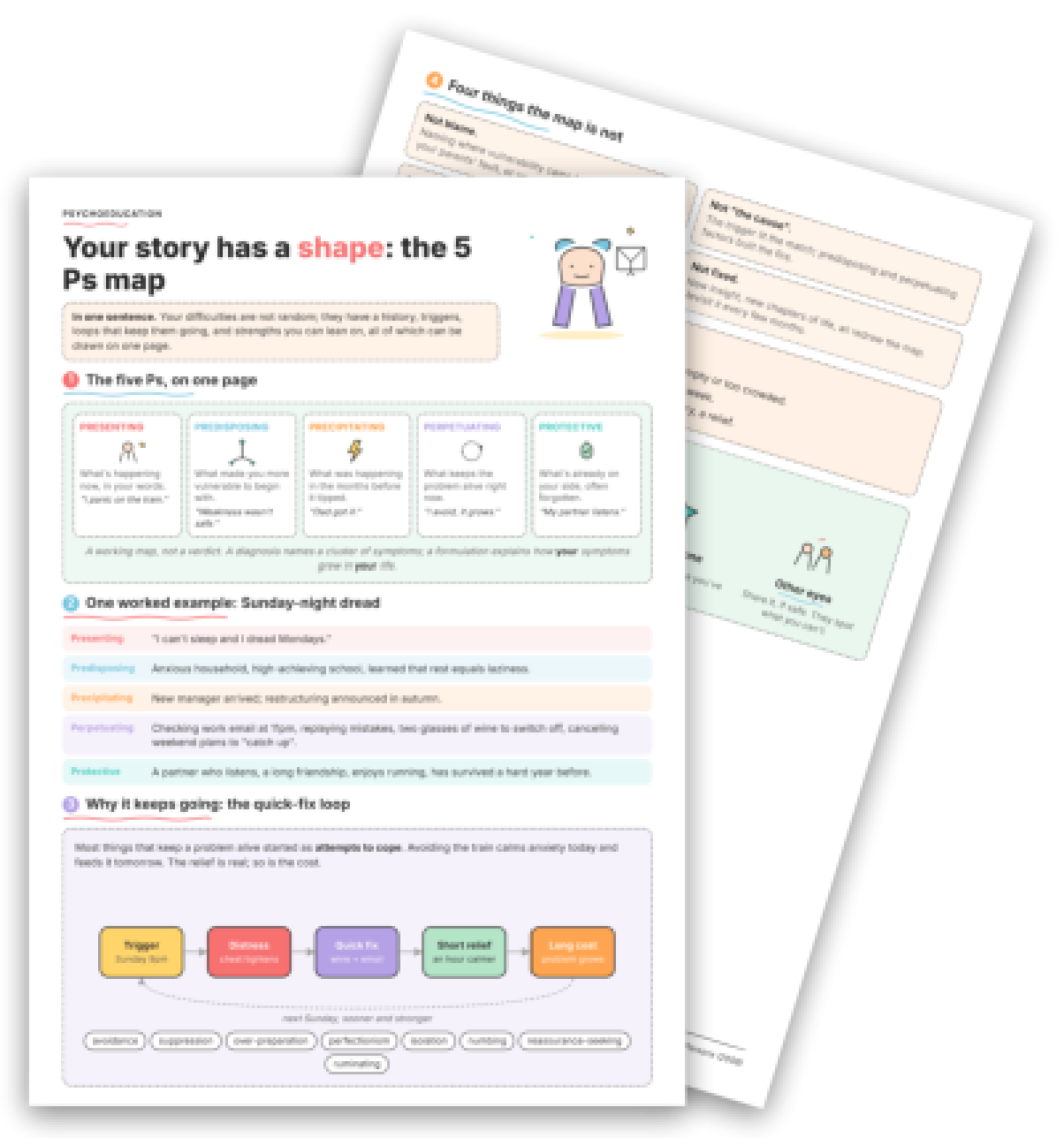
The fiche structures the formulation across four visual panels, all on one page. The first presents the five Ps side by side: Presenting, Predisposing, Precipitating, Perpetuating, Protective, each with a one-line prompt and a verbatim patient example ("I panic on the train"; "Dad got ill"; "I avoid, it grows"). The layout makes the architecture visible at a glance, something no oral walkthrough achieves.
The second panel provides a fully worked example (Sunday-night dread) showing all five boxes populated, so the patient sees immediately what a completed formulation looks like before attempting their own.
The third panel is the clinical centrepiece: a quick-fix loop diagram tracing the path from trigger to distress to quick-fix behavior to short-term relief and long-term cost. Eight maintaining mechanisms are listed explicitly, including avoidance, reassurance-seeking, rumination, and perfectionism. This is the panel that makes the perpetuating factors concrete rather than theoretical, and it maps directly onto cognitive case formulation work you may already be doing.
The fourth panel addresses four common misreadings: "Not blame. Not the cause. Not a footnote. Not fixed." This pre-empts the resistance that often surfaces when patients first see their history laid out in front of them.
> To note: This fiche PDF is not a self-guided questionnaire. It is a visual support designed for use in session, giving you a shared reference to point to, annotate together, and leave with the patient as a working document.
A closing "To discuss in session" block and a "Remember" section (draft in pencil, circle one loop, underline one protective resource) give both clinician and patient concrete next-step anchors.
750+ clinical tools
A library built with and for clinicians, ready to use in session and extend between appointments.
Access all the toolsWhen and How to Propose It
The fiche fits naturally from the second or third session onward, once the anamnèse is complete and you have enough material to begin populating the five boxes together. It works across CBT, schema therapy, and integrative models, and it is particularly useful with patients who intellectualise or who struggle to see the connection between early maladaptive schemas, current triggers, and maintaining behaviors.
Introduce it without clinical labelling: "I'd like to show you a kind of map we can draw together. It won't tell us what's 'wrong' with you; it will show us the shape of what's been happening." Then use the fiche to guide the conversation rather than explain it first. Patients who feel overwhelmed by the predisposing column often relax when you point to the protective box and say, "And this corner is equally real."
Debrief by asking which box felt most surprising, and which loop they'd most want to interrupt. The fiche is explicitly designed to be revisited: the note "Draft in pencil" frames it as a living document rather than a fixed diagnosis. For patients already working with tools for examining core beliefs or behavioral avoidance, the formulation map gives those exercises a coherent structural home.
The fiche does not replace clinical judgment in formulation; it makes the formulation legible to the patient, which is the harder half of the work.
Use it with your patients
Share this tool in the mobile app and follow the work between sessions.
Sources
- Macneil, C. A., Hasty, M. K., Conus, P., & Berk, M. (2012). Is diagnosis enough to guide interventions in mental health? Using case formulation in clinical practice. BMC Medicine.
- Division of Clinical Psychology, British Psychological Society (2011). Good Practice Guidelines on the Use of Psychological Formulation. British Psychological Society.
- Johnstone, L., & Dallos, R. (2013). Formulation in Psychology and Psychotherapy: Making Sense of People's Problems (2nd ed.). Routledge.
Your session continues in your patients' pocket
Use with a patientYour resources, available everywhere
The handouts, exercises, programs and audios above: you choose which ones to make available to your patients, in the mobile app dedicated to them.
And far more than a library
The app goes well beyond resources, to support your patients every day:
Related categories
Explore other clinical resources by category.

Anxiety
Clinical hub for anxiety disorders: CBT and ACT worksheets, psychoeducation sheets, and exercises for assessment and treatment across the anxiety spectrum.

Trauma
Clinical hub on trauma and PTSD: assessment, differential diagnosis, treatment phases, and printable resources for practitioners. 155 chars.

Mood
Evidence-based worksheets and clinical tools for mood disorders: CBT, ACT, and positive psychology resources for psychologists and therapists.

Identity
Clinical resources for self-identity work in therapy: CBT, ACT, schema tools for clinicians addressing self-concept, core beliefs, and identity disruption.

Understand
Clinical hub for the therapeutic aim 'Understand': worksheets and tools to build patient insight across CBT, ACT, schema therapy and more.

Build awareness
Clinical worksheets and tools to build awareness in therapy: cognitive distortions, schemas, emotions, ACT and CBT resources for practitioners.