
Clinical picture. T., a man in his late thirties, presents with longstanding social anxiety and a pattern of systematically declining invitations to group meals, which he recognises as increasingly restrictive. In the first lesson of the program, he is asked to identify situations he finds uncomfortable and to describe the strategies he uses to sidestep them. He lists avoiding shared lunches at work and always sitting near exits in public spaces, noting that these habits feel automatic and that he rarely questions them. Reviewing the lesson's vicious-cycle framework between sessions, he begins to articulate how each avoidance episode reinforces his conviction that the situation is unmanageable. At the following appointment, he arrives with a written reflection on what his daily life might look like without these constraints, which opens a productive conversation about graded exposure.
Automatic Behaviors: A Psychoeducation Program for Avoidance, Checking, and Control
A structured 4-lesson program helping patients understand and dismantle the avoidance, checking, and control cycles that keep their distress alive.

Clinical vignettes
Mapping Avoidance in Social Anxiety
Reassurance-Seeking as a Learned Pattern
Clinical picture. M., a woman in her mid-forties referred for health anxiety, describes spending significant time each day checking her pulse and seeking verbal reassurance from family members after any perceived physical symptom. Working through the first lesson independently, she selects "I feel imprisoned by my behaviours" and "it is getting worse" when prompted to reflect on her motivations for change. The lesson's explanation of how short-term relief perpetually lowers the threshold for distress resonates with her own observation that the checking rituals have become more frequent over two years. She completes the open-ended prompt about her life without these automatic behaviours and shares her response with the clinician, who uses it to collaboratively set concrete goals for the subsequent lessons.
Use this resource with your patients
Handout, exercises and materials ready to use, right inside SessionFuel.
The clinical challenge: what words alone rarely fix
Automatic behaviors are among the most frustrating targets in CBT and ACT-informed work. Patients readily agree they check too much, avoid too reliably, or control too tightly. They understand it in the room. And then the week unfolds exactly as before. The gap is not insight; it is the failure of insight to transfer into daily life, where the behavior is fast, familiar, and instantly rewarding. Explaining the cycle of avoidance or the checking-doubt loop in a single consultation can land well conceptually, but the patient walks out into a world that keeps triggering the same automatic sequences.
What resists a purely verbal intervention is the reinforcement structure of these behaviors: each one delivers rapid relief, stamping itself in more firmly every time. To shift that, patients need repeated, structured contact with the mechanism, spread across days, not just across explanations.
750+ clinical tools
A library built with and for clinicians, ready to use in session and extend between appointments.
Access all the toolsWhat this program contains
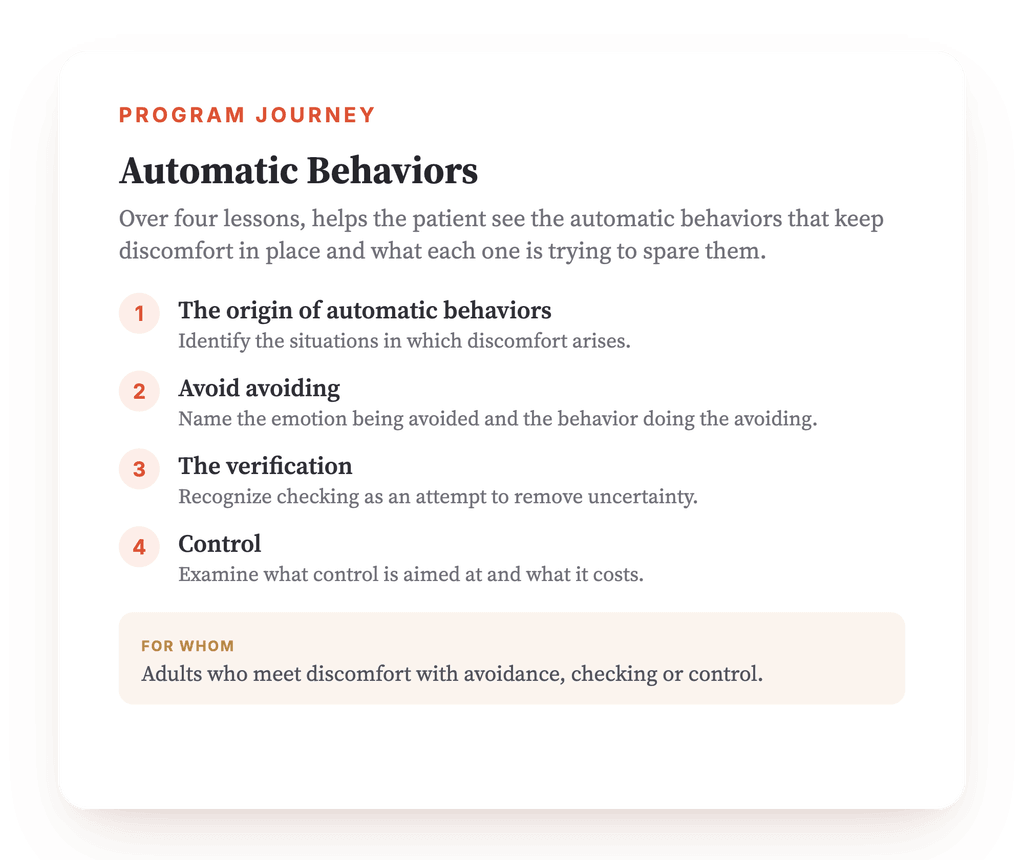
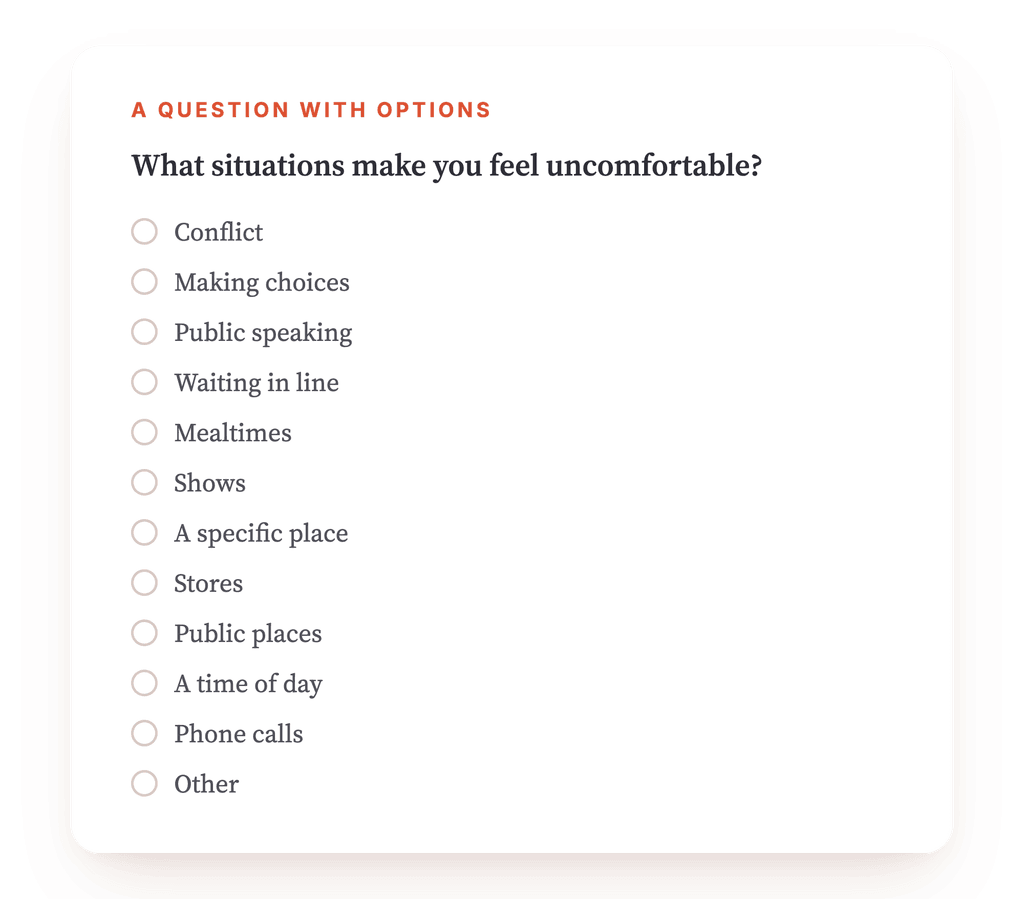
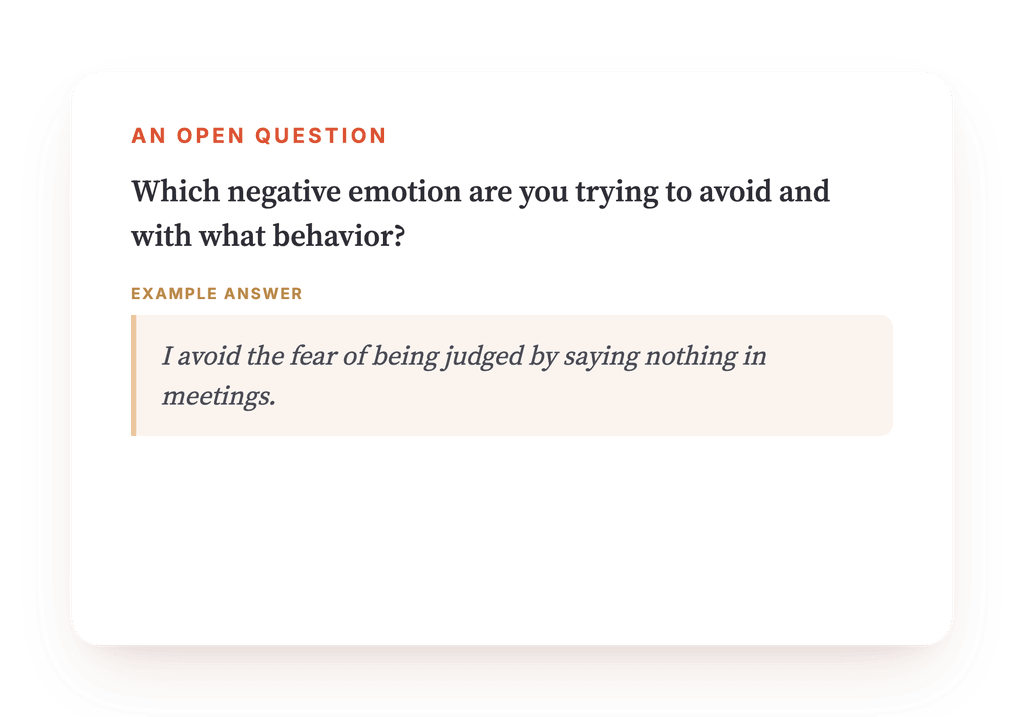
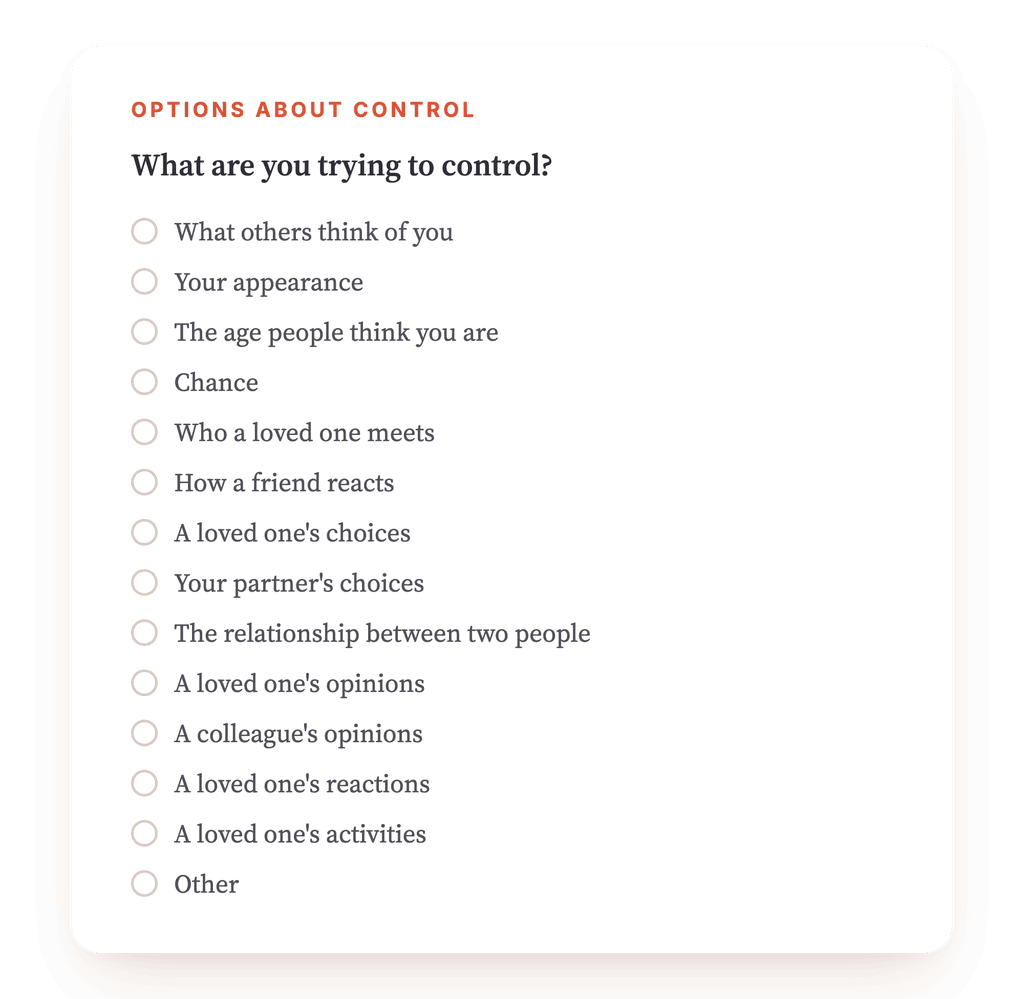
This four-lesson psychoeducation program moves step by step through the architecture of automatic behaviors. The preview images embedded here show only a small aperçu of the program: these few excerpt cards represent a fraction of the lessons, steps, guided prompts, and multiple-choice reflection questions that make up the complete curriculum.
Lesson 1 traces the developmental origins of automatic behaviors, walking patients through how avoidance-based responses form around uncomfortable internal experiences and gradually harden into defaults. Patients reflect on which situations trigger discomfort and why they started managing them the way they did, a foundation that mirrors operant conditioning principles made personally legible.
Lesson 2 targets avoidance specifically, the most pervasive and the most vicious loop. Patients identify their own avoidance repertoire, examine how each behavior maps onto a feared emotion, and begin selecting one pattern to drop first. The lesson introduces the idea of acting in line with values rather than in the service of relief, a move that connects naturally with adaptive versus maladaptive coping work.
Lesson 3 focuses on checking and the intolerance of uncertainty. The lesson makes the reward cycle of doubt visible and proposes concrete behavioral challenges to practise sitting with unresolved questions, directly complementing structured work on embracing uncertainty and intolerance of uncertainty.
Lesson 4 addresses control behaviors, including the urge to manage others' choices, reactions, and opinions. Patients sort what genuinely lies within their sphere of influence from what does not, using the same logic as the control, influence, accept framework, and examine the relational costs of compulsive control.
Key insight: The program works because it separates understanding from practice. Each lesson ends with a personal prompt that roots the psychoeducation in the patient's own behavior, making the mechanism concrete before the next consultation.
Use it with your patients
Share this tool in the mobile app and follow the work between sessions.
How to use it as between-session homework
Assign this program after you have introduced the maintenance loop of whichever automatic behavior is most clinically pressing, whether that is the confronting avoidance work already underway, a checking ritual that overlaps with OCD compulsion patterns, or control behaviors straining a relationship. The program is designed for patient-led, autonomous work: each lesson is completed independently between two consultations, at the patient's pace, on their own device.
This program is available to patients through the mobile application that is the dedicated patient-side interface of SessionFuel: the clinician assigns it directly, and the patient then works through each lesson autonomously on their phone between appointments.
Suitable profiles include patients with health anxiety, social anxiety, GAD, OCD-spectrum presentations, and relationship difficulties driven by reassurance-seeking or controlling patterns. It also suits patients who intellectually understand their avoidance but need structured, repeated prompting to engage differently with it, a profile where changing avoidance tools alone do not hold.
Introducing it is straightforward: frame the program as a way to keep the work going between consultations rather than starting from scratch each time. Position each lesson as a step in a longer process, not a standalone reading.
When the patient returns, their written responses to the guided prompts become direct clinical material: which emotions they are still avoiding and with which behavior, which checking ritual they would tackle first, and what they fear would happen if they released control. That raw material shortens the review phase and lets you move quickly into exposure planning, including graded work supported by the Practicing Exposure Therapy program, or targeted work on safety behaviors that prop the automatic cycle up.
The program does not replace the formulation conversation. It deepens and extends it, one lesson at a time, across the week.
Your session continues in your patients' pocket
Use with a patientYour resources, available everywhere
The handouts, exercises, programs and audios above: you choose which ones to make available to your patients, in the mobile app dedicated to them.
And far more than a library
The app goes well beyond resources, to support your patients every day:
Related categories
Explore other clinical resources by category.

Anxiety
Clinical hub for anxiety disorders: CBT and ACT worksheets, psychoeducation sheets, and exercises for assessment and treatment across the anxiety spectrum.

Trauma
Clinical hub on trauma and PTSD: assessment, differential diagnosis, treatment phases, and printable resources for practitioners. 155 chars.

Mood
Evidence-based worksheets and clinical tools for mood disorders: CBT, ACT, and positive psychology resources for psychologists and therapists.

Identity
Clinical resources for self-identity work in therapy: CBT, ACT, schema tools for clinicians addressing self-concept, core beliefs, and identity disruption.

Emotions
Clinical resources on emotion regulation: worksheets, coping tools, CBT, REBT, and ACT exercises for therapists working across diagnoses and age groups.

Behaviours
Clinical hub for behaviors in therapy: worksheets and tools for coping, eating disorders, CBT formulation, and maladaptive behavioral patterns.