
Clinical picture. M., a woman in her late thirties, presented with chronic insomnia, recurrent somatic pain without identified organic cause, and a persistent low mood she described as "just how I am." She had not connected these difficulties to a period of prolonged workplace harassment that had ended four years prior, partly because, as she put it, "nothing physically happened to me." The clinician introduced the psychoeducation sheet mid-session, focusing on the distinction between event and nervous system response, and on the six factors that intensify a traumatic mark, noting that prolonged exposure and a sense of helplessness were both present in her history. M. paused at the self-blame item and said quietly that she had spent years wondering why she could not simply move on. By the following session she returned with the sheet annotated, and reported that having a vocabulary for her experience had reduced, at least partially, the secondary layer of shame she carried about her own symptoms.
Trauma: PDF Worksheet, Tools and Exercises for Clinical Practice
A printable PDF worksheet with psychoeducation tools and exercises to make the trauma response tangible in session and leave patients with a durable conceptual map.
Clinical vignettes
Naming the Echo, Not the Event
Reframing Irritability as a Protective Reflex
Clinical picture. T., a man in his mid-forties referred for anger management after incidents at work, arrived skeptical and described himself as someone who "just has a short fuse." During the assessment it emerged that he had witnessed repeated domestic violence in childhood and had experienced two road traffic accidents in adulthood. The clinician offered the informational sheet not as an assignment but as a shared reading exercise within the session, drawing attention to the section on exaggerated startle and irritability framed as protective reflexes that had overstayed their welcome. T. visibly relaxed when the text reframed his reactivity as a nervous system that had stayed on guard rather than a character flaw. This reframe did not resolve the presenting difficulties, but it shifted his posture toward treatment: he agreed to return for a structured trauma-focused assessment, which he had previously declined.
Reframing trauma from event to nervous system response is the conceptual move most patients need early in treatment, and it rarely lands cleanly through oral explanation alone. This fiche PDF provides a structured visual support to make that shift during the session itself, giving the patient something to look at, refer back to, and take home.
Use this resource with your patients
Handout, exercises and materials ready to use, right inside SessionFuel.
Why the Trauma Response Is Hard to Explain Verbally
The dominant lay model is event-based: if the precipitating event doesn't cross some internal severity threshold ("others had it much worse"), the patient dismisses their own symptoms as unjustified or evidence of weakness. Oral psychoeducation helps, but the self-dismissal tends to reassert itself between sessions, because the patient has no durable image to anchor the reframe.
A second friction point is symptom recognition. Presentations built on chronic irritability, medically unexplained somatic pain, or persistent sleep disruption rarely read as trauma-related to the patient. They are looking for a discrete fear memory, and when they can't find one, they conclude they are simply "not coping." The connection between the original nervous system response and its later disguise is genuinely difficult to convey without something visible. This is where a psychoeducation tool used in session, rather than assigned as a handout, earns its clinical place.
What the Fiche Contains: A Four-Panel Visual Map
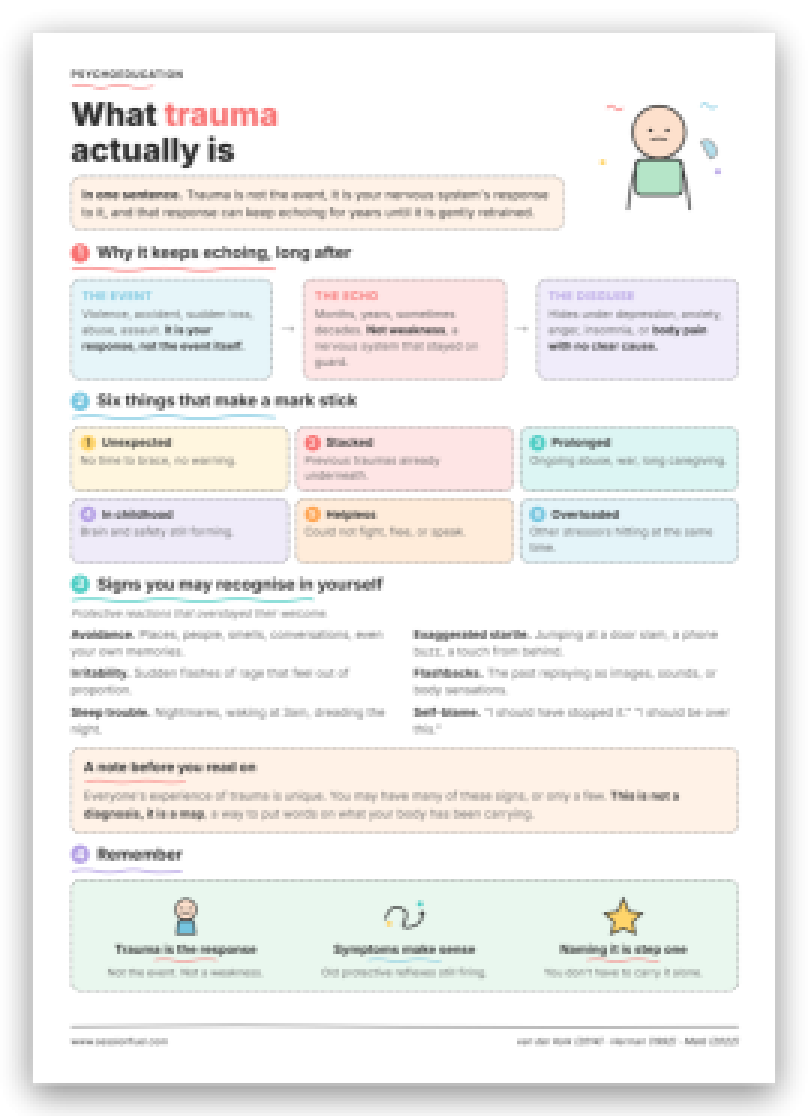
The fiche opens with a single orienting sentence: "Trauma is not the event, it is your nervous system's response to it, and that response can keep echoing for years until it is gently retrained." That sentence alone tends to do more in ten seconds than several paragraphs of explanation, because it names the mechanism and removes the moral charge in one move.
From there, four numbered sections build the map:
- The echo sequence: a three-stage visual chain (Event → Echo → Disguise) showing how an acute stress response can persist as depression, anxiety, anger, insomnia, or somatic pain long after the original threat is gone. The spatial layout makes the maintenance logic legible in a way prose rarely achieves.
- Six vulnerability factors: unexpected, stacked, prolonged, in childhood, helpless, overloaded. Short enough to scan, specific enough to generate recognition. The item "stacked: previous traumas already underneath" is particularly useful for patients presenting with cumulative exposure who have never organised their history that way.
- Six common signs: avoidance, exaggerated startle, irritability, flashbacks, sleep disruption, and self-blame, each framed explicitly as "protective reactions that overstayed their welcome." Framing is everything here: the fiche does the normalisation work visually, not through the clinician's words alone.
- Three closing anchors: trauma is the response, symptoms make sense, naming it is step one.
> Key takeaway: this fiche PDF is a visual support that facilitates the psychoeducation of trauma in session, not a patient self-assessment. You lead the patient through it in real time, using the layout to structure the conversation and leave a concrete reference behind.
The echo sequence pairs naturally with the Fight-Flight-Freeze Response fiche and the Autonomic Nervous System worksheet for patients who want to understand the physiological substrate. The How Your Body Responds to Stress tool deepens the somatic side of what the map introduces.
750+ clinical tools
A library built with and for clinicians, ready to use in session and extend between appointments.
Access all the toolsWhen and How to Introduce the Fiche
This resource sits most comfortably in the early psychoeducation phase, after the initial anamnèse and once a working alliance is established. It is not a first-session intake instrument.
A low-threshold introduction: "I'd like to show you a diagram that often helps people make sense of what's been happening. Have a look at this with me." The word "sense" signals that what follows is a frame, not a verdict.
Spend the most time on the echo sequence and the vulnerability factors. For patients who minimise ("it wasn't that bad"), the vulnerability items stacked and helpless are where recognition tends to surface. For those entrenched in self-blame, the closing anchors function as explicit counter-statements worth reading aloud together.
After the session, the fiche serves as a reference the patient can return to. Pair it with Common Reactions to Trauma for a fuller symptom map, with Properties of Trauma Memories when memory fragmentation is clinically central, and with the Ehlers & Clark PTSD Model when moving into a structured trauma-focused protocol.
For presentations of repeated or developmental trauma, the Complex PTSD fiche and the How Your Past Affects Your Present worksheet extend the conversation naturally. When EMDR is part of the plan, the EMDR Negative and Positive Cognitions resource builds directly on the self-blame and helplessness themes the fiche introduces. A full treatment roadmap can then be offered through the PTSD Therapy Blueprint or the Understanding PTSD worksheet.
The fiche does not substitute for case formulation or trauma processing work. What it does is give the patient an accurate, durable map at the moment they most need one: before they have understood why they are struggling.
Use it with your patients
Share this tool in the mobile app and follow the work between sessions.
Sources
- Herman, J. L. (1992). Trauma and Recovery: The Aftermath of Violence from Domestic Abuse to Political Terror. Basic Books.
- van der Kolk, B. A. (2014). The Body Keeps the Score: Brain, Mind, and Body in the Healing of Trauma. Viking Penguin.
- Mate, G., Mate, D. (2022). The Myth of Normal: Trauma, Illness, and Healing in a Toxic Culture. Avery.
Your session continues in your patients' pocket
Use with a patientYour resources, available everywhere
The handouts, exercises, programs and audios above: you choose which ones to make available to your patients, in the mobile app dedicated to them.
And far more than a library
The app goes well beyond resources, to support your patients every day:
Related categories
Explore other clinical resources by category.

Trauma
Clinical hub on trauma and PTSD: assessment, differential diagnosis, treatment phases, and printable resources for practitioners. 155 chars.

Understand
Clinical hub for the therapeutic aim 'Understand': worksheets and tools to build patient insight across CBT, ACT, schema therapy and more.

CBT
CBT worksheets, cognitive restructuring exercises & behavioral tools for clinicians. Evidence-based resources for every phase of cognitive behavioral therapy.

EMDR
Clinical hub for EMDR therapy resources: worksheets, stabilisation tools, and guided audio for all 8 phases of trauma reprocessing. For trained clinicians.

Anxiety
Clinical hub for anxiety disorders: CBT and ACT worksheets, psychoeducation sheets, and exercises for assessment and treatment across the anxiety spectrum.

Mood
Evidence-based worksheets and clinical tools for mood disorders: CBT, ACT, and positive psychology resources for psychologists and therapists.