
Clinical picture. M., a man in his late thirties, presented eight months after a road traffic collision with hypervigilance, sleep disruption, and a firm belief that he was "going soft" for still being affected. In the first psychoeducation session, the clinician walked through the PTSD maintenance loop, pointing to how the memory had been stored as fragments rather than as a finished narrative, and how M.'s systematic avoidance of motorways was preventing that narrative from closing. M. sat quietly for a moment, then said the diagram looked "exactly like what happens in my head." He did not reframe his symptoms as weakness by the session's end, but he agreed to return, which he had not been willing to do previously.
Understanding PTSD: PDF Worksheet, Tools and Exercises
A visual psychoeducation tool helping clinicians explain the PTSD maintenance loop, raw memory storage, and the role of avoidance in keeping symptoms alive.
Clinical vignettes
Naming the Loop, Not the Weakness
Beliefs Formed at the Worst Moment
Clinical picture. T., a woman in her mid-forties, was referred following a traumatic delivery three years prior; she reported intrusive images, emotional numbing, and a persistent conviction that she had failed as a mother by "not coping" during the birth. The clinician used the informational sheet to distinguish between memories stored as raw sensory fragments and the hot beliefs drawn at the moment of greatest fear, naming "I'm damaged" and "I have no future" as conclusions formed under terror rather than as facts. T. recognised her own self-blame in the belief list and noted, unprompted, that she would not apply that standard to another woman in the same situation. This small shift in perspective opened space for further work on the belief content, without the clinician needing to challenge it directly.
Explaining PTSD to a patient who believes they are broken, weak, or losing their mind is one of the more delicate psychoeducation moments in trauma work. This PDF worksheet gives you a ready-made visual support to reframe that narrative in the early sessions, without relying on a verbal explanation that most patients do not retain past the waiting room.
Use this resource with your patients
Handout, exercises and materials ready to use, right inside SessionFuel.
Why the PTSD maintenance loop resists verbal explanation
The central difficulty is not vocabulary. It is the counterintuitive mechanics of why symptoms persist. Patients understand PTSD emotionally before they understand it mechanistically, and what they almost universally miss is this: the memory was never processed to completion, so the nervous system cannot register that the threat is over.
Explaining the maintenance loop orally leaves patients nodding without really internalising it. The interaction between fragmented intrusive memories, the hot beliefs formed at the worst moment, and the avoidance that prevents both from being updated is a three-way system. It requires a diagram. The same applies to the then-vs-now confusion at the heart of the Ehlers and Clark model: a door slam is not the original event, but without that distinction made visible and explicitly named, patients cannot begin to use it clinically.
A checklist of PTSD symptoms can establish what is present. This fiche explains why those symptoms keep recurring.
Clinical library
750+ clinical tools
A library built with and for clinicians, ready to use in session and extend between appointments.
Access all the toolsSeveral resource types
Psychoeducation handouts
Understand at a glance
Interactive exercises
To do and fill in
Interactive programs
A structured path
Audios
Meditation and relaxation
Psychometric tests
Automatic scoring
What the fiche contains: five panels built around one loop
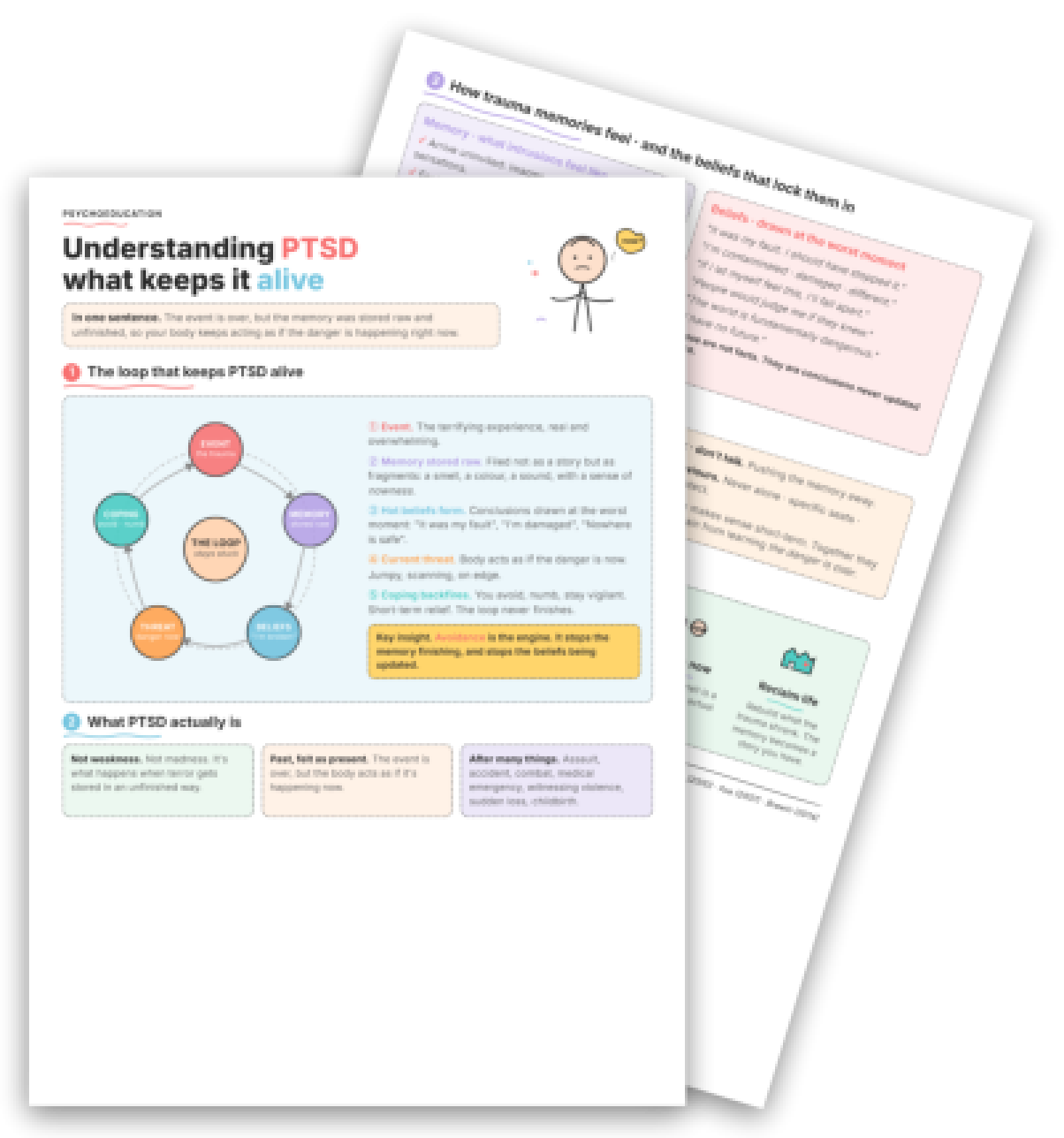
The fiche opens with a single-sentence formulation worth reading aloud at the start of the psychoeducation: "The event is over, but the memory was stored raw and unfinished, so your body keeps acting as if the danger is happening right now." That sentence alone often produces more clinical recognition than ten minutes of spoken explanation.
The visual centrepiece is the maintenance loop: a circular diagram linking the original event, raw memory storage, hot beliefs ("I'm broken", "It was my fault"), current threat perception, and the coping responses that short-circuit the cycle. Each step is numbered and annotated on the printed page, making the logic scannable in one glance. The fiche states the key clinical insight explicitly: "Avoidance is the engine. It stops the memory finishing, and stops the beliefs being updated." That framing is useful for debrief: it relocates the problem from character to mechanism.
Panel 3 lists what intrusions feel like (arriving uninvited, feeling present-tense rather than past-tense, fragmented into a colour or a smell, triggered by tiny contextual cues) alongside the beliefs drawn at the worst moment ("The world is fundamentally dangerous", "I have no future"), explicitly labelled as conclusions never updated since. This distinction between sensory re-experiencing and frozen belief is exactly what the Ehlers and Clark PTSD cognitive model centres on; the fiche renders it visually accessible without requiring theoretical language from the patient.
Panel 4 maps the coping behaviours that maintain the problem: situational avoidance, thought suppression, hypervigilance, safety behaviours, and numbing. Panel 5 outlines five directions of change: memory processing, belief updating, reducing avoidance, then-vs-now discrimination, and life reclamation. The properties of trauma memories resource and the work on stimulus discrimination extend panel 5 for patients who need more scaffolding on those specific points.
> Key point: this fiche is a visual support that facilitates in-session explanation, not a self-administered questionnaire. You walk through it with the patient, use the loop diagram to build a shared language, and leave them with a concrete reference to consult between appointments.
Use it with your patients
Share this tool in the mobile app and follow the work between sessions.
When and how to introduce it in session
The fiche fits naturally after the initial assessment, once a working formulation is in place and before active trauma processing begins, typically in the second or third session when the patient is asking "why is this still happening to me?" rather than simply listing symptoms.
For patients carrying significant shame or self-blame, introduce it explicitly: "I want to show you a diagram that explains why these reactions make complete sense, given what happened to your nervous system." This framing is especially important before EMDR work or trauma-focused exposure protocols, where patients need to understand avoidance as a clinical target, not a personal failing.
Debrief by asking which step in the loop feels most recognisable, which beliefs from panel 3 fit, and which coping strategies from panel 4 they rely on most. The PTSD linen cupboard metaphor can complement the loop diagram for patients who respond better to narrative framing. For complex presentations meeting criteria for complex PTSD, or for patients whose trauma occurred in a medical context, the critical care and PTSD resource addresses specific maintenance processes not covered here. When working with families or younger patients, how trauma affects children and young people extends the same logic developmentally.
The fiche does not replace the case formulation or the therapeutic relationship. It makes the explanation more precise, saves session time, and gives the patient a shared vocabulary for the work ahead.
Patient mobile app
Your session continues in your patients' pocket
Use with a patientYour resources, available everywhere
The handouts, exercises, programs and audios above: you choose which ones to make available to your patients, in the mobile app dedicated to them.
Psychoeducation handoutsInteractive exercisesInteractive programsAudiosPsychometric tests
And far more than a library
The app goes well beyond resources, to support your patients every day:
Standardized tests
Therapy journal
Gamification
Wellbeing challenges
Introspection prompts
Therapist homework
Related categories
Explore other clinical resources by category.

Trauma
Clinical hub on trauma and PTSD: assessment, differential diagnosis, treatment phases, and printable resources for practitioners. 155 chars.

Understand
Clinical hub for the therapeutic aim 'Understand': worksheets and tools to build patient insight across CBT, ACT, schema therapy and more.

CBT
CBT worksheets, cognitive restructuring exercises & behavioral tools for clinicians. Evidence-based resources for every phase of cognitive behavioral therapy.

Anxiety
Clinical hub for anxiety disorders: CBT and ACT worksheets, psychoeducation sheets, and exercises for assessment and treatment across the anxiety spectrum.

Mood
Evidence-based worksheets and clinical tools for mood disorders: CBT, ACT, and positive psychology resources for psychologists and therapists.

Identity
Clinical resources for self-identity work in therapy: CBT, ACT, schema tools for clinicians addressing self-concept, core beliefs, and identity disruption.