
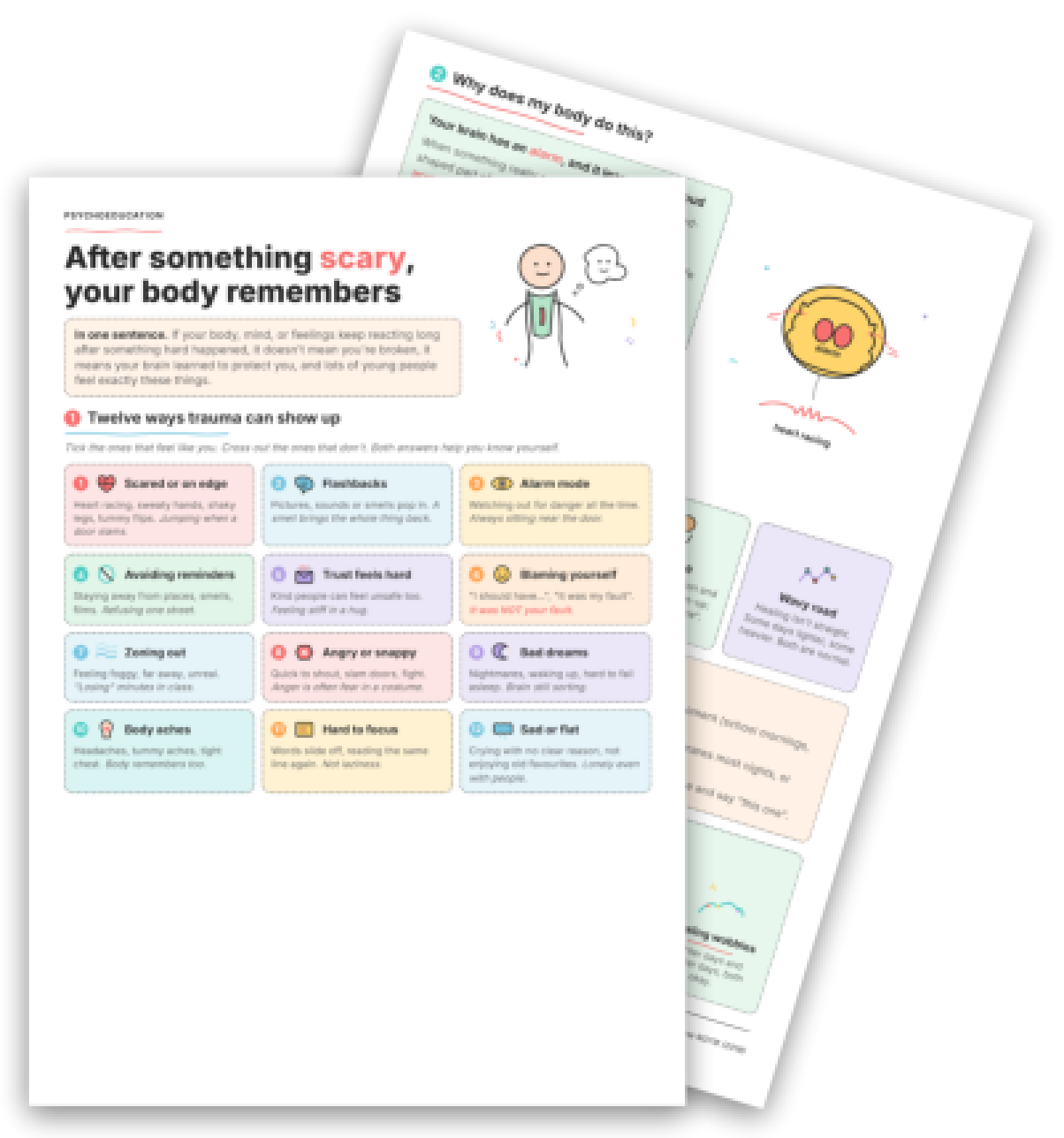
Clinical picture. J., 14, was referred following a road traffic collision eight months prior. His parents described deteriorating school attendance and frequent stomach aches with no medical cause identified. In the first psychoeducation session, the clinician introduced the informational sheet and invited J. to work through the twelve symptom descriptors at his own pace, ticking or crossing each one. J. marked six items, pausing longest at body aches and hard to focus, and commented that he had assumed the stomach aches meant something was physically wrong with him. Reframing these as recognised trauma responses appeared to reduce his self-blame noticeably, and he agreed to bring the sheet back annotated for the following session.
How Trauma Can Affect Children and Young People: PDF Worksheet, Tools and Exercises
A psychoeducation fiche PDF with tools and exercises to help clinicians explain trauma reactions to children and young people in plain, body-anchored language.
Clinical vignettes
Naming Body Signals in an Adolescent
Psychoeducation With a Younger Child and Caregiver
Clinical picture. M., 9, had witnessed domestic violence in the home and was presenting with frequent nightmares, clingy behaviour, and a marked startle response to raised voices. The clinician used the sheet jointly with M. and her foster carer, reading each item aloud and letting M. point rather than write. When the amygdala explanation was introduced using the sheet's alarm analogy, M. said her brain felt like a smoke detector that kept going off when there was no fire, which the clinician noted as a useful personal metaphor to return to in subsequent sessions. The carer reported that having a shared vocabulary helped her respond with less anxiety when M. became distressed at home.
Explaining trauma reactions to a child or adolescent without a visual support tends to produce polite nodding rather than genuine recognition. This fiche PDF gives clinicians a single-page psychoeducation tool calibrated to children and young people (CYP), naming twelve common reactions in age-appropriate, body-grounded language and offering the neuroscience behind them without jargon.
Use this resource with your patients
Handout, exercises and materials ready to use, right inside SessionFuel.
Why Trauma Reactions Resist Oral Explanation With Young People
The core clinical difficulty is one of reattribution. The child who is hypervigilant, irritable, or dissociating has usually already constructed a self-narrative in which those reactions mean something is broken in them, not that their nervous system learned to protect them. An oral explanation rarely dislodges that narrative, because abstract concepts such as hyperarousal, intrusion, or amygdala dysregulation have no referent a ten-year-old can hold.
The problem is compounded when the referral describes secondary features rather than trauma per se: poor concentration, somatic complaints, social withdrawal, sudden anger. Without a shared vocabulary, the child cannot connect those symptoms to their experience, and neither can the caregiver sitting next to them. The fiche solves both problems at once, by making the full footprint of trauma, somatic, cognitive, behavioural, and relational, visible on a single page.
Clinical library
750+ clinical tools
A library built with and for clinicians, ready to use in session and extend between appointments.
Access all the toolsSeveral resource types
Psychoeducation handouts
Understand at a glance
Interactive exercises
To do and fill in
Interactive programs
A structured path
Audios
Meditation and relaxation
Psychometric tests
Automatic scoring
What the Fiche Contains: A Visual Map of Twelve Trauma Reactions
The resource is structured in three panels. The first, titled Twelve ways trauma can show up, lists twelve named reactions paired with concrete sensory descriptions: "Heart racing, sweaty hands, shaky legs" for being scared or on edge; "A smell brings the whole thing back" for flashbacks; "Anger is often fear in a costume" for irritability. The tick/cross format invites active participation without requiring narrative disclosure. A child can point to a box on the page without speaking about what happened, which substantially lowers the threshold for engagement. For clinicians building a PTSD symptom picture or mapping common reactions to trauma, the checklist doubles as an informal clinical inventory.
The second panel explains the amygdala in one paragraph, using an alarm metaphor: the brain's alarm "learned to be loud" to protect the child, and afterwards "stays sensitive", triggering on cues even when safety is present. This framing is consistent with the Ehlers and Clark model and lays the conceptual groundwork for later fight-flight-freeze psychoeducation or, with younger children, the simpler fight-or-flight explanation designed for children. It also connects directly to autonomic nervous system work, should you move toward a somatic regulation focus.
The third panel offers four micro-strategies (naming the reaction, ticking the fiche, showing one box to a trusted adult, accepting non-linear recovery) and a set of explicit safety prompts, including nightmares most nights and thoughts of self-harm, framed as cues to "tell someone today".
> Key point: The fiche is a visual support that facilitates the explanation in session: the clinician leads, using the panels as a shared referent, and the sheet stays with the young person as a concrete anchor between appointments. It is not a self-administered questionnaire.
Use it with your patients
Share this tool in the mobile app and follow the work between sessions.
When and How to Introduce the Fiche in Trauma Work
This resource is best introduced once a basic working alliance is established, typically in the second or third appointment, after rapport work and an initial anamnèse. It is particularly well-suited when:
- The child is pre-verbal about the trauma but presents somatic or behavioural sequelae a caregiver cannot make sense of
- Concentration problems, sleep disruption, or irritability have been flagged without a trauma formulation being in place yet
- EMDR preparation is underway: the twelve reactions give the young person a ready vocabulary before you move into EMDR negative and positive cognitions work
Introduce it plainly: "Here's a sheet that lists some things young people sometimes notice after something hard has happened. Can you look through and tick the ones that feel like you?" Then debrief item by item. Pay particular attention to item 6 (self-blame), which frequently carries strong affect and where the fiche's direct message, "It was NOT your fault", does useful therapeutic work before you name it explicitly.
The fiche integrates naturally with 50 coping strategies for children and adolescents, grounding techniques, and belly breathing exercises for kids. For caregiver sessions, it pairs with the Anxiety in Children and Adolescents parent programme and the Depression in Children and Adolescents parent programme. With younger children, use it alongside emotion thermometers to build the affective vocabulary the fiche assumes.
The "healing wobbles" framing in the final Remember panel is worth discussing explicitly with both child and caregiver. It pre-empts the discouragement that follows a difficult week and keeps the therapeutic alliance intact through the non-linear course that trauma recovery almost always takes.
Patient mobile app
Your session continues in your patients' pocket
Use with a patientYour resources, available everywhere
The handouts, exercises, programs and audios above: you choose which ones to make available to your patients, in the mobile app dedicated to them.
Psychoeducation handoutsInteractive exercisesInteractive programsAudiosPsychometric tests
And far more than a library
The app goes well beyond resources, to support your patients every day:
Standardized tests
Therapy journal
Gamification
Wellbeing challenges
Introspection prompts
Therapist homework
Related categories
Explore other clinical resources by category.
Trauma
Clinical hub on trauma and PTSD: assessment, differential diagnosis, treatment phases, and printable resources for practitioners. 155 chars.

Understand
Clinical hub for the therapeutic aim 'Understand': worksheets and tools to build patient insight across CBT, ACT, schema therapy and more.

Build awareness
Clinical worksheets and tools to build awareness in therapy: cognitive distortions, schemas, emotions, ACT and CBT resources for practitioners.
CBT
CBT worksheets, cognitive restructuring exercises & behavioral tools for clinicians. Evidence-based resources for every phase of cognitive behavioral therapy.
Anxiety
Clinical hub for anxiety disorders: CBT and ACT worksheets, psychoeducation sheets, and exercises for assessment and treatment across the anxiety spectrum.
Mood
Evidence-based worksheets and clinical tools for mood disorders: CBT, ACT, and positive psychology resources for psychologists and therapists.