
Clinical picture. T., a 6-year-old referred for separation anxiety, presented with daily distress at school drop-off: rapid shallow breathing, tearfulness, and clinging behaviour that lasted well past the parent's departure. The clinician introduced the belly-breathing worksheet during a parent-child session, using the teddy-bear variation so T. could watch a small stuffed animal rise and fall on her abdomen. The parent was coached to run one brief practice round each morning at home before leaving, rather than waiting until distress was already high. Over three weeks, T.'s teacher noted that drop-off transitions had shortened, though some mornings still required brief adult prompting to initiate the breathing.
Belly Breathing for Kids: PDF Worksheet, Tools and Exercises
A visual psychoeducation fiche PDF clinicians can use in session to teach diaphragmatic breathing to children from age 4, with concrete tools, exercises, and take-home reference.
Clinical vignettes
Belly Breathing Before School Separation
Anger Regulation in a School-Age Boy
Clinical picture. M., age 9, was seen following referral for explosive outbursts in the classroom, typically triggered by perceived unfairness during group activities. During session, the clinician reviewed the informational sheet with M. and his mother, focusing on the upset-mode versus calm-mode contrast and the four-step sequence. M. practised the pursed-lip exhale with the "blow the candle slowly" cue and reported finding the counting pause easier to remember than previous strategies. The clinician framed daily calm-state practice as skill-building rather than crisis management, and the teacher agreed to provide a brief private cue when early signs of frustration appeared. At four-week review, the frequency of full outbursts had reduced, though M. still required adult prompting to initiate the technique independently.
Teaching diaphragmatic breathing to a child is harder than it sounds. Most young patients will nod, puff their chest, and walk out with a technique that fails at the first real activation peak. This fiche PDF on belly breathing for kids gives you a structured visual support to explain the technique during the session itself, correct the most common error on the spot, and leave the child with a concrete take-home reference.
Use this resource with your patients
Handout, exercises and materials ready to use, right inside SessionFuel.
Why Belly Breathing Resists Verbal Explanation Alone
The core difficulty is proprioceptive, not conceptual. Children under ten have limited interoceptive awareness and struggle to isolate belly movement from chest movement without an external anchor. You can explain the mechanism clearly, and the child will still engage accessory muscles and raise their shoulders, precisely the pattern the fiche labels as the "common mix-up to fix".
The second obstacle is timing. Diaphragmatic breathing needs to be automatised during baseline before it becomes accessible at peak arousal. Practitioners who introduce the skill only in reactive moments, when the child is already flooded, find it consistently fails. This is the same acquisition logic underlying graded exposure work: the body must learn the response when calm, not only when upset.
A third friction point is parent or caregiver buy-in. The technique requires co-regulation at home, and without a shared reference to guide practice, instructions given verbally in session rarely transfer. The fiche directly addresses this: it is designed to go home as a printed tool both child and adult can consult together.
What the Fiche Contains: A Visual Support for Session and Home
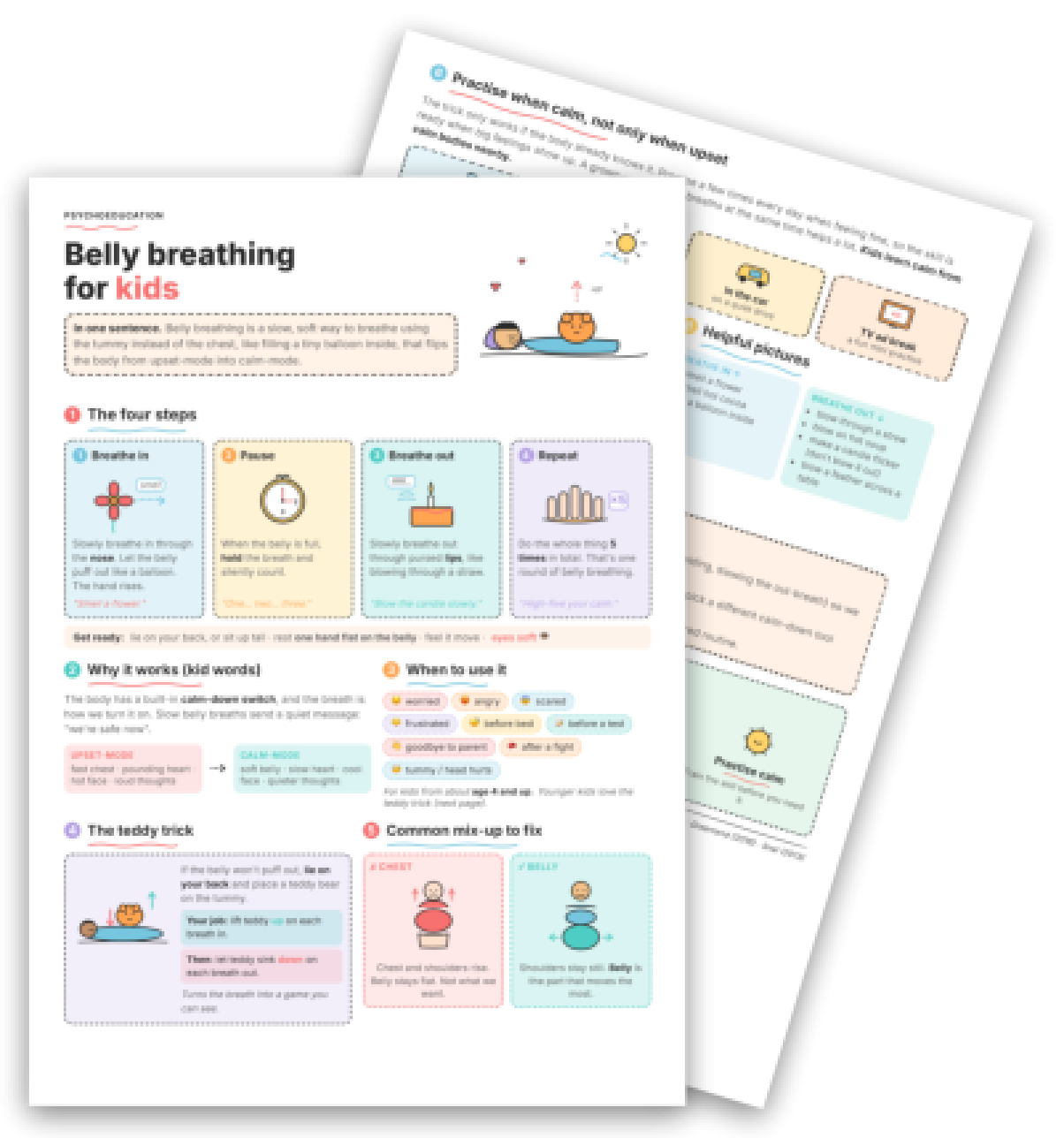
The fiche PDF is structured across eight numbered panels, each designed to support one distinct explanation step rather than overwhelm the child with text.
The opening panel gives a single child-friendly sentence defining the skill: "filling a tiny balloon inside, that flips the body from upset-mode into calm-mode." That framing maps directly onto a simple two-column contrast in panel 2, opposing upset-mode (fast chest, pounding heart, loud thoughts) to calm-mode (soft belly, slow heart, quieter thoughts), a visual shortcut to the autonomic rationale you would otherwise need several minutes to explain. If you also use the Autonomic Nervous System worksheet with older patients, this panel is the child-facing equivalent of the same mechanism.
Panel 1 lays out the four steps with a distinct sub-cue for each: "Smell a flower" for the inhale, a silent count of three for the hold, "Blow the candle slowly" for the pursed-lip exhale, and a five-round target with "High-five your calm." These micro-metaphors do the work of an oral explanation without requiring verbal instruction mid-practice. Panel 5, the common mix-up section, pairs a ✗ (chest rising, belly flat) with a ✓ (shoulders still, belly moving), a contrast that is far more efficient to point at than to describe.
Panel 4 introduces the teddy bear trick for children whose belly simply will not puff on cue: lying supine and lifting a soft toy on each inhale makes diaphragmatic movement visible and turns the exercise into a game. This is a practical solution to the proprioceptive problem described above, and it requires no additional equipment beyond whatever stuffed animal a child brings to session or has at home.
> Key takeaway: this fiche is a visual support that facilitates explanation in session, not a self-administered questionnaire. Point to each panel as you talk, demonstrate alongside the child, then send the printed sheet home as a shared practice guide.
Panel 7 closes with honest safety messaging: if the technique amplifies anxiety or causes dizziness, the child is instructed to keep eyes open, reduce to two or three breaths, or switch to a 5-things-I-can-see grounding exercise, a built-in pivot that pairs naturally with sensory grounding tools you may already use. The "To discuss in session" prompts at the bottom are addressed to the practitioner, flagging what to debrief at the next appointment.
Clinical library
750+ clinical tools
A library built with and for clinicians, ready to use in session and extend between appointments.
Access all the toolsSeveral resource types
Psychoeducation handouts
Understand at a glance
Interactive exercises
To do and fill in
Interactive programs
A structured path
Audios
Meditation and relaxation
Psychometric tests
Automatic scoring
When and How to Propose the Fiche in Session
The fiche suits children from approximately age 4 upward, as noted on the sheet, and adapts easily to anxious, angry, or somatising presentations. It fits naturally into the early-to-mid phase of a treatment focused on emotion regulation, anxiety in children, or childhood depression, once the child has a basic vocabulary for their internal states. You can pair it with the Basic Emotions worksheet if that vocabulary is still being built.
Introduce it during a calm moment in session, not after a distressing disclosure. A workable framing: "I want to show you a body trick that can help when feelings get really big. Let's try it together right now." Practise one full round of five breaths with the child before handing over the sheet. For children with heightened arousal or an anger profile, co-regulation is especially critical: demonstrate alongside them and encourage the caregiver to do the same at home.
Debrief at the following session using the three prompts printed on the fiche (which step was hardest, whether dizziness occurred, whether a caregiver joined the practice). Responses give you direct information about skill acquisition and whether a pivot to an alternative is warranted. The fiche slots comfortably into a broader coping strategy toolkit for children and adolescents and can be supplemented with fear psychoeducation as the work deepens.
The fiche does not replace your clinical judgement about readiness, pacing, or contraindications. It does replace several minutes of verbal instruction with a shared visual reference that child, caregiver, and clinician can all point to, which is exactly where psychoeducation earns its session time.
Use it with your patients
Share this tool in the mobile app and follow the work between sessions.
Sources
- Kendall, P. C., Hedtke, K. A. (2006). Coping Cat Workbook, Second Edition. Workbook Publishing.
- Johns Hopkins All Children's Hospital. Diaphragmatic Breathing. Johns Hopkins All Children's Hospital.
- GiKids - North American Society for Pediatric Gastroenterology, Hepatology and Nutrition (2024). Diaphragmatic (Abdominal) Breathing. GiKids.
Patient mobile app
Your session continues in your patients' pocket
Use with a patientYour resources, available everywhere
The handouts, exercises, programs and audios above: you choose which ones to make available to your patients, in the mobile app dedicated to them.
Psychoeducation handoutsInteractive exercisesInteractive programsAudiosPsychometric tests
And far more than a library
The app goes well beyond resources, to support your patients every day:
Standardized tests
Therapy journal
Gamification
Wellbeing challenges
Introspection prompts
Therapist homework
Related categories
Explore other clinical resources by category.

Emotions
Clinical resources on emotion regulation: worksheets, coping tools, CBT, REBT, and ACT exercises for therapists working across diagnoses and age groups.

Regulate
Clinical resources for emotion regulation: worksheets, ACT exercises, and psychoeducation tools for affect regulation across diagnoses. For clinicians.

Build skills
Skill-building resources for clinicians: printable worksheets and exercises for coping, assertiveness, and communication skills training in therapy.
CBT
CBT worksheets, cognitive restructuring exercises & behavioral tools for clinicians. Evidence-based resources for every phase of cognitive behavioral therapy.

Anxiety
Clinical hub for anxiety disorders: CBT and ACT worksheets, psychoeducation sheets, and exercises for assessment and treatment across the anxiety spectrum.

Trauma
Clinical hub on trauma and PTSD: assessment, differential diagnosis, treatment phases, and printable resources for practitioners. 155 chars.