
Clinical picture. M., a man in his late thirties, was referred following two incidents of verbal aggression toward his partner; he described his anger as appearing "out of nowhere" and reported significant post-episode shame. During a session focused on the anger cycle, the clinician introduced the concept of early warning signs and asked M. to map his own body cues rather than working from a generic list. M. identified jaw tension and a rising urge to pace as his two earliest signals, both consistently appearing before he rated his anger above four out of ten. Over the following fortnight he used these cues as a prompt to initiate the 4-4-6 breathing sequence, and he reported two situations in which he left the room briefly rather than escalating. He remained ambivalent about the effort required, but acknowledged that the incidents had been less severe.
Coping Skills for Anger: PDF Worksheet, Tools and Exercises
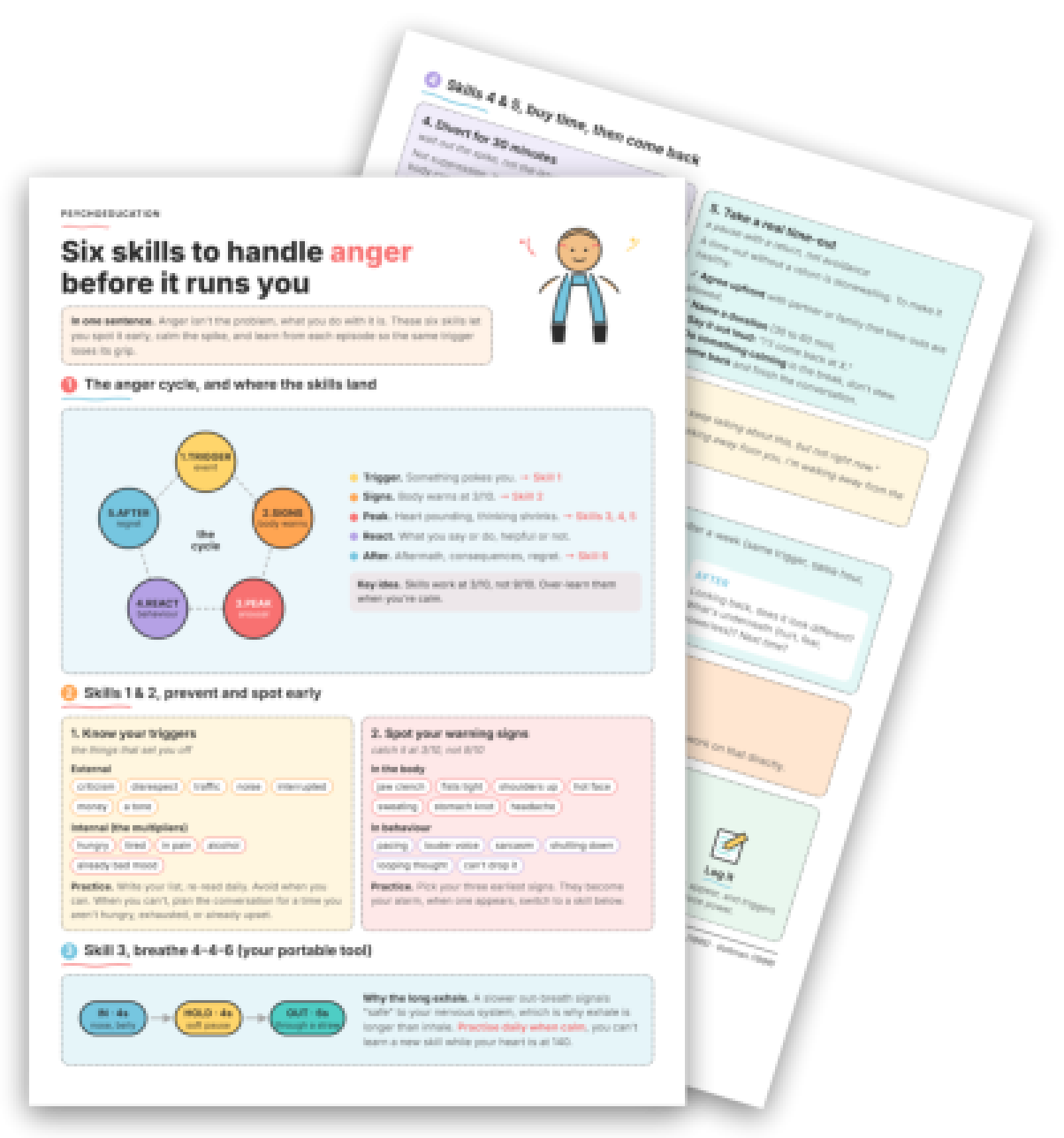
A printable PDF worksheet presenting six structured skills to interrupt the anger cycle early, built on Novaco's model and designed to support psychoeducation directly in session.
Clinical vignettes
Early Warning Signs in Couples Conflict
Trigger Mapping with a Chronic Pain Patient
Clinical picture. A., a woman in her mid-fifties living with fibromyalgia, presented with recurrent anger outbursts directed at family members; she attributed these entirely to external provocations and had not previously considered internal multipliers. The clinician used the triggers section of the informational sheet to introduce the concept of physiological multipliers, specifically pain level, sleep deficit, and low mood, as factors that lower the threshold at which a neutral event becomes a trigger. A. completed a written trigger list between sessions and noted that nearly all recent outbursts had occurred on high-pain days when she was also sleep-deprived. This reframe reduced some of her self-criticism and prompted a practical adjustment: she and her family agreed to postpone difficult conversations to mornings, when her pain was typically lower. The outburst frequency did not resolve, but her sense of agency over the pattern increased noticeably.
Explaining anger regulation to a patient who just recounted a blow-up often lands as a list of good intentions they already know. Telling someone to "calm down" or "take space" does not create a shared clinical vocabulary, and it leaves nothing in their hands when they leave the room. This fiche PDF gives you a structured visual support to walk through the anger cycle and six concrete skills together in session, so the concept moves from abstract advice into something the patient can actually locate in their own experience.
Use this resource with your patients
Handout, exercises and materials ready to use, right inside SessionFuel.
Why Anger Regulation Resists Verbal Explanation
The core difficulty is timing. Patients arrive either at 0/10, still processing, or still at 8/10, not yet ready to learn. Both states make oral psychoeducation thin. The second difficulty is granularity: patients tend to describe anger as a sudden event, collapsing the trigger, the physiological build-up, and the behavior into one undifferentiated "I lost it." Without a visual map of the cycle, the precursors remain invisible, and the intervention window at 3/10 stays closed.
This is exactly where anger warning signs work and anger stop-sign tools become clinically useful, and where a shared schematic makes the difference between a patient who understands the concept and a patient who can use it.
What the Fiche Contains, and Why the Visual Format Matters
The fiche PDF is structured across five panels, each mapped to a moment in the anger cycle drawn directly on the sheet: trigger, signs, peak, reaction, aftermath. The visual cycle diagram is the anchor. It shows, at a glance, that skills work at 3/10, not 9/10, a point that resists oral delivery because patients chronically overestimate how much agency they retain at peak arousal.
The six skills covered are:
- Trigger mapping (Skill 1): external triggers (criticism, noise, disrespect) and internal multipliers (hunger, fatigue, pre-existing mood), with a prompt to build a personal list and rehearse it daily
- Warning sign recognition (Skill 2): somatic cues (jaw clench, hot face, stomach knot) and behavioural cues (louder voice, looping thought), framed explicitly as an alarm system
- 4-4-6 breathing (Skill 3): inhale 4s, hold 4s, exhale 6s, with a brief neurophysiological rationale for the extended exhale
- Diversion for 30 minutes (Skill 4): a menu of activities to occupy attention during the arousal spike, framed as parking the problem, not suppression
- Structured time-out (Skill 5): five conditions that distinguish a healthy pause from stonewalling, including naming a return time. Ready-to-use phrases are printed verbatim: "I'm not walking away from you, I'm walking away from the fight."
- Anger log (Skill 6): a three-column format (before, during, after) designed for brief daily notes, with a dedicated "To discuss in session" section pointing the patient back to the therapeutic relationship
The visual layout does something a verbal walk-through cannot: it shows which skill belongs at which point in the cycle. A patient scanning the fiche can see that breathing and diversion belong at the peak, not after. That spatial relationship is lost in spoken explanation.
> Key takeaway: this fiche PDF is a visual support for explaining the anger cycle in session. It is not a self-help checklist to hand over without framing: it works because the clinician uses it as a shared reference, then leaves it with the patient as a concrete between-session anchor.
750+ clinical tools
A library built with and for clinicians, ready to use in session and extend between appointments.
Access all the toolsWhen and How to Introduce the Fiche
This worksheet is most useful from the second or third session, once the anamnesis has given you enough of the patient's cycle to personalise the conversation. It fits patients presenting with impulse control difficulties, relational conflict, or frustration intolerance, and adapts naturally to work alongside the anger iceberg framework when the underlying affect (shame, fear, perceived injustice) is part of the formulation.
Introduce it without pathologising: "I want to show you a map of what happens in your body and mind before things escalate. We'll go through it together and mark what fits your experience." Walk through the cycle diagram first, then the skills in order. Do not hand the sheet over before you have oriented the patient to it.
For debrief, the anger log (Skill 6) gives you direct material: ask the patient to bring two or three entries and use the "To discuss in session" prompts as an entry point. If diversion is drifting into avoidance, the time-out section's five conditions provide a ready structure for that conversation.
For patients who need more granular somatic work, pair the fiche with anger regulation audio practice or the frustration tolerance exercise. For adolescents, the anger thermometer may be a more accessible first step before introducing this full framework. The anger self-reflection exercise and the six-lesson anger psychoeducation program extend the work across the broader care plan once the patient has integrated the cycle and the core skills.
The fiche does not replace the therapeutic frame. It makes the explanation more precise, gives the patient something to hold onto between sessions, and opens the anger cycle to collaborative exploration rather than leaving it as a private black box.
Use it with your patients
Share this tool in the mobile app and follow the work between sessions.
Sources
- Novaco, R. W. (1975). Anger Control: The Development and Evaluation of an Experimental Treatment. D. C. Heath.
- Novaco, R. W., Renwick, S. J.. Anger Management. Common Language Psychotherapy.
- DiGiuseppe, R. A., Tafrate, R. C. (2007). Understanding Anger Disorders. Oxford University Press.
- Substance Abuse and Mental Health Services Administration (SAMHSA) (2019). Anger Management for Substance Use Disorder and Mental Health Clients: A Cognitive-Behavioral Therapy Manual (PEP19-02-01-001). SAMHSA.
Your session continues in your patients' pocket
Use with a patientYour resources, available everywhere
The handouts, exercises, programs and audios above: you choose which ones to make available to your patients, in the mobile app dedicated to them.
And far more than a library
The app goes well beyond resources, to support your patients every day:
Related categories
Explore other clinical resources by category.

Emotions
Clinical resources on emotion regulation: worksheets, coping tools, CBT, REBT, and ACT exercises for therapists working across diagnoses and age groups.

Build awareness
Clinical worksheets and tools to build awareness in therapy: cognitive distortions, schemas, emotions, ACT and CBT resources for practitioners.

Regulate
Clinical resources for emotion regulation: worksheets, ACT exercises, and psychoeducation tools for affect regulation across diagnoses. For clinicians.

Build skills
Skill-building resources for clinicians: printable worksheets and exercises for coping, assertiveness, and communication skills training in therapy.

CBT
CBT worksheets, cognitive restructuring exercises & behavioral tools for clinicians. Evidence-based resources for every phase of cognitive behavioral therapy.
Anxiety
Clinical hub for anxiety disorders: CBT and ACT worksheets, psychoeducation sheets, and exercises for assessment and treatment across the anxiety spectrum.