
Clinical picture. A, a woman in her late thirties, presents with generalised anxiety and a long-standing habit of suppressing emotional reactions, which she describes as "just getting on with things." Her clinician introduces the first lesson of the Managing Your Emotions program and asks her to complete it before their next appointment, paying particular attention to the prompted reflection on physical symptoms she notices during fear. At the following session, A reports that identifying her specific bodily responses, tight abdomen, cold hands, and racing heart, had shifted her relationship to those sensations; she described them as "information" rather than signs that something was wrong. This reframe was modest but clinically useful as a foundation for the exposure work planned for subsequent lessons.
Managing Emotions: A 4-Lesson Psychoeducation Program
A structured autonomous curriculum helping patients understand, feel, and express emotions, from physiology to practical regulation techniques.
Clinical vignettes
Naming Physical Fear Responses
Confronting Emotional Contagion in Social Anxiety
Clinical picture. M, a man in his mid-forties with social anxiety disorder, reports that he consistently withdraws from colleagues after group meetings, unable to account for the exhaustion he feels. His clinician assigns the first two lessons of the Managing Your Emotions program between sessions, with particular attention to the unit on emotional contagion and the reflection prompt asking when he was last overwhelmed by another person's emotion. M returned having written a detailed account of a recent team meeting in which a colleague's visible frustration had rapidly amplified his own distress. Externalising the mechanism, rather than attributing the reaction to personal weakness, reduced his self-critical rumination and opened a productive conversation about boundary-setting strategies to be addressed in later lessons.
Use this resource with your patients
Handout, exercises and materials ready to use, right inside SessionFuel.
What Makes Emotion Work Clinically Difficult
Emotion regulation sits at the heart of most presentations you see, yet it is one of the hardest things to transmit verbally. Patients who arrive carrying anxiety, suppression, or somatic complaints often have no framework for what emotions actually are, why they appear in the body the way they do, or why pushing feelings away reliably makes things worse. Explaining the fight-or-flight cascade, the link between repression and tension, or the difference between naming and feeling an emotion takes more than a single explanation. Concepts from Emotion-Focused Therapy, the DBT emotion regulation model, or even basic nervous system regulation tend to slide away unless the patient actively engages with them between appointments.
The structural problem is that emotion literacy is built through practice, not through listening. A patient needs to map their own triggers, recognize their own somatic signals, and experiment with expression in their own life, not just nod along in the consulting room.
750+ clinical tools
A library built with and for clinicians, ready to use in session and extend between appointments.
Access all the toolsWhat the Program Contains
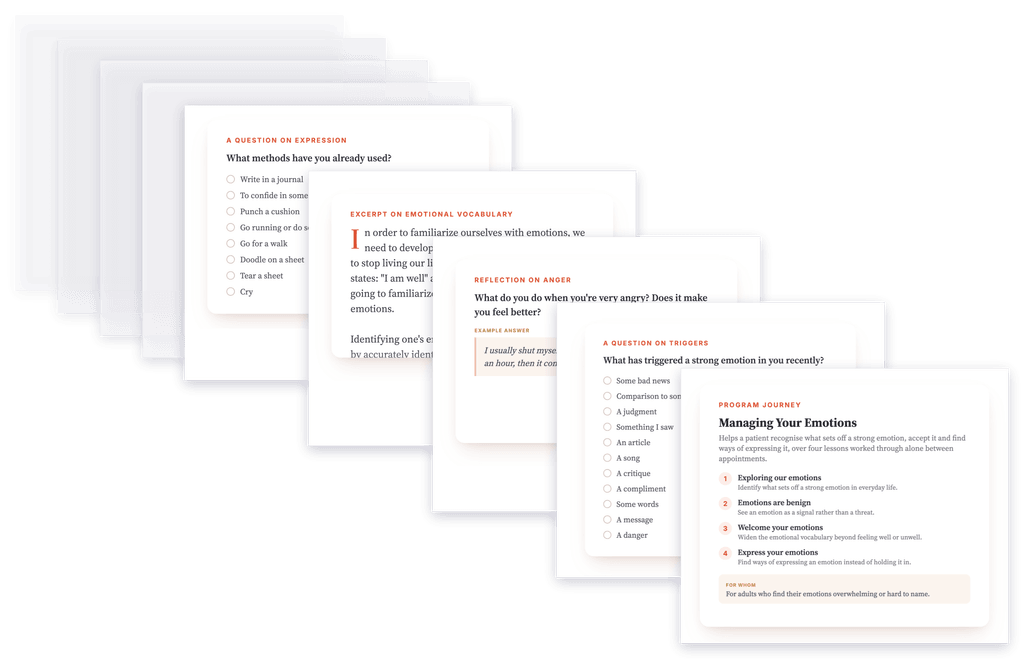
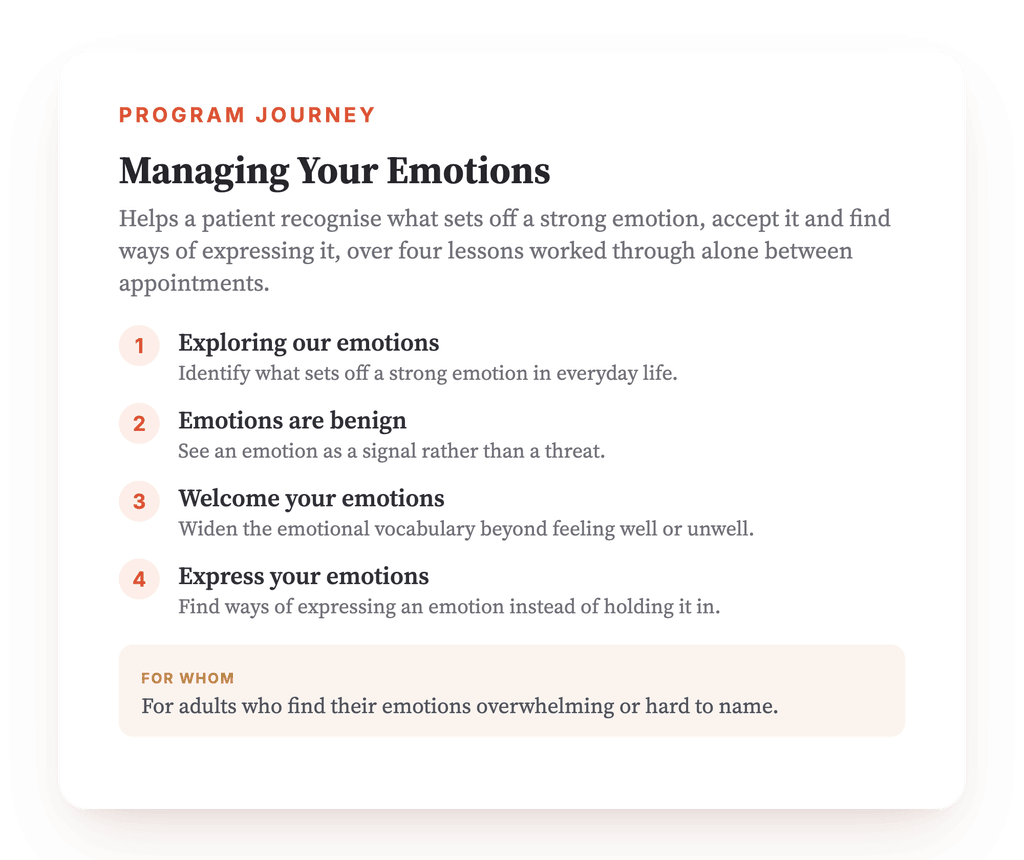
This four-lesson program walks patients through the full arc of emotion work, step by step, with guided prompts and multiple-choice questions woven throughout.
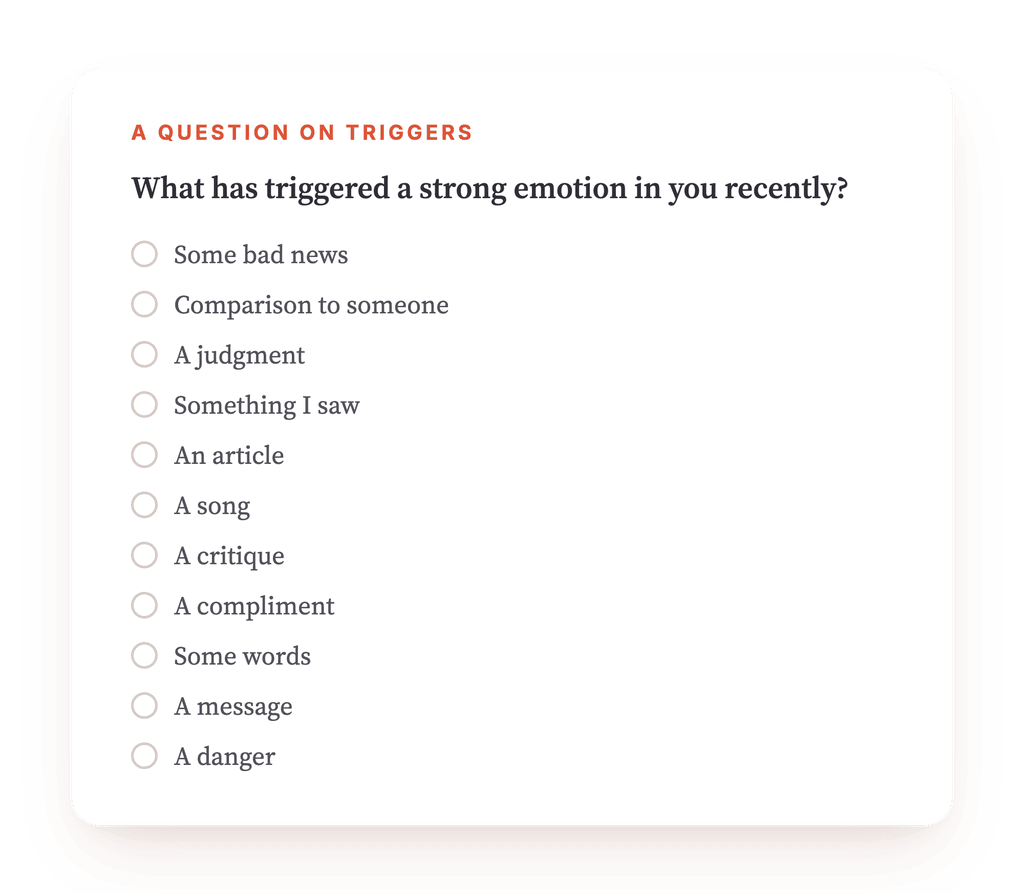
Lesson 1 (Discovering emotions) covers the function and mechanics of emotion: why feelings arise in response to events, what happens in the body during fear, and how emotions are contagious. Patients answer concrete questions about their own recent triggers and physical fear symptoms, building a personal reference rather than abstract knowledge.
Lesson 2 (Emotions are benign) addresses the core clinical obstacle: the belief that emotions are dangerous and must be controlled. It traces the origins of suppression in both anxiety and early socialization, then maps the real cost: psychosomatic symptoms, unexplained muscular tension, and the emotion-to-anxiety conversion that maintains distress. Patients reflect on childhood messages about anger and sadness, material that connects directly to work on the function of emotions and emotional inhibition schemas.
Lesson 3 (Welcoming emotions) develops emotional vocabulary and somatic awareness. Rather than the binary of "fine / not fine," patients build granularity, naming recent positive and negative emotions from structured lists and then describing the physical texture of sadness and joy in their own bodies. This step grounds the conceptual work in identifying emotional triggers and prepares patients for the final lesson.
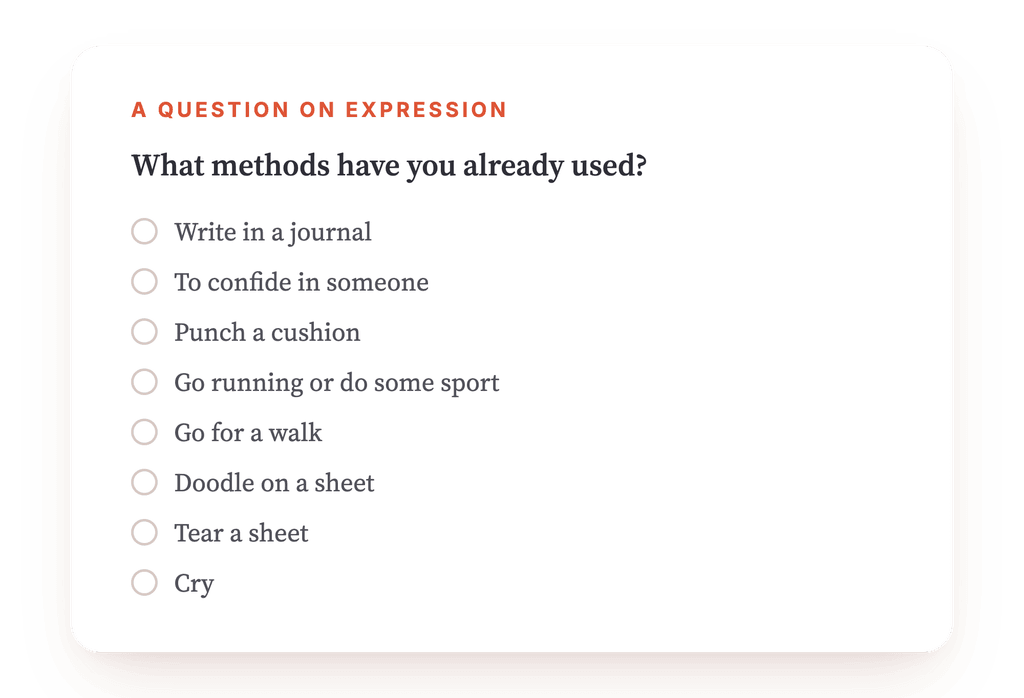
Lesson 4 (Expressing emotions) is the most practical: it covers written expression, confiding in others, crying as a regulation act, and physical outlets for anger. Patients reflect on what they have already used and practise writing about a recent emotion. The lesson is closely related to coping strategy work and complements techniques like urge surfing or the ACCEPTS distress tolerance skills.
The preview images below show only a handful of cards from the overview map and two sample lesson cards. These aperçus represent a small fraction of the program: the complete curriculum contains far more lessons, steps, reflective prompts, and multiple-choice exercises than what is visible here.
Key insight: The clinical value of this program is its sequencing, it does not ask patients to express emotions they cannot yet name, or to name emotions they do not yet feel safe having. Each lesson builds on the last.
This program is available to patients through the mobile application that is the dedicated patient-side interface of SessionFuel: once you assign it within your SessionFuel account, your patient receives it directly on their phone and works through each lesson independently, at their own pace, between your appointments.
Use it with your patients
Share this tool in the mobile app and follow the work between sessions.
Integrating the Program as Between-Session Work
This curriculum is designed entirely as autonomous homework: patients complete each lesson on their own, between two consultations, and bring their written responses back to the next appointment.
It suits a wide range of profiles, patients with anxiety, unexplained somatic complaints, emotional numbing, or a long history of suppression are the most direct candidates. It also works well as a foundation before introducing more demanding work such as radical acceptance, psychological flexibility, or active acceptance.
To introduce it, frame the program as a structured way to develop a skill that cannot be built in conversation alone. You might say something like: "Between now and next time, I'd like you to work through the first two lessons. There is no right answer, just your own observations."
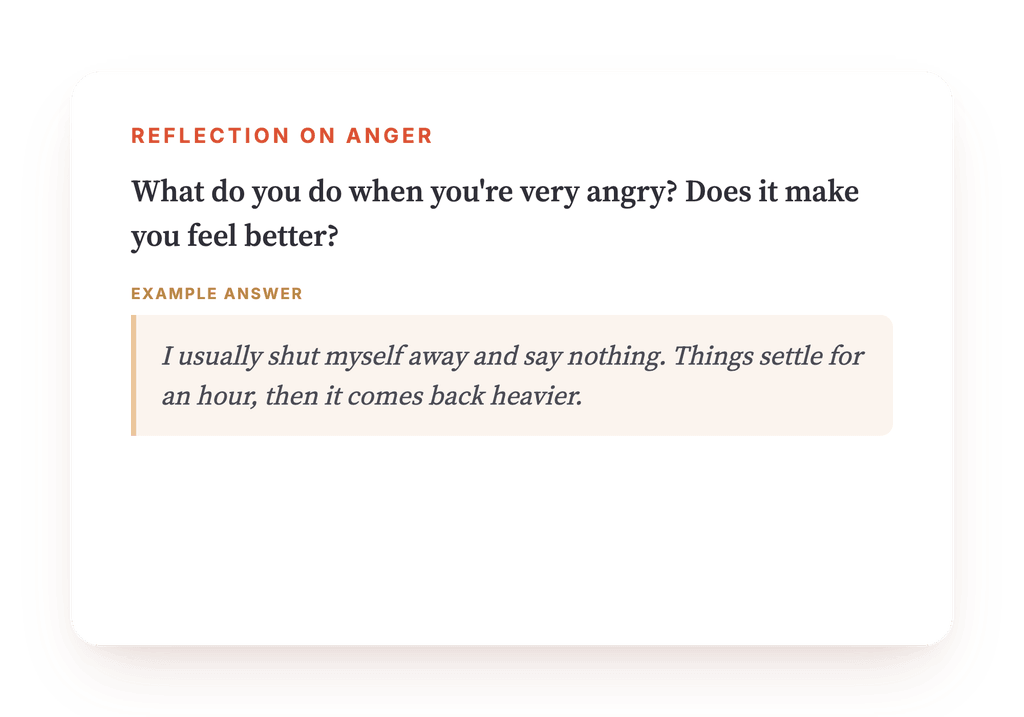
When the patient returns, their written prompt responses are the richest clinical material. What did they say when asked what childhood messages told them about anger? What somatic texture did they find for sadness? These responses give you concrete, patient-generated language to work with, rather than reconstructed memories from the previous week. Pair the debrief naturally with the emotion hierarchy map, the emotion wheel, or the Feel, Reflect, Act Differently worksheet, depending on where the patient's edge is.
For patients who are ready to go further, the program pairs well with the Anger Psychoeducation program or the Sadness Psychoeducation Program once the foundational four lessons are complete.
Your session continues in your patients' pocket
Use with a patientYour resources, available everywhere
The handouts, exercises, programs and audios above: you choose which ones to make available to your patients, in the mobile app dedicated to them.
And far more than a library
The app goes well beyond resources, to support your patients every day:
Related categories
Explore other clinical resources by category.

Emotions
Clinical resources on emotion regulation: worksheets, coping tools, CBT, REBT, and ACT exercises for therapists working across diagnoses and age groups.

Understand
Clinical hub for the therapeutic aim 'Understand': worksheets and tools to build patient insight across CBT, ACT, schema therapy and more.

Build awareness
Clinical worksheets and tools to build awareness in therapy: cognitive distortions, schemas, emotions, ACT and CBT resources for practitioners.

Regulate
Clinical resources for emotion regulation: worksheets, ACT exercises, and psychoeducation tools for affect regulation across diagnoses. For clinicians.

ACT
Clinical hub for Acceptance and Commitment Therapy (ACT): worksheets, exercises, programs and audio resources for practitioners using the ACT model.

Emotion-focused
Emotion-focused therapy clinical resources: worksheets, exercises & programs for EFT practitioners working with individuals and couples.