
Clinical picture. A, a man in his early forties, presented with recurrent conflict in his marriage and described himself as "always irritable" since his father's death two years prior. He had not cried at the funeral and reported that showing grief felt, in his words, "pointless." The clinician introduced the psychoeducation on primary and secondary emotions, framing his anger as a signal worth slowing down for rather than a flaw to correct. In session, when A was invited to locate the irritation in his body and stay with it briefly, a quieter sadness surfaced; he named it as missing his father and never having said so aloud. He left the session visibly less agitated, and noted that the anger had not disappeared but felt less urgent once the grief beneath it had been acknowledged.
Emotion-Focused Therapy: PDF Worksheet, Tools and Exercises for Clinical Practice
A printable fiche PDF with visual tools and exercises to explain the EFT model, introduce the emotion-as-signal reframe, and guide psychoeducation in session.
Clinical vignettes
Anger as Surface, Grief Underneath
Numbing Recognised as Avoidance
Clinical picture. T, a woman in her late twenties, sought therapy for low motivation and a persistent sense of flatness she could not explain; she described her inner life as "just blank." During psychoeducation about emotion as signal, she identified that she had learned early on to suppress distress quickly, as emotional expression at home had been met with dismissal. The clinician introduced the idea that numbing is itself an active move, not an absence of feeling, and invited T to approach the blankness with curiosity rather than try to shake it off. Over two sessions, T began to notice a low, steady fear beneath the flatness, linked to uncertainty about her professional direction. The goal at that point was not resolution but contact: T reported that simply naming the fear as fear, rather than treating it as a malfunction, made it feel less overwhelming.
Most patients who arrive in therapy have already been managing their emotions as the problem for years. Getting that framing to shift, at the verbal level, in a single session explanation, is harder than it sounds. This fiche PDF provides a visual psychoeducation support to make EFT's foundational reframe legible and memorable without relying on the clinician's words alone.
Use this resource with your patients
Handout, exercises and materials ready to use, right inside SessionFuel.
Why EFT's Core Premise Resists Oral Explanation
The central move in Emotion-Focused Therapy, as developed by Greenberg and elaborated by Fosha and Gendlin, is phenomenologically simple but cognitively counterintuitive: the patient who has spent years organizing their life around évitement expérientiel is now being asked to approach the very experience they have been fleeing. Said aloud in session, this lands as another instruction to "manage feelings differently." The concept registers, then evaporates.
The difficulty sharpens when secondary and primary emotions are layered. A patient reporting chronic anger and one reporting emotional numbness are often describing the same avoidance architecture at different depths. Untangling that verbally, mid-session, rarely produces the clarity needed to sustain between-session work. And when maladaptive primary emotions rooted in early attachment ruptures are involved, the distance between intellectual understanding and embodied recognition becomes even larger.
What clinicians working with emotional avoidance patterns or the behavior-emotion-need cycle know well is that patients need a stable, retrievable reference point, not just a session explanation they half-remember the following week.
What the Fiche Contains: A Five-Panel Visual Support for EFT
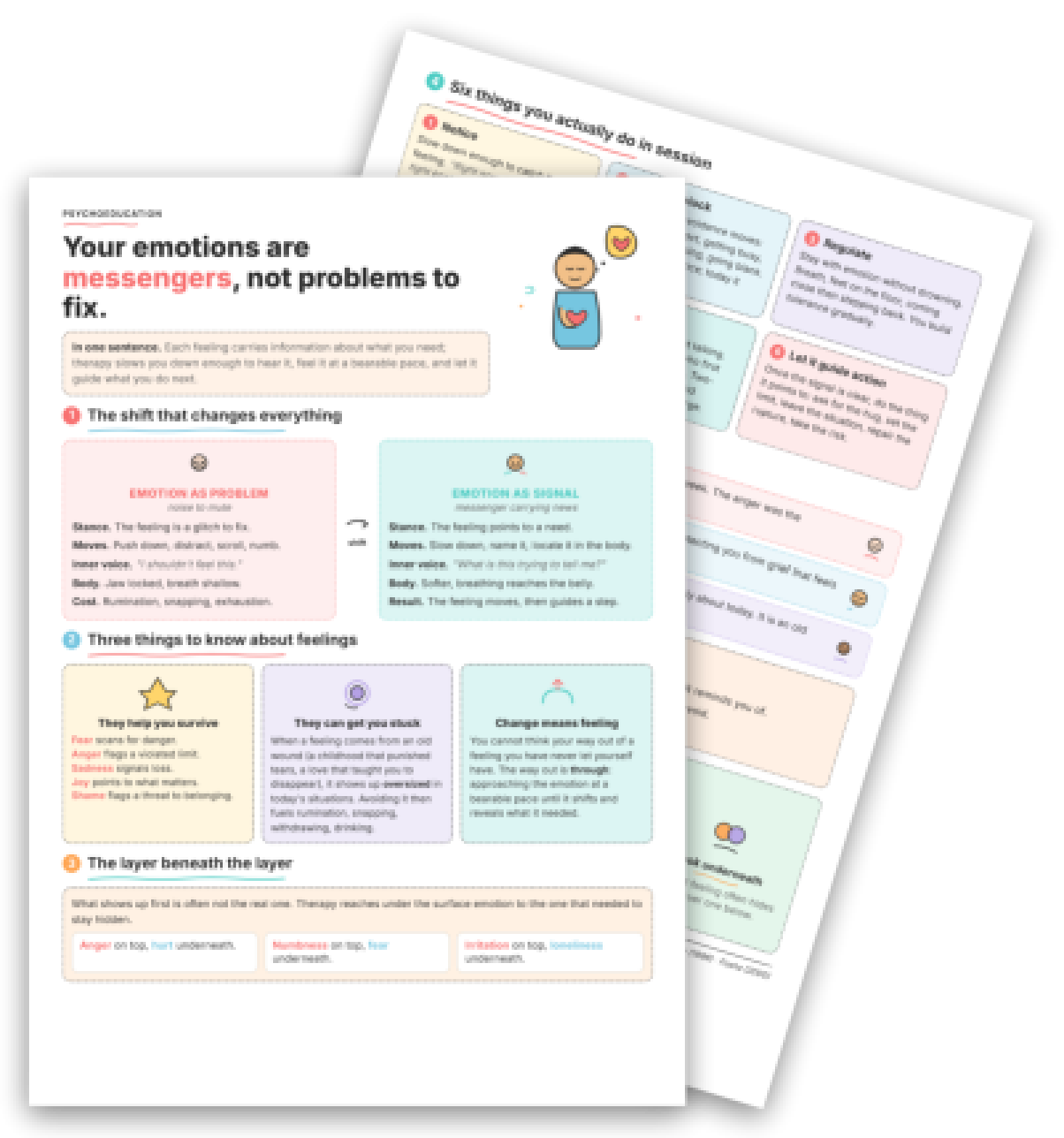
The fiche is a visual support that facilitates the explanation of EFT in session. It is not a questionnaire for the patient to fill in alone; it is a structured psychoeducation map the clinician walks through collaboratively, then leaves as a concrete take-home reference.
The opening panel presents a side-by-side contrast between two emotional stances. On the left: "Emotion as Problem" (stance: "the feeling is a glitch to fix"; inner voice: "I shouldn't feel this"; body: jaw locked, breath shallow; cost: rumination, snapping, exhaustion). On the right: "Emotion as Signal" (stance: "the feeling points to a need"; inner voice: "What is this trying to tell me?"; body: softer, breathing reaches the belly). This layout makes the somatic and behavioral consequences of each stance visible simultaneously, something a verbal description cannot do.
The second panel addresses three clinical principles: that emotions evolved to help survival (fear scans for danger, anger flags a violated limit, sadness signals loss), that they become maladaptive when tied to old wounds, and that "the way out is through" (approaching emotion at a bearable pace until it shifts). The third panel maps the layer beneath the layer: "Anger on top, hurt underneath. Numbness on top, fear underneath." This vertical structure is exactly what patients cannot hold without a visual reference.
The fourth panel, central to session use, names the six steps of EFT work: Notice, Spot the block, Regulate, Hear the message, Process the old, Let it guide action. Each is described in plain language grounded in somatic and experiential terms. The fiche closes with three reflection prompts linked to "To bring up next session", and a four-item summary grid: Signals not noise, Name to soften, Through not around, Look underneath.
> À retenir: The fiche is a visual support that facilitates the explanation of the EFT model in session; it gives the patient a retrievable map after the session ends, not a homework task to complete alone.
750+ clinical tools
A library built with and for clinicians, ready to use in session and extend between appointments.
Access all the toolsWhen and How to Propose It
The fiche fits naturally from the second or third session, once the anamnèse is complete and the formulation de cas is taking shape. It works well across a wide range of presentations: patients with emotional inhibition schemas (see Emotional Inhibition Schema), patients reporting alexithymia-adjacent difficulties, and patients who have been in previous cognitive work where understanding emotions and reactions was never explicitly addressed.
A useful introduction: "I'd like to show you a schema that maps how we'll be working together. It's not a test, just a reference point we can come back to." Then walk through the Emotion as Problem / Emotion as Signal contrast first, pausing to ask where the patient currently sits. The identifying emotional triggers framework and how emotions motivate actions support this panel well as companion tools.
Debrief by asking which of the six EFT steps feels most unfamiliar. Patients with strong intellectualizing defenses often identify "Regulate" or "Process the old" as foreign; that observation directly informs what to prioritize. For patients where early relational wounds are central, linking the fiche to how the past affects the present adds clinical depth. For couples work, the EFT Infinity Loop pairs naturally as the relational extension of the same model.
The fiche does not replace the therapeutic frame. It makes the explanation clearer and leaves the patient with a concrete visual anchor between sessions.
Use it with your patients
Share this tool in the mobile app and follow the work between sessions.
Sources
- Greenberg, L. S. (2017). Emotion-Focused Therapy, Revised Edition. American Psychological Association.
- Elliott, R., Watson, J. C., Goldman, R. N., Greenberg, L. S. (2004). Learning Emotion-Focused Therapy: The Process-Experiential Approach to Change. American Psychological Association.
- Greenberg, L. S. (2006). Emotion-Focused Therapy: A Synopsis. Journal of Contemporary Psychotherapy.
- Greenberg, L. S., Goldman, R. N. (2019). Clinical Handbook of Emotion-Focused Therapy. American Psychological Association.
Your session continues in your patients' pocket
Use with a patientYour resources, available everywhere
The handouts, exercises, programs and audios above: you choose which ones to make available to your patients, in the mobile app dedicated to them.
And far more than a library
The app goes well beyond resources, to support your patients every day:
Related categories
Explore other clinical resources by category.

Identity
Clinical resources for self-identity work in therapy: CBT, ACT, schema tools for clinicians addressing self-concept, core beliefs, and identity disruption.

Emotions
Clinical resources on emotion regulation: worksheets, coping tools, CBT, REBT, and ACT exercises for therapists working across diagnoses and age groups.

Understand
Clinical hub for the therapeutic aim 'Understand': worksheets and tools to build patient insight across CBT, ACT, schema therapy and more.

Build awareness
Clinical worksheets and tools to build awareness in therapy: cognitive distortions, schemas, emotions, ACT and CBT resources for practitioners.

Emotion-focused
Emotion-focused therapy clinical resources: worksheets, exercises & programs for EFT practitioners working with individuals and couples.

Anxiety
Clinical hub for anxiety disorders: CBT and ACT worksheets, psychoeducation sheets, and exercises for assessment and treatment across the anxiety spectrum.