
Clinical picture. A 10-year-old boy, referred here as T., presented with recurrent aggressive outbursts at home following minor frustrations; his parents described daily incidents of shouting and object-throwing that were straining sibling relationships. During a session focused on emotion regulation, the clinician introduced the four-step worksheet and walked T. through a recent incident in which his brother had changed the television channel without asking. T. identified "angry" from the feeling-word list, located the trigger at Step 2, and acknowledged at Step 3, with minimal prompting, that he had thrown a cushion. By Step 4 he generated "walk to my room and count to ten" as an alternative, a move he rated as feasible. At the following session T. reported using the coping menu once during the week, with the outburst stopping short of physical contact.
Understanding My Emotions and Reactions: PDF Worksheet, Tools and Exercises
A structured visual PDF worksheet with tools and exercises to help clinicians explain the emotion-action loop to children and adolescents in session.
Clinical vignettes
Naming Anger Before Acting on It
Reducing Classroom Withdrawal After Embarrassment
Clinical picture. A 13-year-old girl, referred here as M., was seen following teacher concerns about progressive disengagement in class; she described intense shame after being corrected publicly and had begun refusing to answer questions aloud. The clinician used the informational sheet to help M. map a specific classroom incident, working through each step in sequence. At Step 3 M. wrote "I stopped writing and stared at the desk for the rest of the lesson," and noted this honestly without the self-critical commentary that had dominated earlier sessions. Step 4 produced two alternatives she considered realistic: silently reminding herself that errors are part of learning, and asking the teacher a clarifying question after class. Over the following fortnight her form tutor observed that she had volunteered one written response, which M. herself acknowledged as a small but meaningful shift.
Explaining the emotion-to-action loop verbally in session rarely lands with children and younger adolescents: the concept stays abstract, the vocabulary slips away, and the next activation arrives without any pause between feeling and behaviour. This fiche PDF is a structured visual support designed for clinicians to walk through that link directly in session, giving patients a concrete scaffold to keep and use.
Use this resource with your patients
Handout, exercises and materials ready to use, right inside SessionFuel.
Why the Emotion-Action Link Resists Verbal Explanation
Young patients in particular tend to present with action-first narratives: "I yelled," "I walked out," "I stopped working." The internal sequence that preceded those behaviours, the triggered feeling, the somatic signal, the moment of choice, is invisible to them without explicit mapping. Asking them to reconstruct it in retrospect, using only speech, often produces thin or defended accounts.
The second difficulty is affective vocabulary. Clinicians working with children regularly meet patients who oscillate between "fine" and "angry," with little nuance in between. Without a shared lexicon, identifying emotional triggers becomes a laborious conversational exercise rather than a productive clinical moment.
The fiche addresses both problems simultaneously: it externalises the sequence and supplies the language. The result is a shared reference object you can point to, annotate together, and leave with the patient at the end of the session.
What the Fiche Contains: A Visual Framework for the Emotion-Behaviour Sequence
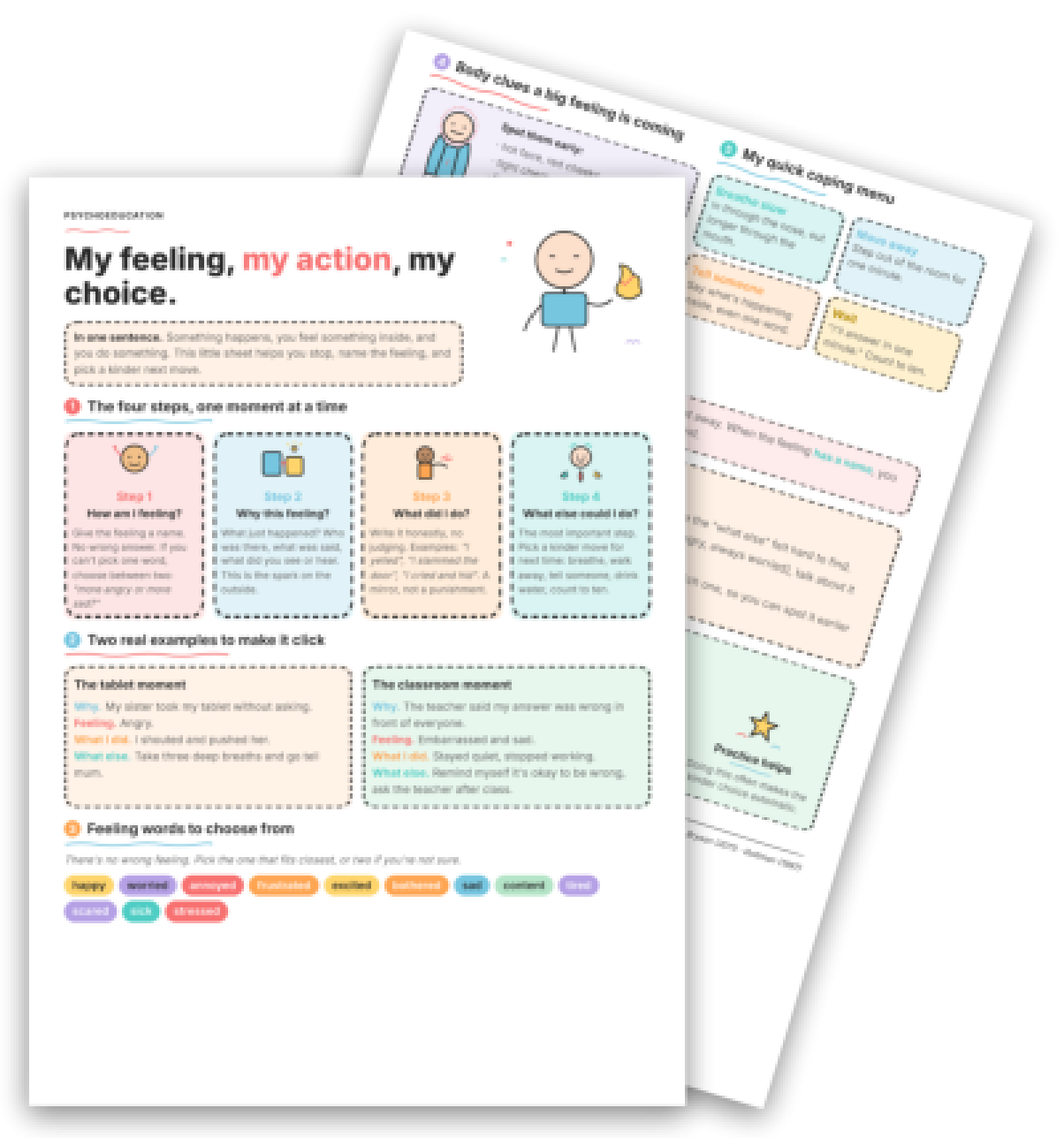
The support visuel is organised into six sections, each doing a specific clinical job.
The spine of the fiche is a four-step framework: How am I feeling? / Why this feeling? / What did I do? / What else could I do? The visual layout makes the sequence irreversible: step four, the choice of a kinder response, cannot be reached without naming the feeling and its external spark first. That sequencing is what the fiche shows that a verbal explanation alone does not.
Two worked examples (a sibling taking a tablet, a teacher correcting a student publicly) demonstrate the framework in filled-in form. Seeing a completed sequence normalises the exercise and lowers the threshold for patients who hesitate to engage. These pair naturally with CBT for Kids: Thoughts, Feelings & Actions if you want to extend the cognitive triangle within the same session.
A feeling word bank (twelve terms: happy, worried, annoyed, frustrated, excited, bothered, sad, content, tired, scared, sick, stressed) serves as a practical lexicon. For patients who over-rely on a narrow vocabulary, it functions similarly to a simplified Printable Emotion Faces or the Emotion Thermometers resource: it expands the affective field without demanding introspective fluency the patient does not yet have.
A body clues panel (hot face, tight chest, fists clenching, fast breathing, tears starting, stomach twisting) connects somatic signals to the approaching activation. This is clinically significant: it positions early body awareness as a detection skill, directly supporting work on anger stop signs or the fight-or-flight response in children.
A quick coping menu (breathe slow, move away, tell someone, wait) gives patients an immediately actionable toolkit. The fiche frames it as a menu, not a prescription, which preserves patient agency. You can debrief which strategy they tried against which body clue, making adaptive versus maladaptive coping discussions concrete rather than abstract.
Finally, a "To discuss in session" panel prompts the patient to bring completed sheets back, flag situations where step four felt impossible, and name which body clue showed up before they could stop themselves. This transforms the fiche from a one-time handout into a structured between-session observation tool.
> À retenir: the fiche is a visual support that facilitates the explanation of the emotion-action loop directly in session; it is not a self-administered questionnaire, but a psychoeducation scaffold the clinician uses to build shared language and leave the patient with a concrete, retrievable reference.
750+ clinical tools
A library built with and for clinicians, ready to use in session and extend between appointments.
Access all the toolsWhen and How to Introduce the Fiche
This fiche fits naturally after initial anamnesis, once you have identified a pattern of reactive behaviour the patient cannot yet connect to an emotional antecedent. It is particularly indicated for children and early adolescents presenting with anger, school-based avoidance, or impulsive social conflict, and for patients whose emotion regulation work is just beginning.
A low-pressure introduction: "Let's use this sheet to look at one moment from your week, not to judge what happened, but to slow it down and see the pieces." Walk through the four steps using an episode the patient already mentioned. Avoid selecting a high-stakes event for the first use; a minor irritation is enough to demonstrate the sequence.
For the debrief, focus on step four: what else could I do? That is where the therapeutic work lives, and where you can connect to coping strategies for children and adolescents or the Feel, Reflect, Act Differently framework for patients ready to go further. Patients who struggle to populate step four are telling you precisely where the intervention needs to concentrate next.
The fiche does not replace the therapeutic frame. It makes the explanation sharper, the vocabulary shared, and the homework session-generated rather than imported.
Use it with your patients
Share this tool in the mobile app and follow the work between sessions.
Sources
- Greenberg, L. S. (2017). Emotion-Focused Therapy (Revised Edition). American Psychological Association.
- Greenberg, L. S., & Goldman, R. N. (2019). Clinical Handbook of Emotion-Focused Therapy. American Psychological Association.
- Siegel, D. J., & Bryson, T. P. (2011). The Whole-Brain Child: 12 Revolutionary Strategies to Nurture Your Child's Developing Mind. Delacorte Press.
Your session continues in your patients' pocket
Use with a patientYour resources, available everywhere
The handouts, exercises, programs and audios above: you choose which ones to make available to your patients, in the mobile app dedicated to them.
And far more than a library
The app goes well beyond resources, to support your patients every day:
Related categories
Explore other clinical resources by category.

Emotions
Clinical resources on emotion regulation: worksheets, coping tools, CBT, REBT, and ACT exercises for therapists working across diagnoses and age groups.

Cognition
Printable cognitive therapy worksheets and clinical tools for therapists: CBT, ACT, schema work, defusion, distortions, and belief restructuring.

Build awareness
Clinical worksheets and tools to build awareness in therapy: cognitive distortions, schemas, emotions, ACT and CBT resources for practitioners.

Regulate
Clinical resources for emotion regulation: worksheets, ACT exercises, and psychoeducation tools for affect regulation across diagnoses. For clinicians.

Build skills
Skill-building resources for clinicians: printable worksheets and exercises for coping, assertiveness, and communication skills training in therapy.

CBT
CBT worksheets, cognitive restructuring exercises & behavioral tools for clinicians. Evidence-based resources for every phase of cognitive behavioral therapy.