
Clinical picture. P., a 7-year-old referred for recurrent classroom outbursts, typically responded to check-ins with a shrug or a flat "fine" before escalating without warning. During a session following a school incident, the clinician placed the Emotion Thermometers sheet on the table and invited P. to colour each one. P. filled the angry thermometer to the top and the worn-out thermometer roughly two-thirds up, leaving happy nearly empty. The clinician reflected the result back without judgment: "Two really big ones today, and the tired one is pretty high too." With the worksheet as a shared reference point, P. was able to describe having slept poorly before the incident, a link he had not previously articulated. The clinician noted this as a useful entry for subsequent work on recognising physical fatigue as a precursor to anger.
Emotion Thermometers: PDF Worksheet, Tools and Exercises
A printable visual tool helping clinicians turn a child's 'I don't know' into six colour-coded feeling levels that can be seen, named, and discussed together in session.
Clinical vignettes
Naming the Level, Not Just the Meltdown
Re-Rating After a Coping Strategy
Clinical picture. M., age 9, presented with generalised anxiety and a limited emotional vocabulary; she described most distress as simply "bad." Her psychologist introduced the Emotion Thermometers sheet at the start of sessions as a brief orienting ritual. On one occasion M. coloured the worried thermometer near the top and the calm one at the lowest level, prompting a short discussion about an upcoming school presentation. The clinician coached two minutes of slow belly breathing, then asked M. to re-colour the sheet. The worried thermometer dropped by roughly one level and the calm one rose slightly. M. commented, unprompted, that worry could "go down a little without disappearing," which the clinician reinforced as a realistic and clinically useful expectation.
"Fine" and "I don't know" close down more child sessions than any diagnostic complexity. When emotion labeling stalls at the verbal level, pressing the same question harder rarely moves things forward. This PDF worksheet offers a concrete visual scaffold: six colour-coded emotion thermometers the child fills in themselves, turning an internal state that felt unspeakable into something clinician and child can look at, name, and discuss together.
Use this resource with your patients
Handout, exercises and materials ready to use, right inside SessionFuel.
Why Verbal Emotion Identification Breaks Down With Children
Many children, and a good number of adolescents, lack the interoceptive vocabulary to match a felt state to a word on demand. Even those with some emotional lexicon face alexithymic-adjacent blocks under social pressure or hyperarousal. A standard prompt ("what are you feeling?") asks for two operations simultaneously: naming the feeling and rating its intensity. For a child already flooded or shut down, that double demand typically produces a blank.
Developmental context compounds this. Before approximately age 8 or 9, the concept that emotions are graded rather than binary is still being consolidated. The emotion regulation skills literature confirms that differentiating feeling type from feeling intensity is a distinct and teachable competency. Clinicians working within CBT for children and adolescents, or using the CBT for Kids: Thoughts, Feelings & Actions framework, regularly encounter this bottleneck: the child can draw a face, but cannot say whether the feeling is "a little" or "a lot." The fiche is built to address exactly that gap.
750+ clinical tools
A library built with and for clinicians, ready to use in session and extend between appointments.
Access all the toolsWhat the Fiche Contains: Six Thermometers as a Shared Visual Language
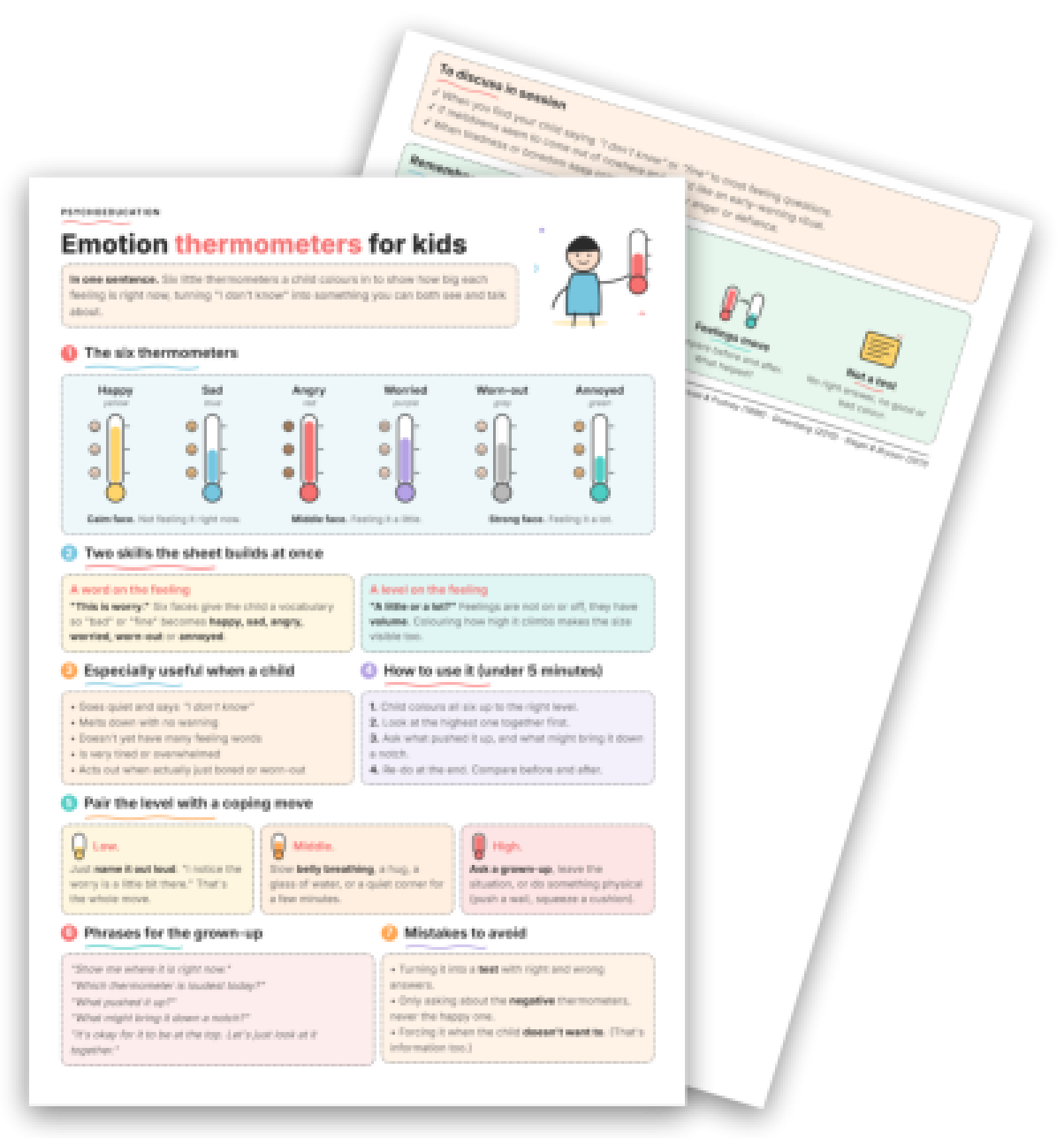
The printable centres on six thermometers, each assigned a colour and a feeling label: Happy (yellow), Sad (blue), Angry (red), Worried (purple), Worn-out (grey), and Annoyed (green). Each thermometer carries three facial expressions: calm (not feeling it), middle (feeling it a little), strong (feeling it a lot). The child colours each thermometer to whatever level fits. No verbal output is required to get started.
The fiche explicitly names the two competencies it builds simultaneously: a word on the feeling ("this is worry, not anger") and a level on the feeling ("feelings have volume, not just an on/off switch"). That dual framing is the core psychoeducational payload, and it is far easier to communicate with a coloured thermometer on the table than through an oral explanation alone.
Four ready-to-use adult prompts are embedded in the sheet: "Show me where it is right now," "Which thermometer is loudest today?", "What pushed it up?", and "What might bring it down a notch?" These anchor the debrief and require no adaptation. Paired coping guidance by level is also built in: low readings call for naming the emotion aloud; mid-range readings suggest slow belly breathing (which you can extend with the Belly Breathing for Kids worksheet); high readings prompt help-seeking or physical discharge. For deeper coping strategy work with children and adolescents, this tiered structure provides a natural bridge.
> Key point: The Emotion Thermometers fiche is a visual support that facilitates the explanation of feeling intensity in session. It is not a questionnaire to hand out and collect; it is a shared object clinician and child use together, in real time, to make an invisible internal state jointly visible.
Use it with your patients
Share this tool in the mobile app and follow the work between sessions.
When and How to Introduce It in Session
The fiche fits comfortably from the first or second contact, particularly during the psychoeducation phase of child-focused CBT or parent-child communication work. It is especially well-suited to:
- Children aged 5 to 12 who default to "fine" or "I don't know"
- Profiles with limited feeling vocabulary, mild developmental delay, or ASD features
- Presentations where meltdowns appear to arrive without warning (the thermometers function as an early-warning ritual when used at the start of each appointment)
- Inattentive or hyperactive profiles: the colouring task provides motor engagement while generating clinically useful data, making it effective alongside children's ADHD strategies
- Children who confuse tiredness or boredom with anger, a specific clinical pattern the fiche names and addresses
A minimal introduction works well: "I have a sheet with six thermometers. Could you colour each one up to show me how much of that feeling is here for you right now?" No diagnostic framing needed.
Debrief by starting with the highest thermometer. The fiche explicitly instructs this, and it prevents the conversation gravitating toward easier affects before the primary one. When anger is the dominant presenting affect, the Anger Thermometer resource offers a natural companion. When parental understanding of the child's emotional world is part of the work, frame the fiche inside anxiety in children and adolescents parent psychoeducation or the parent-child communication program to give caregivers the same language at home.
The one genuine contraindication is coercion. The fiche states it plainly: "Forcing it when the child doesn't want to is information too." A refusal is a clinical datum, not a failure of the tool. The fiche does not replace the therapeutic frame; it makes the explanation clearer and leaves the child with a concrete reference point between sessions.
Your session continues in your patients' pocket
Use with a patientYour resources, available everywhere
The handouts, exercises, programs and audios above: you choose which ones to make available to your patients, in the mobile app dedicated to them.
And far more than a library
The app goes well beyond resources, to support your patients every day:
Related categories
Explore other clinical resources by category.

Emotions
Clinical resources on emotion regulation: worksheets, coping tools, CBT, REBT, and ACT exercises for therapists working across diagnoses and age groups.

Relationships
Clinical worksheets and tools on relational functioning: attachment, schemas, assertiveness, and communication skills for therapists. Printable PDF resources.

Build awareness
Clinical worksheets and tools to build awareness in therapy: cognitive distortions, schemas, emotions, ACT and CBT resources for practitioners.

Regulate
Clinical resources for emotion regulation: worksheets, ACT exercises, and psychoeducation tools for affect regulation across diagnoses. For clinicians.
CBT
CBT worksheets, cognitive restructuring exercises & behavioral tools for clinicians. Evidence-based resources for every phase of cognitive behavioral therapy.

Emotion-focused
Emotion-focused therapy clinical resources: worksheets, exercises & programs for EFT practitioners working with individuals and couples.