
Clinical picture. A boy aged 8, referred for inattention and frequent homework-related meltdowns, attends a session with his mother after a school week marked by escalating evening conflicts. The clinician introduces the Children's ADHD Skill Packet and walks both of them through the ocean-breathing section, modelling the slow nasal inhale and pursed-lip exhale together in the room. The mother reports that practising the technique at the kitchen table before homework reduced the time spent in protest from roughly twenty minutes to five across the following two weeks. At the next session the boy demonstrated the breathing unprompted, describing it as "the wave thing I do when my body goes fast." No claim was made that the technique resolves attentional difficulties; it was framed as one coping tool within a broader plan.
Children's ADHD: PDF Worksheet, Tools and Exercises for Clinical Practice
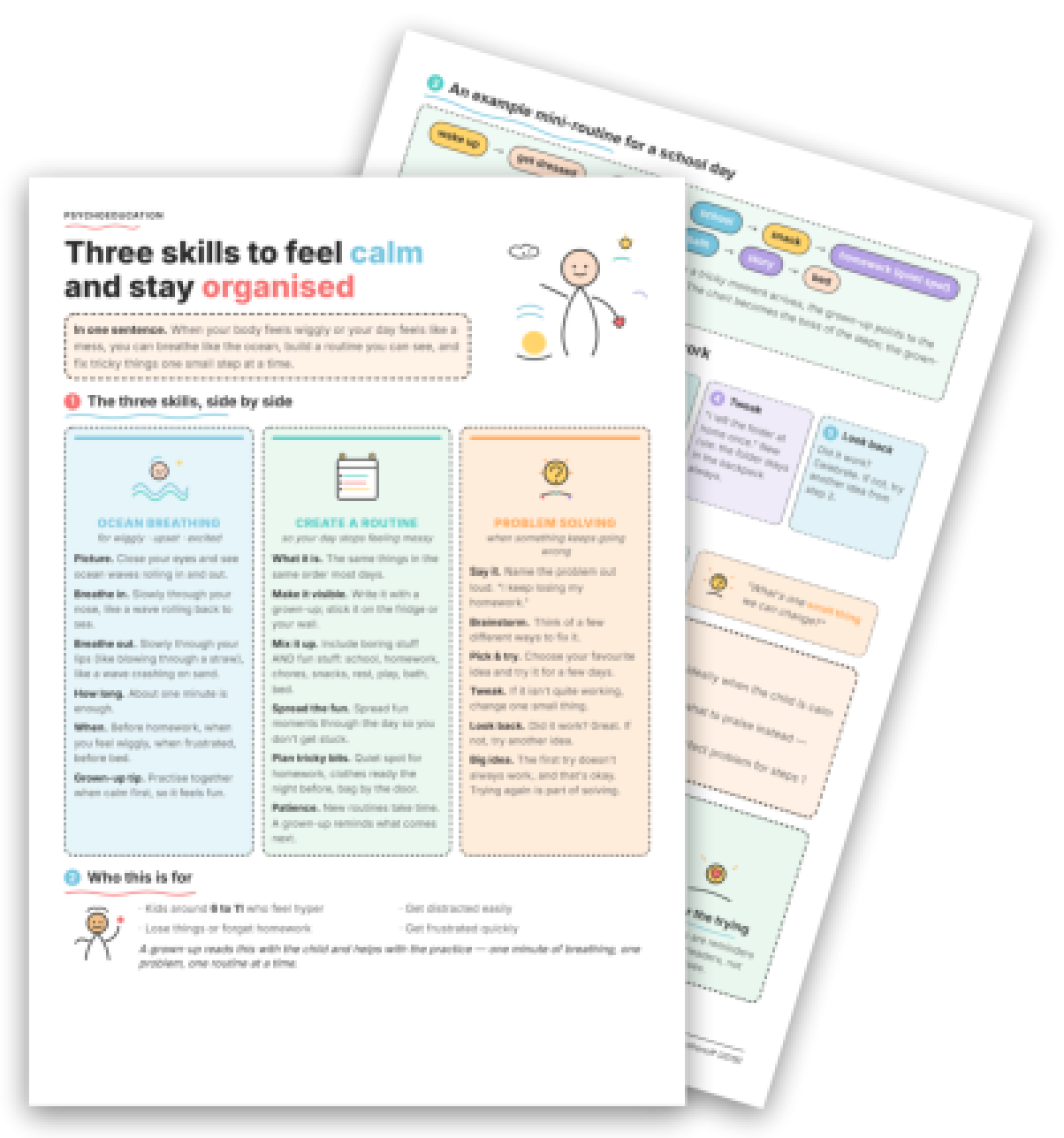
A visual psychoeducation worksheet presenting three concrete self-regulation skills for children aged 6 to 11 with ADHD, designed as a clinical in-session support.
Clinical vignettes
Breathing Anchor Before Homework
Visible Routine Reduces Morning Chaos
Clinical picture. A girl aged 10 with a confirmed ADHD diagnosis presents with chronic morning disorganisation: missed buses, forgotten kit, and daily arguments with her father before school. Using the routine-building section of the skill packet as a shared activity, the clinician guides father and daughter to write out a sequenced morning checklist, alternating obligatory steps with small preferred activities, then photograph it for the fridge. Over three weeks the father noted fewer prompted reminders and one full week without a forgotten item, though mornings remained variable on days with schedule changes. The exercise also shifted the relational tone: the daughter described having "her own plan" rather than being told what to do, which the clinician noted as a useful entry point for subsequent work on autonomy and self-monitoring.
Explaining self-regulation to a child with ADHD at the moment they are already dysregulated is, predictably, futile. This Children's ADHD Skill Packet PDF worksheet gives you a structured visual anchor to introduce three core skills, calmly, in session, with both child and caregiver present, so the concepts travel home rather than staying in the consultation room.
Use this resource with your patients
Handout, exercises and materials ready to use, right inside SessionFuel.
Why ADHD Self-Regulation Resists Verbal Explanation Alone
The challenge is not informational; caregivers generally understand that their child struggles with attention and impulse control. What they lack is a shared vocabulary and a visible structure they can refer to when things go wrong at 7 a.m. before school. Oral explanations, even clear ones, produce nodding in the office and paralysis at the kitchen table.
For children in the 6 to 11 age range, abstract psychoeducation about executive functioning simply does not register during emotional arousal. And caregiver instructions during a triggered moment (reminding, redirecting, repeating) tend to escalate the very dysregulation they are trying to reduce. What the dyad needs is an object that becomes authoritative in the caregiver's place: something on the fridge that the child can be pointed toward rather than spoken at.
This is equally relevant when you are working in parallel with the ADHD Parenting Tips worksheet, which addresses the caregiver's own regulatory and relational role.
What the Fiche Contains: Three Skills, Side by Side
The PDF worksheet presents its content across five numbered panels, and every element is grounded in the language a child can hold.
The first panel lays out the three skills in parallel columns: Ocean Breathing (a simple paced breathing exercise, approximately one minute, framed as waves rolling in and out), Create a Routine (making daily sequences visible and predictable), and Problem Solving (a five-step cycle: Say it, Brainstorm, Pick and try, Tweak, Look back). The side-by-side layout lets you point to each skill during the session without switching documents.
Panel three offers a concrete mini school-day routine (wake up through bed), with the explicit clinical note: "Read the chart, don't read the child", signalling to caregivers that the chart becomes the authority, and they shift into the role of cheerleader. This reframe alone tends to reduce the power-struggle dynamic you will have already mapped in your parenting fundamentals work.
Panel four walks through the Problem Solving steps in action, using the example of lost homework, with specific brainstormed solutions (a folder with a "to do" and "done" pocket) and an explicit tweak step. This concrete modelling is what distinguishes the fiche from a generic handout: it shows children and caregivers how iteration works, not just that it is allowed.
Panel five provides scripted caregiver phrases, including "Your brain just needs a plan it can see", which you can rehearse in session with the adult before the child encounters a difficult moment.
The closing "To discuss in session" checklist directs the clinician to identify one skill and one time of day to begin, flag the slip into over-directing, and bring any routine breakdown point into the next appointment as problem-solving material.
> Key takeaway: This fiche is a visual support that facilitates the explanation of ADHD self-regulation skills in session; it is not homework for the child to complete alone, but a shared reference object the caregiver and child take home after you have introduced and rehearsed the concepts together.
750+ clinical tools
A library built with and for clinicians, ready to use in session and extend between appointments.
Access all the toolsWhen and How to Introduce the Fiche
The natural moment is after initial assessment, once you have a formulation and have identified which of the three domains (arousal regulation, routine, problem-solving flexibility) is most pressing. Introducing all three simultaneously is fine because the layout is designed for selective focus: you can say, "We are going to start with just this one column this week."
For caregivers presenting with significant helplessness or high expressed emotion, begin with Ocean Breathing alone, because it is the only skill the adult can practise with the child during a calm moment before it is ever needed under stress. The fiche explicitly notes: "Practise together when calm first, so it feels fun." This instruction, visible on the sheet, tends to land better than when you say it verbally.
The worksheet pairs well with a token reward system for reinforcing routine compliance, and with coping strategies for children and adolescents when the emotional regulation profile is broader than ADHD alone. If the presenting child shows significant anxiety alongside attentional symptoms, the anxiety in children and adolescents parent program addresses the caregiver psychoeducation layer that this fiche does not cover.
For the breathing component specifically, belly breathing for kids offers a complementary visual if the ocean metaphor does not fit a given child's age or preference.
Debrief the fiche at the following session by asking which of the three elements the family actually tried, at what time of day, and where the routine broke down, because that breakdown point is the exact material for the Problem Solving steps 1 through 5. The CBT for Kids worksheet on thoughts, feelings, and actions can follow once the child is ready for a more cognitive framing of their reactions.
The fiche does not replace a full parent-child communication program or a behavioural formulation of case; it condenses three skill clusters into a format that survives the gap between sessions.
Use it with your patients
Share this tool in the mobile app and follow the work between sessions.
Sources
- Barkley, R. A. (2020). Taking Charge of ADHD: The Complete, Authoritative Guide for Parents (4th ed.). The Guilford Press.
- Barkley, R. A. (2015). Attention-Deficit Hyperactivity Disorder: A Handbook for Diagnosis and Treatment (4th ed.). The Guilford Press.
Your session continues in your patients' pocket
Use with a patientYour resources, available everywhere
The handouts, exercises, programs and audios above: you choose which ones to make available to your patients, in the mobile app dedicated to them.
And far more than a library
The app goes well beyond resources, to support your patients every day:
Related categories
Explore other clinical resources by category.

Emotions
Clinical resources on emotion regulation: worksheets, coping tools, CBT, REBT, and ACT exercises for therapists working across diagnoses and age groups.

Neurodevelopment
Clinical hub for neurodevelopmental disorders: psychoeducation, worksheets and intervention tools for ADHD, ASD, learning disorders and related conditions.

Understand
Clinical hub for the therapeutic aim 'Understand': worksheets and tools to build patient insight across CBT, ACT, schema therapy and more.

Regulate
Clinical resources for emotion regulation: worksheets, ACT exercises, and psychoeducation tools for affect regulation across diagnoses. For clinicians.

Build skills
Skill-building resources for clinicians: printable worksheets and exercises for coping, assertiveness, and communication skills training in therapy.
CBT
CBT worksheets, cognitive restructuring exercises & behavioral tools for clinicians. Evidence-based resources for every phase of cognitive behavioral therapy.