
Clinical picture. M., a 34-year-old software developer, presented with a long-standing ADHD diagnosis and persistent self-criticism; he described himself as "fundamentally lazy" despite working longer hours than most colleagues. During a brief psychoeducation session, the clinician introduced the informational sheet and spent time on the reframing section, helping M. replace the laziness narrative with a more accurate one: his brain required external scaffolding that neurotypical peers generated automatically. M. was asked to choose a single lever for the following week and selected structure, anchoring medication intake and a short planning ritual to existing mealtimes. At the next appointment he reported that two of the three anchor tasks had held, and that the self-critical internal commentary had been somewhat quieter once he had a working explanation for his difficulties.
Managing ADHD: PDF Worksheet, Tools and Exercises for Clinical Practice
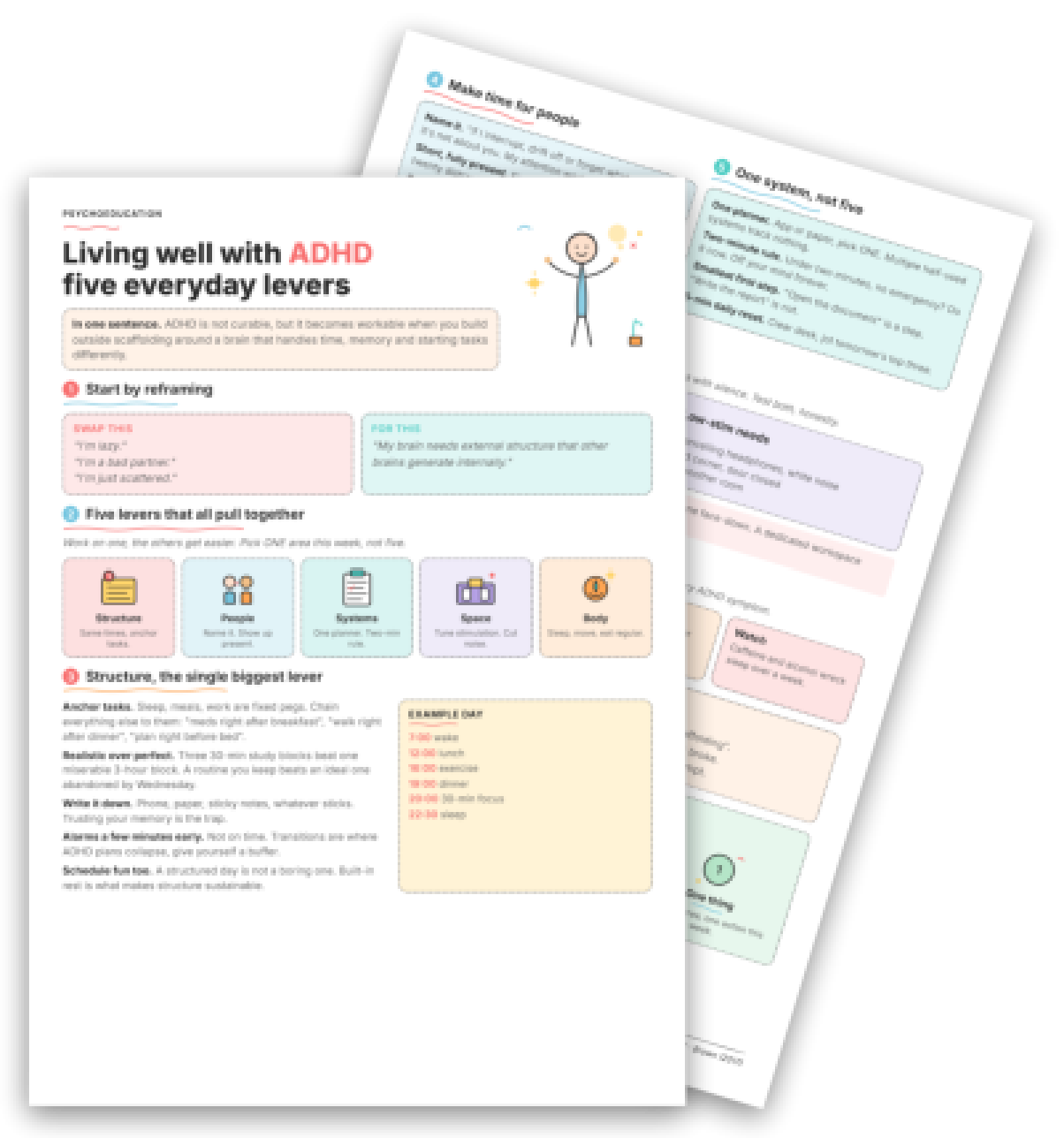
A structured visual fiche to explain ADHD's five key levers in session, build external scaffolding with your patient, and leave them with a concrete, actionable reference.
Clinical vignettes
Reframing Before Building Structure
Relationship Strain and ADHD Disclosure
Clinical picture. T., a 28-year-old woman referred following relationship difficulties, met criteria for ADHD and reported that her partner regularly interpreted her mid-conversation distractibility as disinterest. Using the "Make time for people" section of the sheet, the clinician introduced the concept of brief, phone-away contact as more effective than longer distracted interactions. T. practiced a short disclosure script in session and used it with her partner the same week, framing her attentional pattern as a neurological feature rather than a relational choice. Her partner's response was cautiously receptive, and T. noted that the repair phrase from the sheet, asking to have something repeated without apology, reduced the frequency of conflict around missed conversational cues.
Explaining ADHD's functional impact to an adult patient often stalls at the same point: they intellectually accept that their brain works differently, then walk out still calling themselves lazy. The gap between conceptual understanding and daily behavior change is wide, and oral explanation alone rarely closes it. This fiche PDF gives you a structured visual anchor to bridge that gap in session, shifting the frame and handing the patient a practical reference they can actually use.
Use this resource with your patients
Handout, exercises and materials ready to use, right inside SessionFuel.
Why ADHD Is Hard to Explain Without a Visual Support
The core clinical obstacle is not the diagnosis itself but the self-attribution of deficit. Patients presenting with ADHD, whether newly identified in adulthood or years post-diagnosis, typically operate with an entrenched shame narrative: "I'm lazy," "I'm a bad partner," "I'm just scattered." Oral psychoeducation challenges this, but the challenge evaporates between sessions. What patients retain is emotion, not mechanism.
A second obstacle is executive function diffuseness. ADHD does not degrade one discrete capacity; it disrupts time perception, working memory, initiation, and transition management simultaneously. Naming each deficit verbally produces a list the patient cannot hold. A visual layout showing how these difficulties cluster and interact differently, as the fiche does through its five-lever framework, makes the architecture legible in a way that spoken words do not.
For patients presenting with comorbid all-or-nothing thinking or chronic procrastination patterns, the shame attribution is typically even more entrenched, and the reframing work correspondingly more pressing.
750+ clinical tools
A library built with and for clinicians, ready to use in session and extend between appointments.
Access all the toolsWhat the Fiche Contains and Why the Visual Layout Matters
The fiche opens with a direct reframing panel: swap "I'm lazy" for "My brain needs external structure that other brains generate internally." Having this printed in two columns, side by side, lets you point to it during session rather than narrate it. Patients who have heard the reframe verbally often respond differently when they see it in black and white.
From there, the fiche maps five levers (Structure, People, Systems, Space, Body) and explains that "work on one, the others get easier," with one key instruction: "Pick ONE area this week, not five." Each lever is then unpacked across dedicated panels:
- Structure covers anchor tasks, an example daily schedule (wake, lunch, exercise, dinner, focus block, sleep), and the principle that a routine you keep beats an ideal one abandoned by Wednesday.
- People addresses how ADHD presents relationally: naming attentional drift to partners, staying briefly but fully present, and repairing quickly ("I drifted, can you say that again?" is framed explicitly as a skill, not a failure).
- Systems introduces the two-minute rule, single-planner discipline, and the smallest-first-step principle ("Open the document" is a step; "Write the report" is not).
- Space distinguishes high-stimulation from low-stimulation environments and emphasizes killing distractors before starting, not during.
- Body reframes sleep, movement, and regular meals not as lifestyle extras but as direct modulators of tomorrow's attention and impulse threshold.
The fiche closes with a "To discuss in session" section containing three concrete prompts, giving you a ready-made debrief scaffold at the next appointment.
> Key point: this fiche is a visual support that facilitates the explanation of ADHD's functional logic in session; it is not a self-help checklist the patient completes alone, but a shared reference you work through together, then leave with them as a between-session anchor.
Use it with your patients
Share this tool in the mobile app and follow the work between sessions.
When and How to Propose It
The fiche fits naturally at the psychoeducation phase, typically sessions two to four, once the anamnèse has surfaced the executive function profile and the patient has begun articulating the self-attribution patterns you want to challenge. It is particularly indicated for:
- Adults with a recent ADHD diagnosis who have not yet developed a functional model of their own difficulties
- Patients whose relational or occupational complaints are driven by active listening deficits or disorganization rather than mood
- Parents you are also seeing for ADHD parenting strategies, who benefit from holding the same conceptual map as their child's clinician
- Adolescent patients, alongside the complementary children's ADHD resource
Introduce it without pathologizing the frame: "I have a one-page visual that summarizes exactly how we've been talking about your brain's needs. Let's go through it together now." Walk through the reframing panel first, invite the patient's reaction, then move lever by lever. Ask them to identify which single lever feels most tractable this week, consistent with the fiche's own instruction.
At the next session, use the three "To discuss in session" prompts on the fiche as your opening: which moment did the routine collapse, what repair attempt happened, when did the lazy narrative resurface? The fiche structures the debrief as cleanly as it structures the initial explanation.
For patients who also need help mapping their current activity patterns or building realistic new habits, the fiche pairs well with those exercises as concurrent between-session work. Where executive dysregulation overlaps with difficulty prioritizing tasks, the Eisenhower matrix can complement the Systems lever directly. And for patients whose ADHD intersects with chronic fatigue or exercise avoidance, the Body panel opens a concrete entry point into that domain without repositioning the session's focus.
The fiche does not replace formulation or medication review; it makes the psychoeducational layer more efficient and more durable.
Your session continues in your patients' pocket
Use with a patientYour resources, available everywhere
The handouts, exercises, programs and audios above: you choose which ones to make available to your patients, in the mobile app dedicated to them.
And far more than a library
The app goes well beyond resources, to support your patients every day:
Related categories
Explore other clinical resources by category.

Identity
Clinical resources for self-identity work in therapy: CBT, ACT, schema tools for clinicians addressing self-concept, core beliefs, and identity disruption.

Relationships
Clinical worksheets and tools on relational functioning: attachment, schemas, assertiveness, and communication skills for therapists. Printable PDF resources.

Neurodevelopment
Clinical hub for neurodevelopmental disorders: psychoeducation, worksheets and intervention tools for ADHD, ASD, learning disorders and related conditions.

Understand
Clinical hub for the therapeutic aim 'Understand': worksheets and tools to build patient insight across CBT, ACT, schema therapy and more.

Build skills
Skill-building resources for clinicians: printable worksheets and exercises for coping, assertiveness, and communication skills training in therapy.

CBT
CBT worksheets, cognitive restructuring exercises & behavioral tools for clinicians. Evidence-based resources for every phase of cognitive behavioral therapy.