
Clinical picture. M., a man in his mid-forties, presented with mild depressive symptoms and a growing sense of emotional distance from his partner of twelve years; no acute relational crisis was identified. The therapist introduced the Keeping the flame alive exercise as structured homework, inviting M. to work through its five questions between sessions. M. found question three particularly generative: he had not considered that small verbal expressions of appreciation had gradually disappeared from his daily interactions, not through indifference but through habit. At the following session he reported having sent two brief affectionate messages during the week, which his partner had acknowledged warmly. The exercise did not resolve the broader depressive picture, yet it restored a modest sense of relational agency that M. described as meaningful.
Keeping the Flame Alive: A Relational Maintenance Exercise
A structured homework exercise helping patients deliberately nurture daily love and sustain relational warmth in long-term committed relationships.
Clinical vignettes
Rekindling Intentionality After Routine Sets In
Sustaining Warmth Amid Caregiver Fatigue
Clinical picture. L., a woman in her late thirties, was seen in individual therapy following a period of significant professional and domestic overload; her long-term relationship had become, in her words, logistical rather than affectionate. The clinician proposed the Keeping the flame alive exercise, framing it as an opportunity to identify what was already working before adding new demands. Working through question two, L. recognized that she consistently organized shared weekend breakfasts, a practice her partner valued but that she had begun to experience as routine rather than intentional. Naming that gesture explicitly shifted her perception of it. Her commitment at the close of the exercise was modest: one short shared walk per week without phones. At review, she noted the walk had taken place twice and that the anticipation itself had felt restorative.
What Makes Relational Maintenance So Hard to Address Clinically
Long-term couples rarely come to therapy saying "we've stopped nurturing each other." They come with accumulated grievances, communication breakdowns, or a vague sense of drift. The proactive dimension of relational maintenance gets crowded out by problem-focused work. Yet research on relationship maintenance behaviors consistently shows that what couples do when things are fine largely determines their resilience when things are not.
The difficulty is not conceptual. Most patients understand, in the abstract, that small daily attentions matter. What resists verbal explanation is the translation: from "I know I should invest more" to a concrete, personally-owned commitment. That gap between intention and behavior is precisely where a structured written exercise, completed by the patient on their own, does work that conversation in the consulting room cannot.
This exercise answers a specific clinical need: helping the patient who is motivated but stuck in vagueness to articulate what they already do well, identify what they could add, and commit to something specific.
Use this resource with your patients
Handout, exercises and materials ready to use, right inside SessionFuel.
What the Exercise Contains
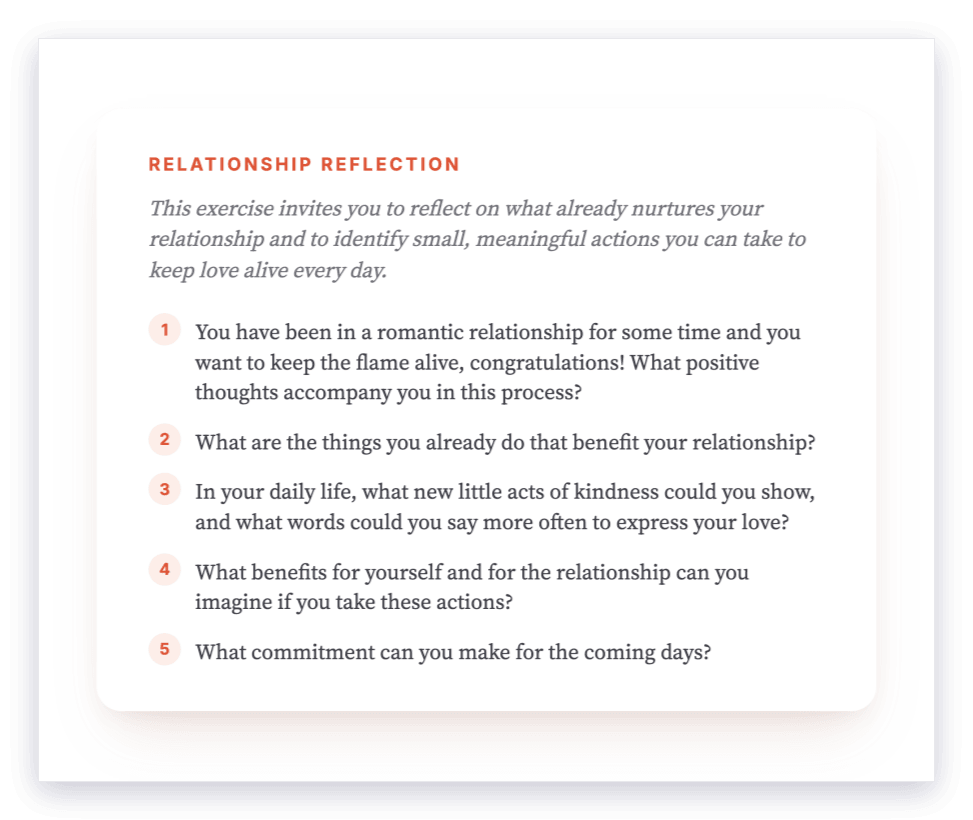
The exercise opens with a positive framing: the patient is explicitly acknowledged for wanting to nurture their relationship. The first question invites them to name the positive thoughts that accompany this motivation, anchoring the work in genuine internal resources rather than pressure or guilt. This is not incidental. It primes the patient to approach the rest of the exercise from a position of agency.
The second question asks what the patient already does that benefits the couple. This builds on existing strengths before adding anything new, a structure closely aligned with the Couple's Strengths Exploration approach and consistent with the relational gratitude work described in the Relational Gratitude: Reactivating Appreciation in Couples exercise.
Key insight: The sequence matters: strengths before gaps, imagination before commitment. This order makes behavioral change more likely because it is built on what is already working.
The third question shifts to prospective action: small daily attentions and words the patient could add. This is where the exercise connects naturally to relationship rituals and to the love language translation work introduced in the The Five Love Languages fiche. Question four anchors the motivational arc by asking the patient to imagine concrete benefits for themselves and for the relationship, a forward-projection that consolidates engagement. The fifth and final question asks for specific commitments for the coming days, transforming reflection into a behavioral plan.
The image above lists the five questions in order. Note that this is a static preview only: the patient does not work from this image. The full guided exercise, with the introductory instructions and dedicated space to write each answer, is experienced by the patient on their own in the app, between sessions.
This exercise is available to your patients through the SessionFuel patient app, the mobile interface reserved for the patients of clinicians who use SessionFuel: you assign the exercise from your clinician dashboard, and the patient completes it directly on their phone, autonomously, between two appointments.
750+ clinical tools
A library built with and for clinicians, ready to use in session and extend between appointments.
Access all the toolsHow to Integrate It Into Your Practice
This exercise is most useful for patients in stable or recovering couples who are motivated to invest but need structure to move from intention to action. It suits individual therapy as well as couples work where only one partner is in treatment. It does not require the relationship to be in crisis; it works best when things are calm enough for the patient to think constructively.
Introduce it by naming the gap it addresses directly: "I'd like you to think about what you already do well for the relationship, and what small things you could add. There's a structured exercise that will walk you through that between now and our next appointment." Patients who have already worked with Building New Habits or the Goal-Setting and Behavior Change exercise will recognize the structure and engage more quickly.
When the patient brings their answers back, the clinical yield is substantial. The specific commitments from question five become a natural follow-up thread: did they follow through, what made it easier or harder, what did they notice in their partner's response. The attentions they named in question three can inform deeper work on relationship values or desire and sexual satisfaction if those areas are part of the therapeutic focus. The existing strengths named in question two are often underestimated by the patient and worth reflecting back explicitly.
Use it with your patients
Share this tool in the mobile app and follow the work between sessions.
Articulations Worth Considering
This exercise fits naturally within the Long-Term Relationships psychoeducation program and alongside the Weekly Couples Relationship Check-In as a complementary, more action-focused complement to regular self-monitoring. For couples where communication gaps are the primary concern, the Couples Communication program provides the broader psychoeducation frame. For patients where the exercise surfaces a sharper relational tension, the Detecting Couple Misalignment exercise offers a natural next step.
Your session continues in your patients' pocket
Use with a patientYour resources, available everywhere
The handouts, exercises, programs and audios above: you choose which ones to make available to your patients, in the mobile app dedicated to them.
And far more than a library
The app goes well beyond resources, to support your patients every day:
Related categories
Explore other clinical resources by category.

Relationships
Clinical worksheets and tools on relational functioning: attachment, schemas, assertiveness, and communication skills for therapists. Printable PDF resources.

Build skills
Skill-building resources for clinicians: printable worksheets and exercises for coping, assertiveness, and communication skills training in therapy.

Engage & motivate
Clinical hub: printable worksheets and exercises to build therapeutic engagement and motivation across ACT, CBT, and integrative practice. For clinicians.

Positive psychology
Positive psychology clinical resources for therapists: worksheets, exercises & programs on well-being, strengths, gratitude, and resilience-based practice.

Solution-focused
Clinical hub for Solution Focused Therapy resources: worksheets, exercises and programs for goal-oriented, strengths-based practice across individual and couple work.

Anxiety
Clinical hub for anxiety disorders: CBT and ACT worksheets, psychoeducation sheets, and exercises for assessment and treatment across the anxiety spectrum.