
Clinical picture. A and B, both in their early forties, presented after two years of increasing emotional distance; both reported feeling like housemates rather than partners, despite shared meals every evening. The clinician introduced the relationship ritual worksheet and invited them to examine the routine-versus-ritual distinction, noting that their current dinners met no named intention. They agreed to a small, concrete shift: phones placed in another room, one candle lit, and a single opening question asked by turns. At the three-week follow-up, neither partner rated the intervention as dramatic, yet both described a tangible sense of having actually met during those meals, a description consistent with the worksheet's framing of felt connection.
Relationship Rituals: PDF Worksheet, Tools and Exercises for Couples Work
A visual PDF worksheet with tools and exercises to help couples understand, design, and protect the small repeated moments that keep connection alive in session.
Clinical vignettes
Ritual Over Routine in Couples Therapy
Protecting Connection During High-Stress Period
Clinical picture. C, a 36-year-old in individual therapy for work-related burnout, raised a secondary concern: their relationship felt like collateral damage of the past several months. The clinician used the worksheet to distinguish protection of time from size of activity, emphasising that a brief, defended ritual holds more relational value than an elaborate one that keeps being cancelled. C chose a 10-minute morning coffee with their partner before screens were opened, naming the moment out loud to their partner as intentional rather than incidental. Over the following month C reported no resolution to the burnout, but noted the ritual had created a small, consistent point of contact that reduced the sense of relational drift.
In couples work, the concept of intentional connection is easy to name and surprisingly hard to operationalise. Patients understand intellectually that they should carve out time together, then leave the session without a concrete structure to protect. This PDF worksheet on relationship rituals gives you a session-ready visual support to close that gap, moving the conversation from vague good intentions to a specific, defensible commitment.
Use this resource with your patients
Handout, exercises and materials ready to use, right inside SessionFuel.
Why "Just Spend More Time Together" Doesn't Land in Session
The instinctive clinician move is to contrast quality time with quantity time. Patients nod, agree, and change nothing. What resists here is the conflation of routine and ritual: two people can share a daily dinner, a morning coffee, an evening on the sofa, and still experience chronic relational drift. Without naming what makes a moment intentional, the recommendation stays abstract.
This confusion is especially visible in couples where one partner reads shared proximity as connection and the other does not. The result is a classic alliance rupture around effort and reciprocity, and it often stalls couples work on communication patterns before the deeper material even surfaces. A visual side-by-side that externalises the difference is far more efficient than re-explaining in session.
The same dynamic appears in long-term relationships where habituation has quietly eroded salience. The long-term relationship psychoeducation program and the healthy relationship program both point to deliberate micro-practices as a key maintenance mechanism. The fiche gives that mechanism a shape patients can actually grasp.
What the Worksheet Contains: A Visual Framework for In-Session Psychoeducation
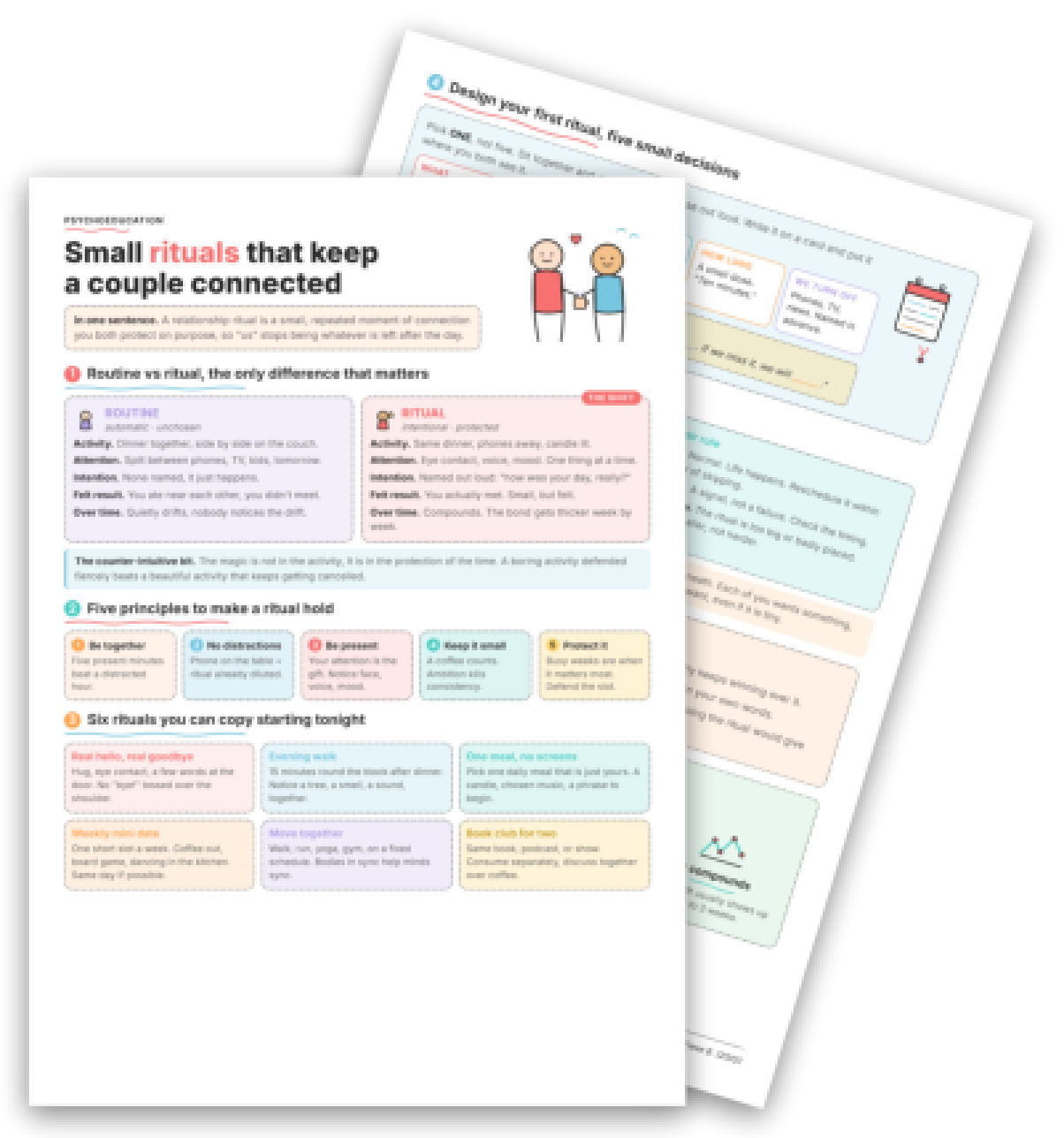
The fiche PDF is structured across five panels, each building on the last. The opening panel draws a direct two-column comparison between routine and ritual, tracking the same activity (dinner, a coffee) across four dimensions: attention, intention, felt result, and long-term effect. This layout does what verbal explanation rarely achieves: it shows patients that the activity itself is not the variable. The worksheet states it plainly: "The magic is not in the activity, it is in the protection of the time."
Panel 2 sets out five principles for sustaining a ritual (presence, no distractions, small scope, named intention, active protection), formatted for rapid in-session reading. Panel 3 offers six concrete examples couples can adopt immediately: a real hello and goodbye with eye contact, a weekly screen-free meal, a 15-minute evening walk, a shared book or podcast discussed over coffee. These are not hypothetical. Patients with attachment insecurity or high relational avoidance often need exactly this level of behavioural specificity to move forward.
Panel 4 is the design grid: five decisions (what, when, where, how long, what you turn off) plus a fill-in commitment sentence, "Our ritual is ____. We do it on ____ at ____. We turn off ____. If we miss it, we will ____." This is the piece patients take home with them. Panel 5 addresses the three most common failure modes (too ambitious, leaky boundaries, no time anchor) and the repair rule for one, two, or three consecutive misses, a graduated response that reframes rupture as signal rather than failure.
> Key point: The worksheet is a visual support that facilitates the explanation in session, not a form patients fill out alone. You work through the routine-versus-ritual grid together, agree on the five design decisions out loud, and hand the sheet over as a concrete reference, not as homework requiring interpretation.
750+ clinical tools
A library built with and for clinicians, ready to use in session and extend between appointments.
Access all the toolsWhen and How to Introduce This Worksheet
This fiche PDF fits naturally after an initial anamnèse has clarified that relational disconnection, and not a specific conflict pattern, is the presenting complaint. It works well in the second or third session, once the therapeutic alliance is sufficient for both partners to engage with a joint task. It is also a strong re-engagement tool mid-treatment when progress has plateaued and the couple has reverted to parallel living.
For couples where conflict is primary, pair this sheet with communication exercises first. The ritual framework presupposes basic goodwill; if contempt is active, introducing it too early will be received as naive.
A low-pressure framing: "I'd like to show you something that distinguishes two things that look the same but feel very different." Open directly to the routine-versus-ritual table, let both partners read it, and ask which column their current evenings look like. The debrief writes itself from there.
Assign the weekly couple check-in exercise or the relational gratitude exercise as parallel between-session work to reinforce what the ritual is building. If desire is part of the clinical picture, the sexual life in couples program and the keeping the flame alive exercise extend the work naturally.
The fiche does not resolve conflict, rebuild trust after rupture, or substitute for a trust-focused psychoeducation program. What it does is give a disconnected couple a very small, very protected first step, and a shared vocabulary to talk about whether they are actually taking it.
Use it with your patients
Share this tool in the mobile app and follow the work between sessions.
Sources
- Gottman, J. M., & Silver, N. (1999). The Seven Principles for Making Marriage Work. Crown Publishers.
- Doherty, W. J. (2013). Take Back Your Marriage: Sticking Together in a World That Pulls Us Apart (2nd ed.). The Guilford Press.
- Doherty, W. J. (1999). The Intentional Family: Simple Rituals to Strengthen Family Ties. Quill / HarperCollins.
- The Gottman Institute (2017). 5 Rituals to Reconnect in Your Relationship.
Your session continues in your patients' pocket
Use with a patientYour resources, available everywhere
The handouts, exercises, programs and audios above: you choose which ones to make available to your patients, in the mobile app dedicated to them.
And far more than a library
The app goes well beyond resources, to support your patients every day:
Related categories
Explore other clinical resources by category.
Relationships
Clinical worksheets and tools on relational functioning: attachment, schemas, assertiveness, and communication skills for therapists. Printable PDF resources.

Build skills
Skill-building resources for clinicians: printable worksheets and exercises for coping, assertiveness, and communication skills training in therapy.

Engage & motivate
Clinical hub: printable worksheets and exercises to build therapeutic engagement and motivation across ACT, CBT, and integrative practice. For clinicians.

Integrative
Integrative therapy clinical resources: worksheets, psychoeducation programs, and exercises for eclectic, multimodal practice across orientations.

Anxiety
Clinical hub for anxiety disorders: CBT and ACT worksheets, psychoeducation sheets, and exercises for assessment and treatment across the anxiety spectrum.
Trauma
Clinical hub on trauma and PTSD: assessment, differential diagnosis, treatment phases, and printable resources for practitioners. 155 chars.