
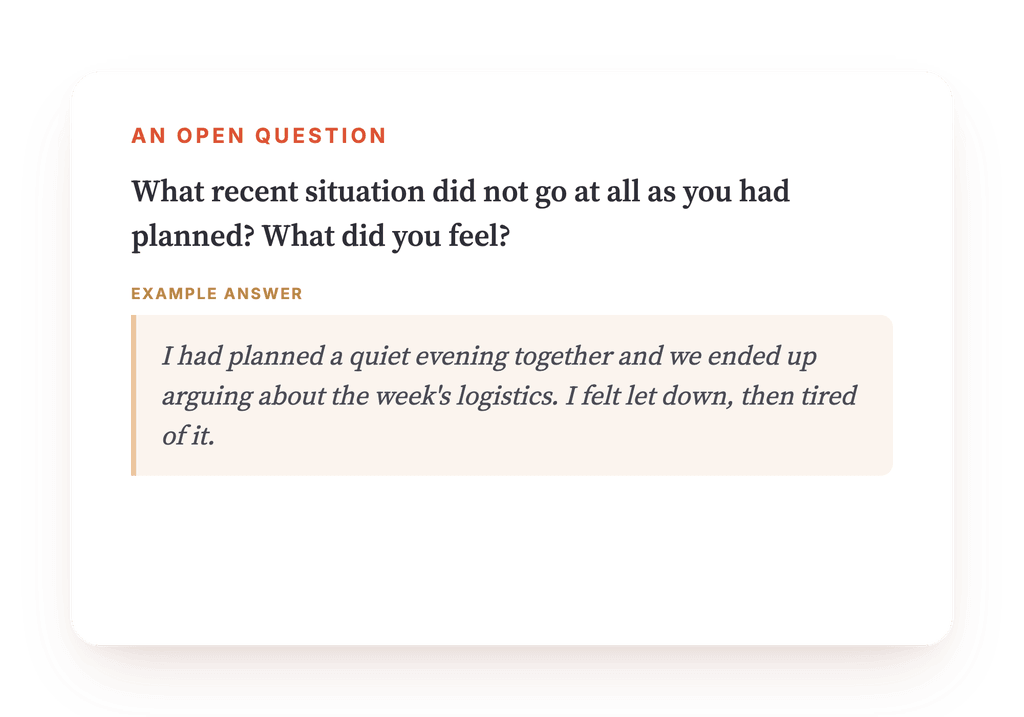
Clinical picture. A. and her partner, both in their early forties, were referred following a period of recurring conflict that neither could clearly articulate. A. described chronic low-grade resentment and said she felt her partner had "stopped trying." The clinician introduced the long-term relationship psychoeducation program, starting with Lesson 1 on expectations, which invited A. to reflect in writing on a recent situation that had not gone as planned and to identify her own unspoken assumptions. Over the following week, A. completed the guided prompts at her own pace and returned to the session having written at length about a holiday that had felt like a failure; she acknowledged, with some surprise, that she had never communicated her expectations to her partner beforehand. This small shift in perspective did not resolve the couple's difficulties, but it gave the clinician a concrete entry point for exploring how unexamined expectations were driving the resentment.
Long-Term Relationships: A Structured Psychoeducation Program
Help patients examine expectations, cultivate evidence-based relational habits, and navigate in-law dynamics with a step-by-step autonomous program.
Clinical vignettes
Mismatched Expectations in a Long Partnership
Rebuilding Communication After Prolonged Conflict
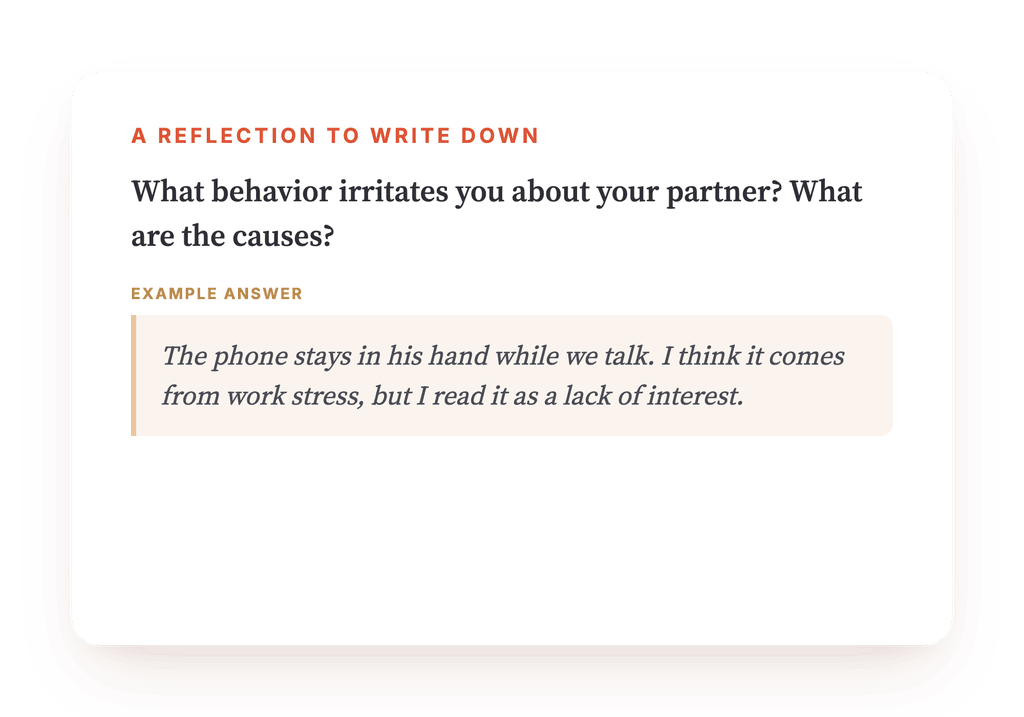
Clinical picture. M., aged 58, sought individual support after a significant rupture with his partner of twenty years; he described feeling that any conversation about the future ended in an argument. The clinician introduced Lesson 2 of the program, which covers constructive practices in long-term relationships, and asked M. to work through the unit on non-judgmental communication before the next appointment. M. found the prompt identifying specific irritating behaviours difficult to complete honestly, and he brought his hesitation back to the session, which opened a productive discussion about the difference between describing a behaviour and attributing it to character. Progress was modest and incremental; by the end of that lesson M. was able to name one recurring pattern without framing it as a verdict on his partner.
Use this resource with your patients
Handout, exercises and materials ready to use, right inside SessionFuel.
What Makes Long-Term Relationships Clinically Tricky to Address
Long-term couples present a specific therapeutic challenge: the problems are rarely dramatic, but they are deeply entrenched. Patients have often stopped noticing the small daily patterns, the creeping resentment after unmet expectations, the avoidance of genuine reconciliation after conflict, the progressive erosion of individual identity inside the couple, because those patterns have become invisible through repetition.
Explaining these dynamics verbally in a consultation has real limits. A clinician can name the concept of shared vision or the value of maintaining individuality within the couple, but the patient nods and then faces the same week with no structured way to examine their own situation. What is needed is a scaffold that prompts reflection between appointments, where the real relational life actually happens.
This program answers that need directly. It covers the full arc of long-term relational health: from expectation management and letting go, through concrete maintenance habits, to one of the most consistently underaddressed topics in couples work, namely in-law dynamics and generational friction.
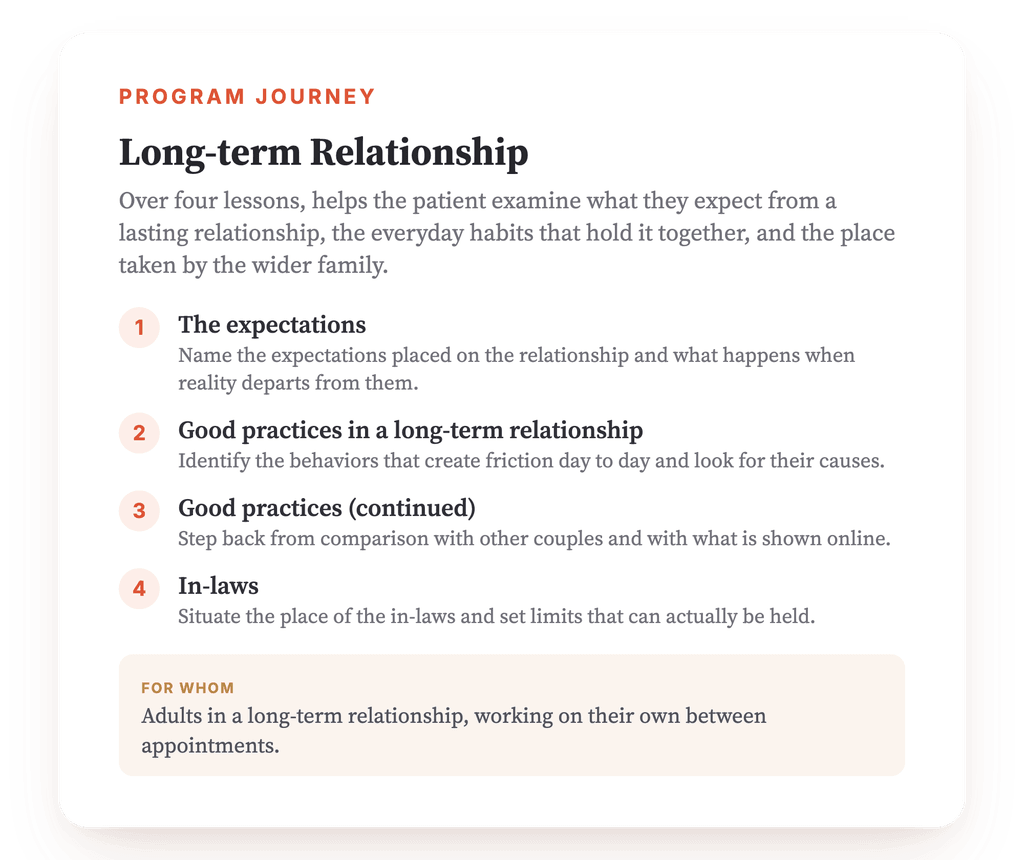
What the Program Contains: Four Lessons, One Clear Arc
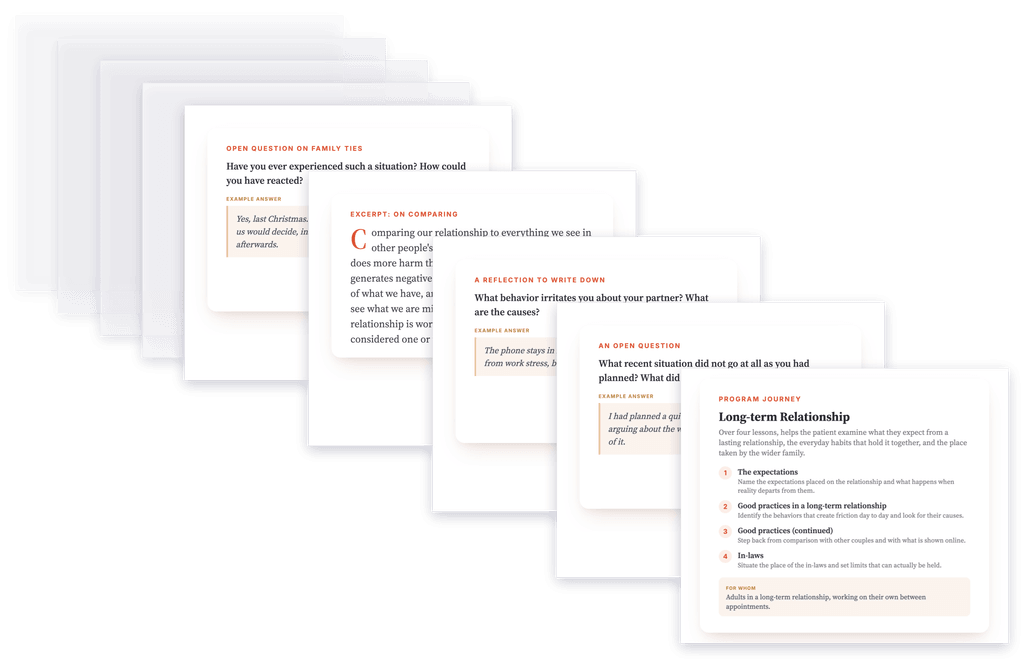
The program is built around four structured lessons, each combining psychoeducation text with guided written prompts that invite the patient to apply the content to their own relationship.
Lesson 1, Expectations opens with the art of letting go and moves through the function of disappointment in long-term relationships, ending with a prompt on shared five-year goals as a concrete tool for aligning relational vision. This connects naturally to work you may already be doing with tools like the Relationship Compatibility: A Structured Psychoeducation Program or the Couple Misalignment and Values: A Guided Clinical Exercise.
Lessons 2 and 3, Best Practices form a continuous sequence. The first covers staying calm and honest, suspending judgment, and the critical importance of genuine reconciliation after conflict, a theme you can deepen with the How to Apologize: PDF Worksheet, Tools and Exercises for Clinical Practice or the Ten Principles for Healthy Conflict: PDF Worksheet, Tools and Exercises. The second continues with avoiding social comparison, protecting individual identity, building shared goals, and deliberately sustaining the "date" dimension of the relationship. The Keeping the Flame Alive: A Relational Maintenance Exercise and the Relationship Rituals: PDF Worksheet, Tools and Exercises for Couples Work pair well here.
Lesson 4, In-Laws addresses three profiles of difficult in-law dynamics (intrusive, critical, openly conflictual) as well as generational and worldview differences. This lesson includes a prompt inviting the patient to imagine what they would genuinely want to say to their in-laws, which can generate rich clinical material.
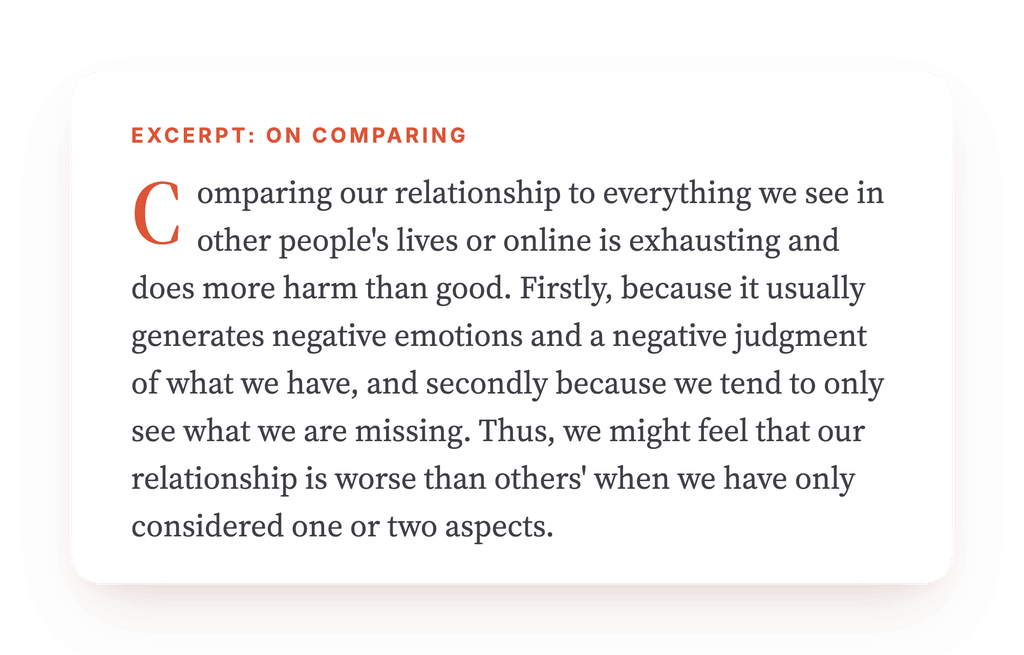
These preview images show only a small fraction of the program. The complete curriculum contains far more lessons, steps, guided prompts, and reflection exercises than what is visible here, the screenshots are a brief aperçu, not a representative sample.
This program is available to your patients through the mobile application that serves as the patient-side interface of SessionFuel: once you assign it in SessionFuel, your patient receives it directly on their phone and completes each lesson autonomously, at their own pace.
750+ clinical tools
A library built with and for clinicians, ready to use in session and extend between appointments.
Access all the toolsHow to Assign It and Make Use of What Patients Bring Back
Key insight: The program's value lies in the written reflections patients produce between sessions, these are the clinical raw material, not a secondary benefit.
This program suits a broad range of patients: couples seen individually who want to understand and improve their long-term dynamic, partners preparing for a significant transition (living together, marriage, blended family), or individuals in long-term relationships who present with vague dissatisfaction or creeping distance.
Introduce it simply: "I'd like you to work through a structured program between our appointments. It will ask you to read and then write about your own relationship. There are no right answers, just honest ones." This framing normalises the homework and reduces performance anxiety.
In terms of timing, Lesson 1 works well early in the work, especially if expectations and disappointment are central to the presenting complaint. Lessons 2 and 3 suit patients who have identified their relational patterns and are ready to work on concrete habits. Lesson 4 can be assigned when in-law conflict is active or when the patient mentions family-of-origin friction affecting the couple.
When the patient returns, open with their written responses rather than a summary question. A prompt like "What came up for you in the section on reconciliation?" gives you access to specific material rather than general impressions. The responses to prompts about shared goals or individual activities often reveal underlying unmet needs worth exploring further, the Behavior, Emotion, Underlying Need: PDF Worksheet, Tools and Exercises can extend that work. If the in-law lesson surfaces deeper attachment material, the Attachment Styles in Romantic Relationships: PDF Worksheet, Tools and Exercises provides a useful parallel frame.
For patients working on communication patterns in parallel, this program articulates well with the Communication Skills in Couples: A Psychoeducation Program, the Nonviolent Communication for Couples: PDF Worksheet, Tools and Exercises, or the Weekly Couples Relationship Check-In: A Guided Exercise as an ongoing between-session ritual alongside the program.
Use it with your patients
Share this tool in the mobile app and follow the work between sessions.
Articulations Worth Considering
Patients who find the letting go theme in Lesson 1 particularly activating may benefit from a parallel look at Healthy Relationships: A Psychoeducation Program for Clinicians or the Relationship Maintenance Behaviors: PDF Worksheet, Tools and Exercises, both of which reinforce complementary foundations. For patients where trust is the organising clinical theme beneath the long-term difficulty, the Trust in Relationships: A Structured Psychoeducation Program provides a natural continuation after this program's arc is complete.
Your session continues in your patients' pocket
Use with a patientYour resources, available everywhere
The handouts, exercises, programs and audios above: you choose which ones to make available to your patients, in the mobile app dedicated to them.
And far more than a library
The app goes well beyond resources, to support your patients every day:
Related categories
Explore other clinical resources by category.

Relationships
Clinical worksheets and tools on relational functioning: attachment, schemas, assertiveness, and communication skills for therapists. Printable PDF resources.

Understand
Clinical hub for the therapeutic aim 'Understand': worksheets and tools to build patient insight across CBT, ACT, schema therapy and more.

Build skills
Skill-building resources for clinicians: printable worksheets and exercises for coping, assertiveness, and communication skills training in therapy.

Integrative
Integrative therapy clinical resources: worksheets, psychoeducation programs, and exercises for eclectic, multimodal practice across orientations.

Positive psychology
Positive psychology clinical resources for therapists: worksheets, exercises & programs on well-being, strengths, gratitude, and resilience-based practice.
Anxiety
Clinical hub for anxiety disorders: CBT and ACT worksheets, psychoeducation sheets, and exercises for assessment and treatment across the anxiety spectrum.