
Clinical picture. T., a woman in her early 40s, presents with low-grade dysphoria and persistent ambivalence about her eight-year partnership; she describes feeling "invisible" but struggles to articulate specific concerns. The clinician introduces the Compatibility program as between-session structured work, beginning with Lesson 1, which prompts T. to reflect on whether she feels valued and how her partner supports her personal growth. She returns the following week having completed the first lesson and notes, with some surprise, that her written responses to the guided prompts revealed a consistent pattern of unmet emotional needs rather than the vague dissatisfaction she had initially reported. This greater specificity gave the subsequent session a clearer focus and reduced her tendency to globally catastrophise the relationship.
Relationship Compatibility: A Structured Psychoeducation Program
A multi-lesson autonomous program helping patients examine emotional fit, shared values, conflict patterns, and life vision in their romantic relationship.
Clinical vignettes
Reassessing a Long-Term Relationship
Navigating Values Divergence as a Couple
Clinical picture. M., a man in his mid-30s, seeks individual therapy after recurring arguments with his partner about finances and long-term plans; both partners had agreed he would work on this between sessions. The clinician assigns Lesson 2 of the Compatibility program, which guides M. through identifying his core values and reflecting on areas of sexual and relational compatibility. He arrives at the next appointment having completed the lesson and acknowledges, for the first time, that several disagreements trace back to a genuine difference in foundational values rather than poor communication alone. The clinician and M. use this material to weigh whether the divergence is workable, without either minimising the difficulty or foreclosing the relationship prematurely.

Use this resource with your patients
Handout, exercises and materials ready to use, right inside SessionFuel.
The Clinical Challenge: Why Compatibility Is So Hard to Think Through Clearly
Patients who come to you questioning their relationship rarely lack opinions about their partner. What they lack is a structured framework for examining compatibility honestly, across the dimensions that actually determine long-term relational viability. Left to their own rumination, they oscillate between idealization and catastrophizing, and the word "compatibility" stays frustratingly vague.
Oral psychoeducation helps only so far. Explaining that compatibility involves values alignment, conflict style, sexual fit, practical life vision, and individual autonomy in one conversation tends to produce nodding, not genuine reflection. The concepts do not stick, and the patient returns the following week no clearer than before. What the work needs is structured, repeated contact with these questions across several steps, with writing prompts that force specificity.
This is exactly where the Compatibility program earns its place.
750+ clinical tools
A library built with and for clinicians, ready to use in session and extend between appointments.
Access all the toolsWhat the Program Contains
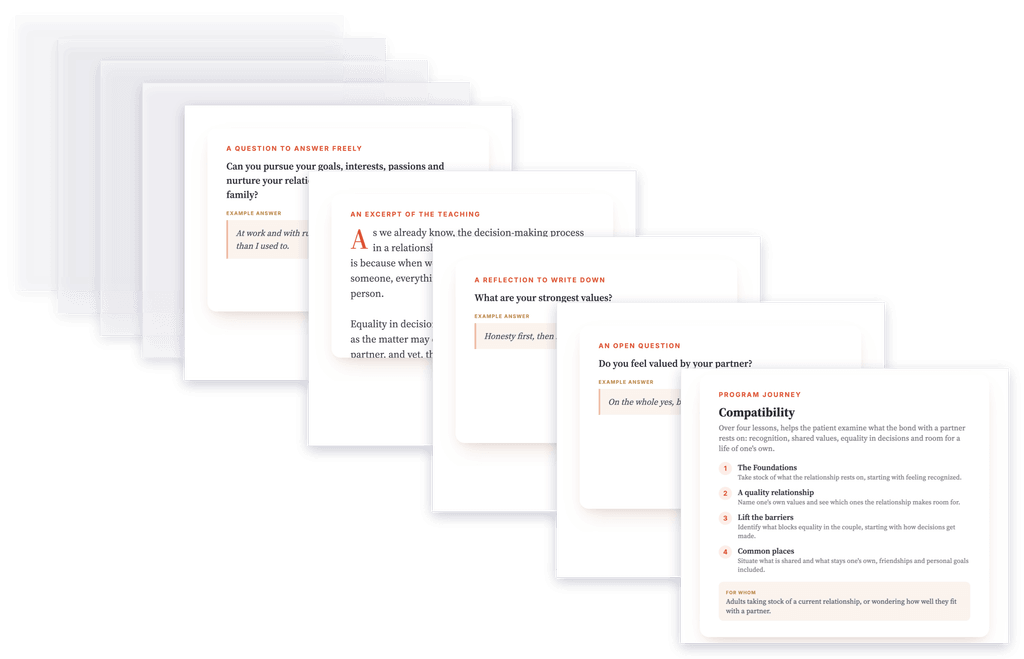
The program unfolds across four lessons, each targeting a distinct layer of relational assessment.
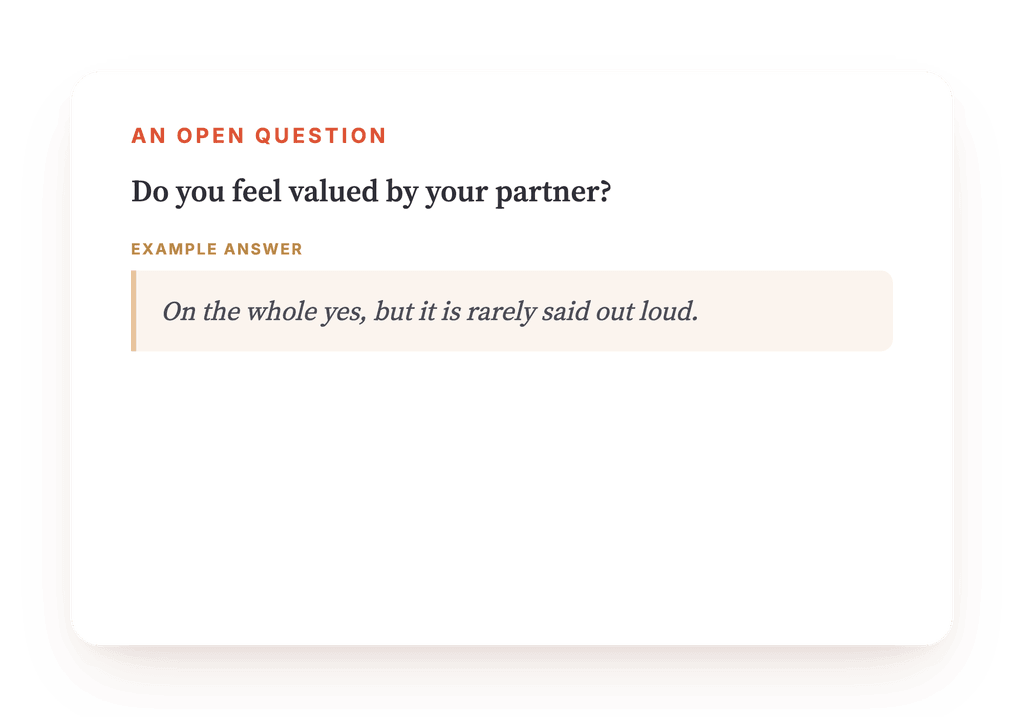
Lesson 1, "The Foundations," opens with the emotional dimension: not just whether the patient feels in love, but whether they feel genuinely valued and supported in their personal growth. It then moves deliberately toward practical life factors, shared daily habits, finances, family expectations, and a shared vision of the future. These are the areas patients often avoid raising until they become crises.
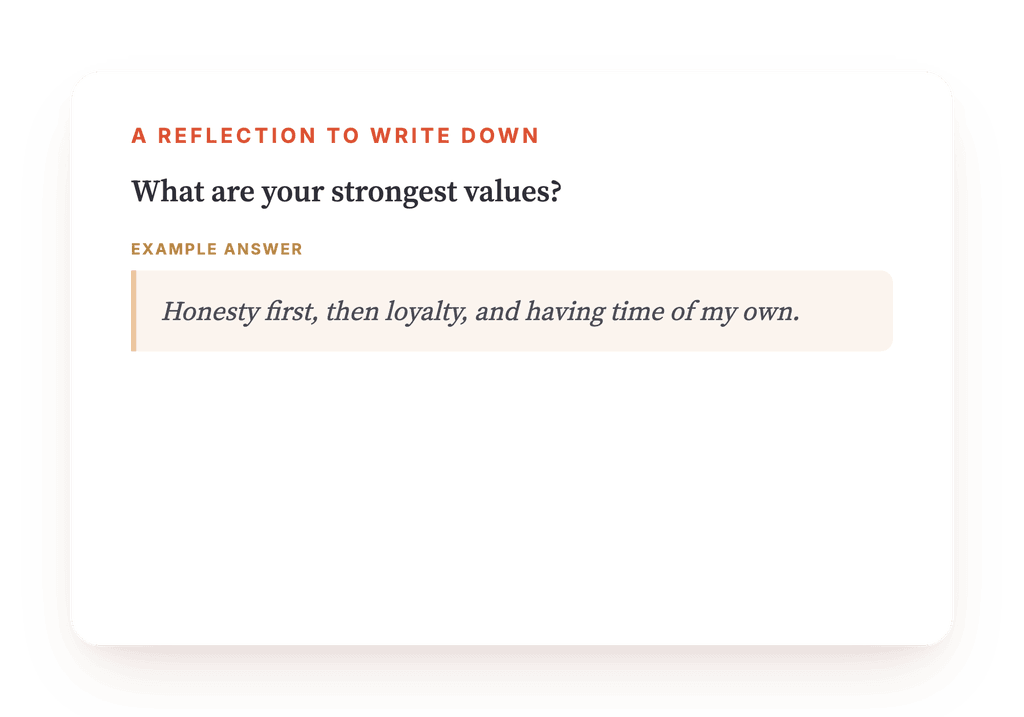
Lesson 2, "A Quality Relationship," takes the patient into territory that is clinically rich and often avoided: core values divergence, sexual compatibility and its link to emotional intimacy, conflict patterns (including limit-crossing behavior), and the shared ground that binds the couple together. The Couple Misalignment and Values exercise and Relationship Values worksheet are natural companions to this lesson.
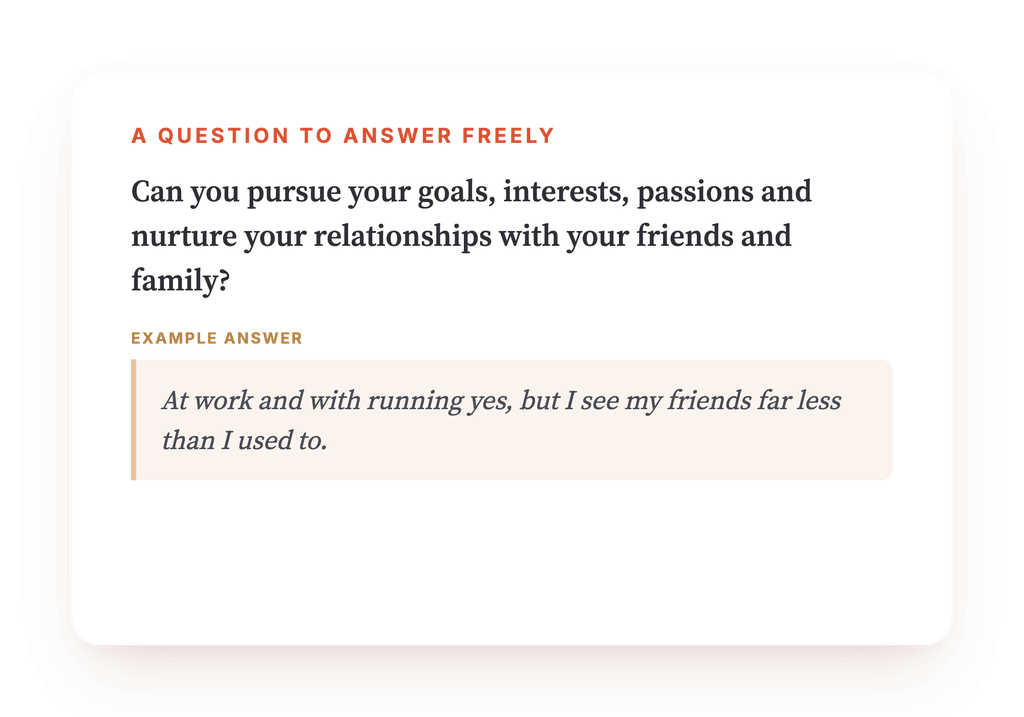
Lesson 3, "Removing Barriers," shifts to what the patient should never compromise: their relationship with themselves, their friendships, their goals, their passions. It examines shared decision-making equity and helps patients articulate where individual identity risks being eroded. This connects directly to questions you might explore with the Enmeshment / Undeveloped Self Schema fiche or the Identity Exploration worksheet.
Lesson 4, "Common Ground," addresses the "opposites attract" phenomenon through a psychological lens, examines the reality of in-law dynamics, and explores what cohabitation actually reveals. It closes with the reminder that no universal rule governs partner choice, only the non-negotiable of protecting one's own mental health.
This program is available to patients through the mobile application that is the dedicated patient-side interface of SessionFuel: you assign the program to your patient directly from your SessionFuel account, and they complete each lesson step by step on their phone, on their own, between appointments.
The previews embedded here (an overview map and a few sample cards) show only a small fraction of the program. The complete program is far richer, with many more lessons, steps, guided prompts, and reflection exercises than what these excerpts can convey.
Key insight: Compatibility is not a static trait a couple either has or lacks. It is a set of negotiable and non-negotiable dimensions that patients can learn to examine, name, and discuss, which is precisely what this program teaches them to do.
Use it with your patients
Share this tool in the mobile app and follow the work between sessions.
Integrating the Program as Between-Session Work
Assign this program as structured homework between consultations, to patients who are actively questioning their relationship's viability, whether they have just begun dating someone, are considering a long-term commitment, or are mid-crisis and wondering whether to stay.
It suits patients who tend toward rumination or avoidance when left to reflect alone: the step-by-step format gives their reflection a container. It also works well alongside Conflict in Romantic Relationships, Healthy Relationships, or Compromise in Relationships for patients who need a broader curriculum.
Introduce it simply: "Between now and our next meeting, I'd like you to work through the first lesson or two of this program on your own. Take your time with the writing prompts, there are no right answers."
When the patient returns, their written responses become your clinical raw material. The values prompt in Lesson 2 pairs naturally with the Exploring Values or Values Clarification fiches. Their answers about conflict and limit-crossing open space to introduce Nonviolent Communication for Couples or Fair Fighting Rules. What they write about individual passions and personal autonomy can anchor a conversation using the Relationship Green Flags fiche or Relationship Maintenance Behaviors.
The patient does the excavation. You guide what they bring back.
Your session continues in your patients' pocket
Use with a patientYour resources, available everywhere
The handouts, exercises, programs and audios above: you choose which ones to make available to your patients, in the mobile app dedicated to them.
And far more than a library
The app goes well beyond resources, to support your patients every day:
Related categories
Explore other clinical resources by category.
Relationships
Clinical worksheets and tools on relational functioning: attachment, schemas, assertiveness, and communication skills for therapists. Printable PDF resources.

Build awareness
Clinical worksheets and tools to build awareness in therapy: cognitive distortions, schemas, emotions, ACT and CBT resources for practitioners.

Build skills
Skill-building resources for clinicians: printable worksheets and exercises for coping, assertiveness, and communication skills training in therapy.

Integrative
Integrative therapy clinical resources: worksheets, psychoeducation programs, and exercises for eclectic, multimodal practice across orientations.
Solution-focused
Clinical hub for Solution Focused Therapy resources: worksheets, exercises and programs for goal-oriented, strengths-based practice across individual and couple work.

Anxiety
Clinical hub for anxiety disorders: CBT and ACT worksheets, psychoeducation sheets, and exercises for assessment and treatment across the anxiety spectrum.