
Clinical picture. M., a woman in her early forties, presents with low sexual desire of several months' duration following a period of professional burnout; her partner has begun withdrawing affectively. The clinician introduces the five-question exercise as a between-session reflection, asking M. to rate her sexual life on the 1-to-10 scale and then write down the emotions the current situation generates. At the next session M. reports a score of 3, names shame and guilt as dominant emotions, and recognises that she has been deflecting her partner's approaches without acknowledging them. Building on question 5, she commits to one small weekly intention: initiating a non-sexual moment of physical closeness on two evenings. The outcome is modest but tangible; M. describes the exercise as the first time she had reflected on desire as something she could actively tend rather than wait to recover.
Desire and Sexual Life: A Guided Couples Reflection Exercise
A structured five-question exercise helping patients assess sexual satisfaction, name emotions, and commit to concrete weekly intentions.
Clinical vignettes
Naming Avoidance Before It Widens
Shifting From Complaint to Agency
Clinical picture. T., a man in his mid-thirties in a two-year relationship, reports recurring conflict around sexual frequency and a sense that desire has become a source of pressure rather than pleasure. The clinician frames the exercise as a structured check-in rather than an evaluation, inviting T. to work through questions 3 and 4 with particular care: what went well, and what share of the difficulty belongs to him. T. returns noting, with some surprise, that he had minimised two positive exchanges earlier in the week while amplifying a single disappointment. His engagement with question 5 produces a concrete commitment to reduce critical comments when a sexual overture is declined. The shift from grievance to personal responsibility, however partial, opens a more productive line of work in subsequent sessions.
The Clinical Need: Why Desire Is Hard to Put Into Words
Sexual desire sits at the intersection of body, emotion, relational history, and self-image. Many patients can describe their anxiety or grief with relative ease. Few can do the same for sexual dissatisfaction. The topic triggers shame, avoidance, or minimization, and even when a patient does raise it, the exchange tends to stay vague: "things have cooled down a bit," "we're not very connected right now." These phrases gesture toward something real without producing clinical traction.
The difficulty is not only taboo. Desire fluctuates week to week, and patients rarely track those fluctuations consciously. They arrive with a diffuse sense that something is off but cannot identify what specifically went well, what did not, or what emotional state is feeding their behavior toward their partner. A purely verbal exchange in a consultation rarely changes that. Written, structured reflection does.
This exercise gives patients a concrete language for an unspeakable domain: it asks them to slow down, rate, name, differentiate, and commit, steps that are genuinely hard to replicate in a spoken clinical exchange alone.
Use this resource with your patients
Handout, exercises and materials ready to use, right inside SessionFuel.
What the Tool Contains
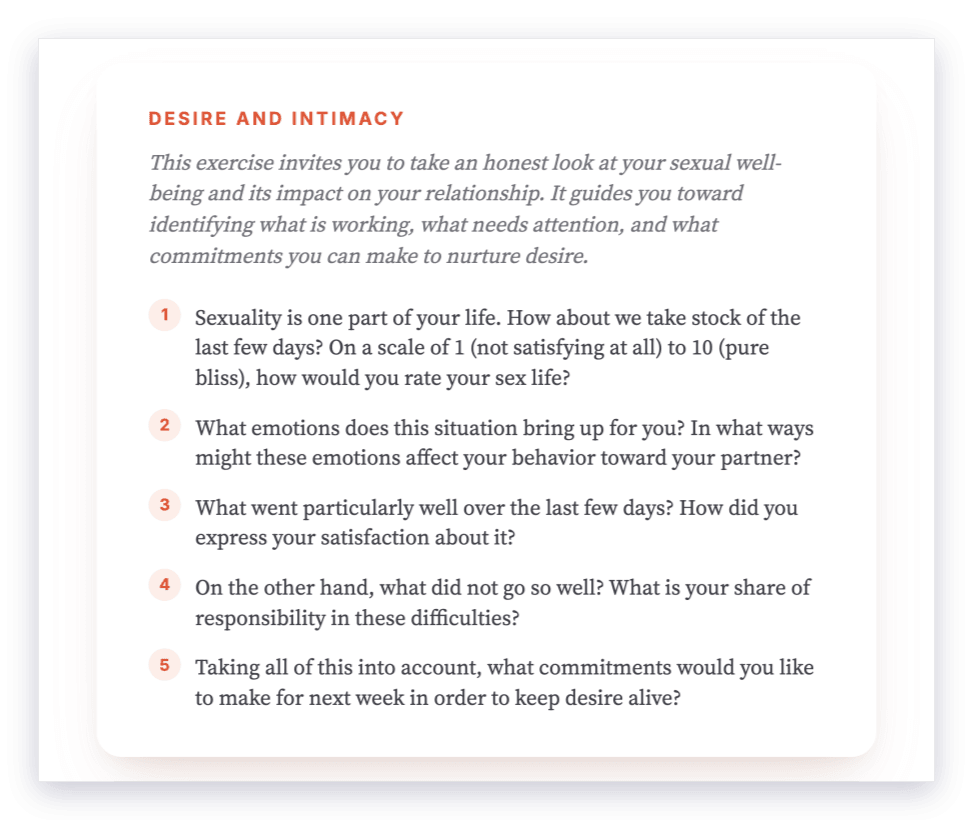
The exercise opens with a 1-to-10 rating of the patient's sexual life over the past few days, anchored between two poles ("not satisfying at all" and "seventh heaven"). That number does more than score satisfaction: it immediately positions the patient as a deliberate observer of their own experience rather than a passive actor within it.
The second question draws out the emotional layer and its behavioral consequence, asking what emotions the current situation generates and how those ripple into behavior toward the partner. This is where the exercise links individual internal states to relational dynamics, a connection frequently invisible without this kind of prompt. It pairs naturally with existing work on behavior, emotion, and underlying need.
Questions three and four introduce a deliberate positive-negative balance. The patient names what went well and, critically, how they expressed that satisfaction, then identifies what went less well and examines their own share of responsibility in those difficulties. This symmetrical structure prevents the exercise from becoming a complaint list and begins building genuine relational self-accountability.
The fifth question is where the exercise lands: the patient formulates concrete weekly commitments to sustain desire. This forward-looking prompt transforms reflection into intention and prepares the clinical material you will work from at the next appointment.
The image above lists all five questions in sequence with a short introductory context. This is a static preview only: the full guided exercise, with patient-facing instructions and space to write, is experienced by the patient independently in the app, and that complete interactive version is not visible here.
This exercise is available to patients through the mobile application that is the dedicated patient-side interface of SessionFuel: the clinician assigns it as homework, and the patient then completes it directly on their phone, on their own, between two appointments.
750+ clinical tools
A library built with and for clinicians, ready to use in session and extend between appointments.
Access all the toolsUse it with your patients
Share this tool in the mobile app and follow the work between sessions.
Assigning It Between Sessions: Which Patients, How to Introduce It, What to Do With the Output
This exercise suits individuals or couples where sexual satisfaction is either a presenting concern or an underexplored dimension of broader relational difficulty. It fits naturally alongside the Sexual Life in Couples: A Structured Psychoeducation Program and is equally relevant when a patient in individual work mentions low desire or disconnection without framing it as a "sexual problem."
To introduce it, no medicalization is needed. A direct framing is enough: "Between now and our next appointment, I'd like you to reflect on your experience of desire this week using a guided set of questions." Patients who feel uneasy naming the topic aloud often find the written, private format far less threatening than a live verbal exchange.
When the patient returns, the numerical score alone opens a discussion: what does that number mean to them, and what would need to shift for it to move one point upward? The emotional and behavioral material from question two connects directly to ongoing work on couple misalignment or communication patterns in the couple. The responsibility question frequently surfaces avoidance or projection patterns worth pursuing further.
The commitments in question five function as a micro-behavioral contract: specific, short-term, and returnable at the next appointment. You can place them alongside the Weekly Couples Relationship Check-In or the Keeping the Flame Alive exercise to build a consistent relational maintenance practice over time.
Key insight: When patients can rate, name emotions, and take responsibility for their sexual experience, they move from diffuse dissatisfaction to workable clinical material. This exercise creates that shift autonomously, between sessions, before you ever open the topic together.
For patients whose relational difficulties extend beyond desire, this exercise pairs well with work on the five love languages, relational gratitude, and relationship maintenance behaviors. For a wider picture of the couple's overall functioning, the Romantic Life Assessment and the Relationship Compatibility: A Structured Psychoeducation Program offer useful adjacent entry points.
Your session continues in your patients' pocket
Use with a patientYour resources, available everywhere
The handouts, exercises, programs and audios above: you choose which ones to make available to your patients, in the mobile app dedicated to them.
And far more than a library
The app goes well beyond resources, to support your patients every day:
Related categories
Explore other clinical resources by category.

Relationships
Clinical worksheets and tools on relational functioning: attachment, schemas, assertiveness, and communication skills for therapists. Printable PDF resources.

Solution-focused
Clinical hub for Solution Focused Therapy resources: worksheets, exercises and programs for goal-oriented, strengths-based practice across individual and couple work.
Anxiety
Clinical hub for anxiety disorders: CBT and ACT worksheets, psychoeducation sheets, and exercises for assessment and treatment across the anxiety spectrum.

Trauma
Clinical hub on trauma and PTSD: assessment, differential diagnosis, treatment phases, and printable resources for practitioners. 155 chars.

Mood
Evidence-based worksheets and clinical tools for mood disorders: CBT, ACT, and positive psychology resources for psychologists and therapists.

Identity
Clinical resources for self-identity work in therapy: CBT, ACT, schema tools for clinicians addressing self-concept, core beliefs, and identity disruption.