
Clinical picture. A and B, a couple in their early forties, presented after two years of escalating conflict, both reporting feeling unloved despite what each described as genuine effort. A regularly organised weekend outings and put the phone away during meals; B consistently left appreciative notes and verbally acknowledged A's contributions at home. In session, the clinician introduced the five love languages framework as a psychoeducational tool, inviting each partner to identify their primary channel independently before sharing. A identified quality time; B identified words of affirmation, and both recognised with some surprise that their gestures, though sincere, had been directed at themselves rather than at the other. Over the following two sessions, the couple began experimenting with deliberately offering love in the partner's language, reporting a modest but noticeable shift in feeling received.
The Five Love Languages: PDF Worksheet, Tools and Exercises
A visual PDF worksheet to help clinicians explain love language mismatches in session, build shared relational vocabulary, and move couples from grievance to translation.
Clinical vignettes
Mismatch Reframed in Couples Therapy
Acts of Service Misread as Criticism
Clinical picture. C, a 35-year-old in individual therapy for low mood within a long-term relationship, described a recurring pattern: a partner who constantly tidied, cooked unasked, and managed household logistics, which C experienced as implicit criticism of C's own organisation. The clinician offered the informational sheet on love languages as a between-session reading, asking C to return with observations rather than conclusions. At the next appointment, C reported recognising acts of service as the partner's dominant language and reflected that the behaviour, previously read as controlling, was more plausibly an expression of care delivered in an unfamiliar dialect. This reframe did not resolve all tension, though it visibly reduced the attribution of hostile intent and opened a more productive conversation about explicit requests.
In couples work, the partner who "does so much" and the one who "never feels loved" are often both loving sincerely, just in entirely different channels. The disconnect isn't a deficit of feeling; it's a translation failure. This PDF worksheet on the Five Love Languages gives clinicians a concrete visual support to name that mismatch in session, shift the frame from grievance to language learning, and leave both partners with a shared vocabulary they can actually use between appointments.
Use this resource with your patients
Handout, exercises and materials ready to use, right inside SessionFuel.
Why the mismatch is so hard to surface verbally
Chapman's model is deceptively simple to state and genuinely difficult to apply in the room. When you explain love languages verbally, couples often hear a personality-typing exercise: "I'm a Words person, he's a Touch person, nothing to be done." The concept flattens fast. Two dynamics make it especially resistant to oral explanation alone.
First, each partner is convinced they are loving. Through the lens of Attachment Styles in Romantic Relationships, partners with avoidant organization express love through acts, not words, and are genuinely baffled when it goes unacknowledged. Second, the complaint each partner voices is usually the clearest available data, but they don't hear it that way. Helping them decode "you never tell me I'm doing well..." as a request for Words of Affirmation, rather than a character attack, is exactly where Communication Styles work meets language theory.
A visual layout showing all five channels side by side, with their corresponding behavioral examples and what hurts when each is neglected, makes the mismatch legible in a way that a verbal description alone rarely achieves.
What the worksheet contains
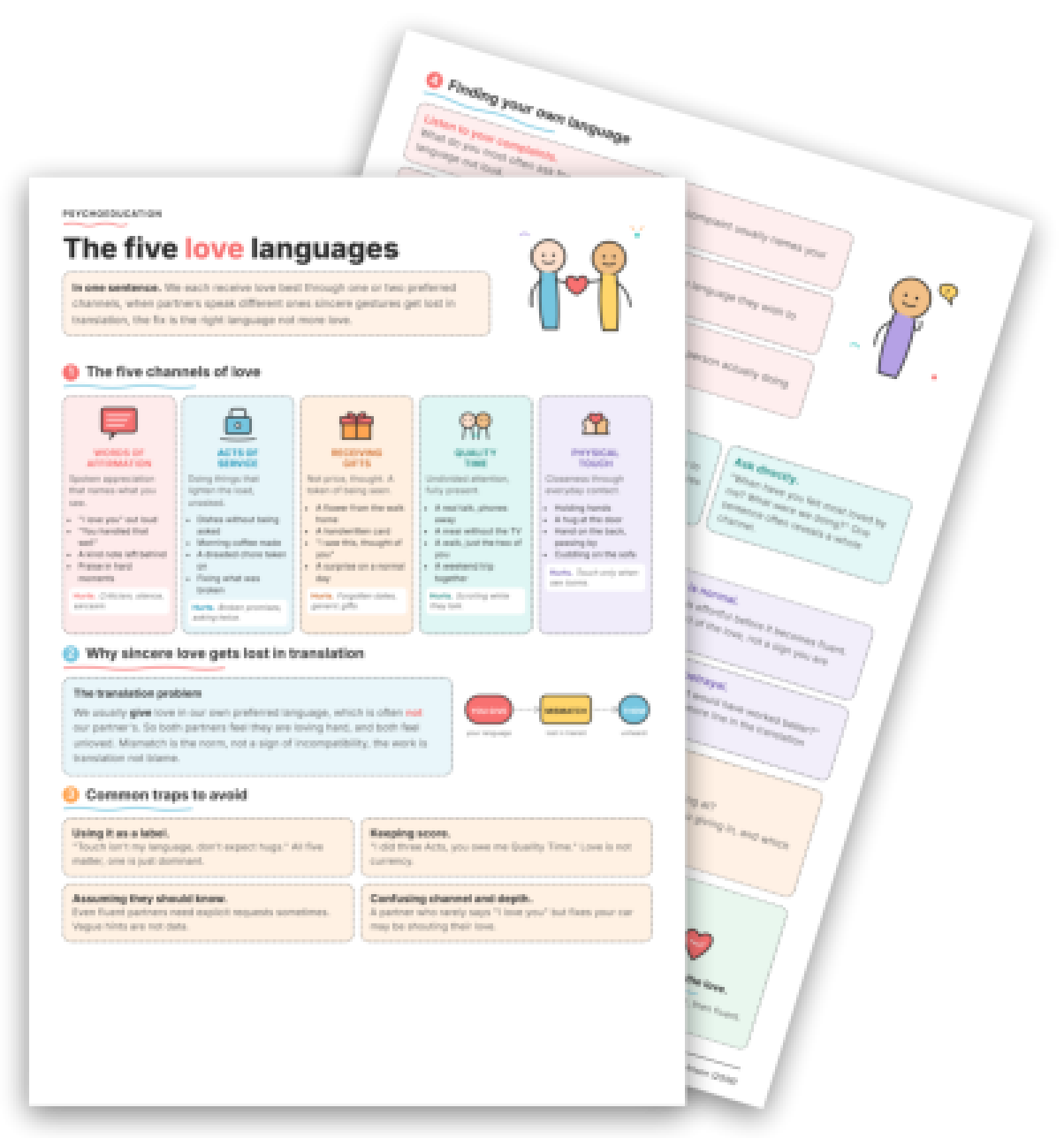
The fiche opens with a one-sentence clinical reframe: "the fix is the right language not more love." Seeing that printed, rather than spoken, removes the sting from the explanation and pre-empts the defensive reading.
Panel 1 maps the five channels: Words of Affirmation, Acts of Service, Receiving Gifts, Quality Time, and Physical Touch. For each, the fiche gives concrete behavioral examples ("a hug at the door", "dishes without being asked") alongside what specifically hurts when that channel is starved ("scrolling while they talk", "broken promises, asking twice"). This behavioural granularity is what Fair Fighting Rules and Assertive Communication work builds on: moving from vague reproach to observable, discussable acts.
Panel 2 is a three-step diagram: YOU GIVE (your language) → MISMATCH (lost in transit) → THEM (unheard). Drawn on the worksheet rather than sketched on a whiteboard mid-session, it holds its clarity as a take-home reference.
The fiche then addresses four common traps: using the model as a fixed label, keeping score across languages, assuming the partner should intuit what is needed, and confusing the channel with the depth of feeling. Two parallel sections guide patients to identify their own dominant language and their partner's through complaints, spontaneous gestures, and direct questions. A closing "To discuss in session" block provides three ready-to-use prompts, including: "If you find yourself thinking 'I do so much and it's never enough', which language are you giving in, and which one is going unheard?"
> To remember: this fiche is a visual support that facilitates explanation in session, not a compatibility questionnaire patients fill out alone. They leave with a concrete reference and a shared frame, not a verdict about incompatibility.
750+ clinical tools
A library built with and for clinicians, ready to use in session and extend between appointments.
Access all the toolsWhen and how to introduce the worksheet
This PDF worksheet fits naturally into the early psychoeducation phase of couples work, typically sessions two through four, once you have a baseline picture of the relational dynamic and enough alliance to introduce a framework without it reading as a label. It complements EFT-informed cycle-mapping, enriches Couple's Strengths Exploration, and sits cleanly alongside Relationship Rituals as a behavioural-change anchor.
Introduce it without pathologizing: "I'd like to show you a framework that often helps couples stop debating who is trying harder, and start talking about what actually lands for each of you." Walk through the five panels together, then invite each partner to name which channel resonates, without framing it as a scoring exercise. The "To discuss in session" questions structure the debrief without requiring improvisation.
For individual therapy around relational dissatisfaction, the same worksheet supports a Romantic Life Assessment conversation or anchors the conceptual groundwork of the Communication in Couples program.
One limit worth naming: the five-language model describes behavioral patterns, not attachment injuries. Where the presenting complaint maps onto chronic Abandonment Schema material or deep Emotional Deprivation, the fiche opens the conversation but doesn't replace a fuller case formulation. Used as a bridge into the work, it saves time; used as an endpoint, it underestimates the clinical picture.
Use it with your patients
Share this tool in the mobile app and follow the work between sessions.
Sources
- Chapman, G. (1992). The Five Love Languages: How to Express Heartfelt Commitment to Your Mate. Northfield Publishing.
- Polk, D. M., Egbert, N. (2013). Speaking the Language of Love: On Whether Chapman's (1992) Claims Stand Up to Empirical Testing. The Open Communication Journal, 7(1), 1-11.
- Hughes, J. L., Camden, A. A. (2020). Using Chapman's Five Love Languages Theory to Predict Love and Relationship Satisfaction. Psi Chi Journal of Psychological Research, 25(3), 234-244.
Your session continues in your patients' pocket
Use with a patientYour resources, available everywhere
The handouts, exercises, programs and audios above: you choose which ones to make available to your patients, in the mobile app dedicated to them.
And far more than a library
The app goes well beyond resources, to support your patients every day:
Related categories
Explore other clinical resources by category.
Relationships
Clinical worksheets and tools on relational functioning: attachment, schemas, assertiveness, and communication skills for therapists. Printable PDF resources.
Understand
Clinical hub for the therapeutic aim 'Understand': worksheets and tools to build patient insight across CBT, ACT, schema therapy and more.

Build skills
Skill-building resources for clinicians: printable worksheets and exercises for coping, assertiveness, and communication skills training in therapy.

Integrative
Integrative therapy clinical resources: worksheets, psychoeducation programs, and exercises for eclectic, multimodal practice across orientations.

Anxiety
Clinical hub for anxiety disorders: CBT and ACT worksheets, psychoeducation sheets, and exercises for assessment and treatment across the anxiety spectrum.

Trauma
Clinical hub on trauma and PTSD: assessment, differential diagnosis, treatment phases, and printable resources for practitioners. 155 chars.