
Clinical picture. J. and M., both in their mid-forties, presented after eleven years together reporting low conflict but pervasive emotional distance; neither partner identified an acute crisis, only a creeping sense of indifference. The therapist introduced the Couple's Strengths Exploration worksheet as a between-session task, asking each partner to complete the private selection independently before the next appointment. In session, when J. read aloud a specific memory tied to M.'s dependability, M. sat quietly for a moment before saying it was the first time in years they had heard something concrete rather than a routine compliment. The exercise did not resolve underlying communication patterns, but it created a small opening: both partners arrived the following week noticeably more willing to engage with relational work.
Couple's Strengths Exploration: PDF Worksheet, Tools and Exercises
A printable PDF worksheet and visual exercises to help clinicians guide couples in rediscovering admiration, naming partner strengths, and rebuilding relational warmth in session.
Clinical vignettes
Naming Faded Admiration in Long-Term Couple
Strengths Work During Conflict-Heavy Phase
Clinical picture. R., aged 34, and T., aged 37, were seen conjointly during a high-conflict period following a disclosure of financial deception; trust was fractured and sessions had been largely reparative. The therapist timed the introduction of the strengths worksheet deliberately, framing it not as minimising the breach but as checking whether admired qualities were still perceptible beneath the current distress. R. struggled to circle five traits and named that difficulty openly, which itself became clinically useful data about the depth of rupture. T. managed to write one concrete scene and read it aloud; R. received it with visible ambivalence, and the therapist used that moment to explore what made acknowledgement feel unsafe rather than pressing for reciprocity prematurely.
Couples who have been together for years often cannot name five things they genuinely admire in their partner, not because those qualities have disappeared, but because habituation has rendered them invisible. This fiche PDF gives clinicians a structured visual support to interrupt that process in session, without relying on a verbal explanation that couples in the negativity bias phase tend to dismiss.
Use this resource with your patients
Handout, exercises and materials ready to use, right inside SessionFuel.
Why Partner Admiration Resists a Verbal Explanation
When couples present with chronic criticism or emotional distance, the clinical instinct is often to reorient attention toward relational assets. The problem is that naming this verbally, "try to focus on your partner's positive qualities", lands as thin advice. It activates resistance precisely because the negativity bias (amply documented in Gottman's longitudinal work) operates below conscious intention. Partners are not choosing to ignore what they love; their attentional system has simply stopped registering it.
Telling a couple this rarely produces insight. What does produce insight is showing the mechanism: how the same quality can be vivid at month one and entirely unseen by year five, not because the quality changed, but because attention did. That distinction, quality vs. attention, is the cognitive lever the fiche makes visible, and it is genuinely difficult to convey with words alone.
This connects directly to the broader pattern you may already be mapping with tools like the 12 beliefs that commonly damage relationship functioning or attachment style profiles in romantic relationships, where the same attentional narrowing amplifies schema-driven distortions.
What the Fiche Contains, and What the Visual Layout Does
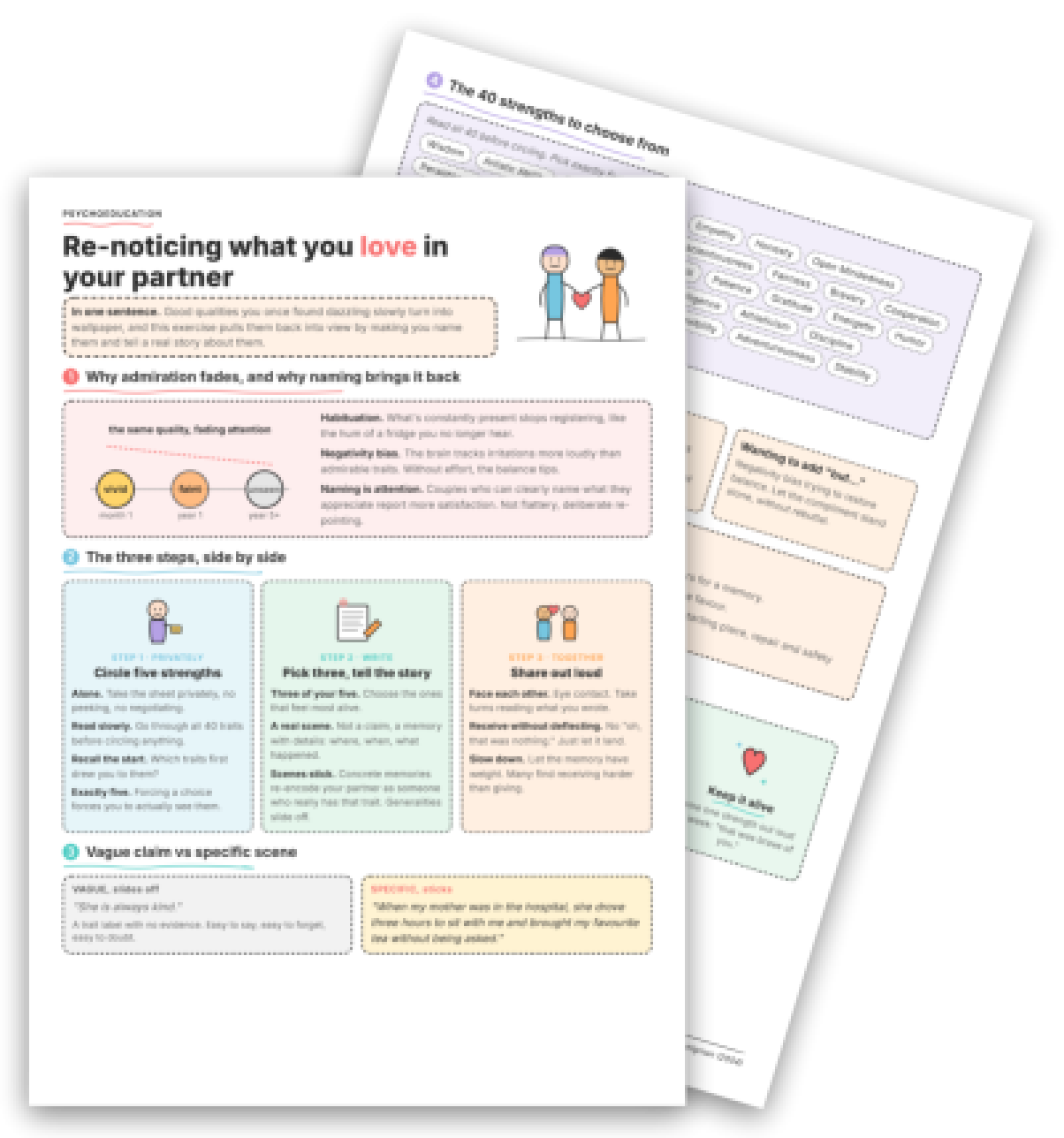
The fiche PDF opens with a timeline graphic: the same quality shown as vivid at month one, faint at year one, and unseen at year five or more. That single image, projected or handed across a desk, does something a verbal account cannot: it externalises the process and depathologises it. Neither partner is to blame. Habituation is the mechanism, and naming is the antidote.
The fiche then walks through three sequential steps, laid out side by side so both partners can follow the structure simultaneously:
- Step 1 (private): Each partner independently circles exactly five strengths from a curated list of 40 traits, Wisdom, Empathy, Patience, Spontaneity, Forgiveness, among others, after reading the full list without negotiating or peeking at their partner's choices.
- Step 2 (written): From those five, each selects three and writes a real scene for each: a specific memory with context, not a generic claim. The fiche makes this explicit: "Not a claim, a memory with details: where, when, what happened."
- Step 3 (together): Partners read aloud, face each other, and receive without deflecting. The fiche flags a common difficulty: "Many find receiving harder than giving."
A dedicated panel contrasts a vague trait label ("She is always kind") with a concrete memory, making visible why generalizations slide off while scenes re-encode. The "Common Difficulties" section, covering an inability to find five strengths, the impulse to add "but...", and discomfort on receiving, gives the clinician ready debrief material. The "To discuss in session" prompts (printed directly on the fiche) flag when contempt or relational rupture makes strengths work premature. This is not a worksheet patients complete alone; it is a visual support that structures the clinical conversation in real time.
For couples where the relational system is still broadly safe, this exercise pairs naturally with relational gratitude work and the weekly couple check-in as a sustained attentional practice.
750+ clinical tools
A library built with and for clinicians, ready to use in session and extend between appointments.
Access all the toolsWhen and How to Propose the Fiche
This fiche fits best after initial alliance and assessment are established, typically from the third session onward, once you have mapped conflict patterns and ruled out active contempt, fear, or harm dynamics. The fiche itself signals this contraindication clearly: when those elements are present, safety and repair work come first. For couples in the early stabilisation phase following a rupture, the trust repair exercise or the couple conflict psychoeducation program may be the better entry point.
For couples presenting with emotional distance, low positivity, or entrenched criticism, you can introduce the fiche with a framing such as: "I want us to look at something together, a map of how attention works in long relationships. It's not about what's wrong between you; it's about what happens to what's right." Hand the sheet before explaining the steps, letting the timeline visual open the conversation.
Debrief by asking each partner what it felt like to receive, not just to give. Difficulty receiving often surfaces low self-esteem material or abandonment schema dynamics worth naming in the next individual session. The "Keep it alive" prompt at the bottom of the fiche, "Name one strength out loud this week", gives a concrete between-session commitment that dovetails with keeping the relational flame alive and the broader healthy relationships program.
The fiche does not replace the therapeutic frame; it gives both partners a shared vocabulary and a concrete visual trace of a mechanism they would otherwise only hear described.
Use it with your patients
Share this tool in the mobile app and follow the work between sessions.
Sources
- Gottman, J. M., & Silver, N. (1999). The Seven Principles for Making Marriage Work. Crown Publishers.
- Peterson, C., & Seligman, M. E. P. (2004). Character Strengths and Virtues: A Handbook and Classification. Oxford University Press / American Psychological Association.
- Leistner, C. E., Richter, S., & Krampe, L. (2023). The Impact of Recognizing a Romantic Partner's Character Strengths on Relationship Satisfaction. Journal of Happiness Studies.
Your session continues in your patients' pocket
Use with a patientYour resources, available everywhere
The handouts, exercises, programs and audios above: you choose which ones to make available to your patients, in the mobile app dedicated to them.
And far more than a library
The app goes well beyond resources, to support your patients every day:
Related categories
Explore other clinical resources by category.

Relationships
Clinical worksheets and tools on relational functioning: attachment, schemas, assertiveness, and communication skills for therapists. Printable PDF resources.
Build awareness
Clinical worksheets and tools to build awareness in therapy: cognitive distortions, schemas, emotions, ACT and CBT resources for practitioners.

Engage & motivate
Clinical hub: printable worksheets and exercises to build therapeutic engagement and motivation across ACT, CBT, and integrative practice. For clinicians.
Repair & soothe
Clinical resources for the repair and soothe therapeutic aim: worksheets, exercises and tools to build self-compassion, reduce shame and restore emotional safety.
CBT
CBT worksheets, cognitive restructuring exercises & behavioral tools for clinicians. Evidence-based resources for every phase of cognitive behavioral therapy.

Integrative
Integrative therapy clinical resources: worksheets, psychoeducation programs, and exercises for eclectic, multimodal practice across orientations.