
Clinical picture. A couple in their late thirties, referred after a first separation attempt, reported that most arguments escalated within seconds and ended without resolution. During session, the partner identified as the primary pursuer described opening difficult conversations with statements such as "You never make time for us" and expressed frustration that the other always "shut down." The clinician introduced the soft-startup framework using the psychoeducational sheet, drawing attention to the link between a blame-laden opening and the listener entering a defensive state before any content is even registered. Both partners practised rewriting one recurring complaint, shifting from a character attribution to an "I feel... when..." structure. By the following session the pursuer reported that two low-stakes conversations had not escalated, and the withdrawing partner noted having felt less cornered from the outset.
Soft Startups for Couples: PDF Worksheet, Tools and Exercises
A printable PDF worksheet, clinical tools and exercises helping couples open difficult conversations in a way their partner can actually receive.
Clinical vignettes
Harsh Opener Blocks Repair Attempt
Timing and Tone as Entry Points
Clinical picture. A woman in her mid-forties, seen in couples therapy alongside her long-term partner, described raising concerns about household labour routinely at the end of the working day, often while her partner was still in front of a screen. Both acknowledged that these conversations reliably ended in mutual withdrawal. The clinician used the soft-startup sheet to make explicit how moment selection and non-verbal tone function as signals before a single word of content is delivered, noting the phrase "your face arrives before your words." The couple agreed on a concrete cue, asking "can we talk after dinner," to replace the pattern of unannounced complaint. Three weeks later the couple reported that the agreed cue had been used twice; on both occasions the partner had turned away from the screen voluntarily, and the conversation had not required clinician facilitation to stay on track.
In couples work, the opening line of a hard conversation often predicts its entire arc, yet most partners cannot hear how their own startup lands on the other person. This soft startups PDF worksheet gives you a concrete visual support to map that gap in session, without relying on abstract instruction that rarely sticks.
Use this resource with your patients
Handout, exercises and materials ready to use, right inside SessionFuel.
Why Soft Startups Resist Verbal Explanation in Session
Partners typically arrive already knowing, at some level, that "starting more calmly" would help. The difficulty is not conceptual; it is operational. Under physiological flooding, the distance between "I've been feeling lonely" and "You never want to spend time with me" collapses entirely. Explaining that difference at the whiteboard, or asking them to simply "use I-statements," usually produces polite nodding followed by the same harsh opener at home.
There is also a persistent clinical misconception to untangle: many patients equate a soft startup with capitulation, with minimising what matters to them. Until that reframe lands, they resist the skill. The fiche addresses it directly: "A soft startup is not being nice or swallowing your needs. You still raise the issue. You raise it so the other person can actually receive it." Having that sentence on paper, attributed to the support rather than to you, removes a layer of therapeutic resistance.
For couples where the Four Horsemen) are already mapped, this fiche PDF slots in immediately as the next operational step: here is what the antidote to criticism actually sounds like, in full sentences.
What the Fiche Contains: A Visual Contrast That Does the Work
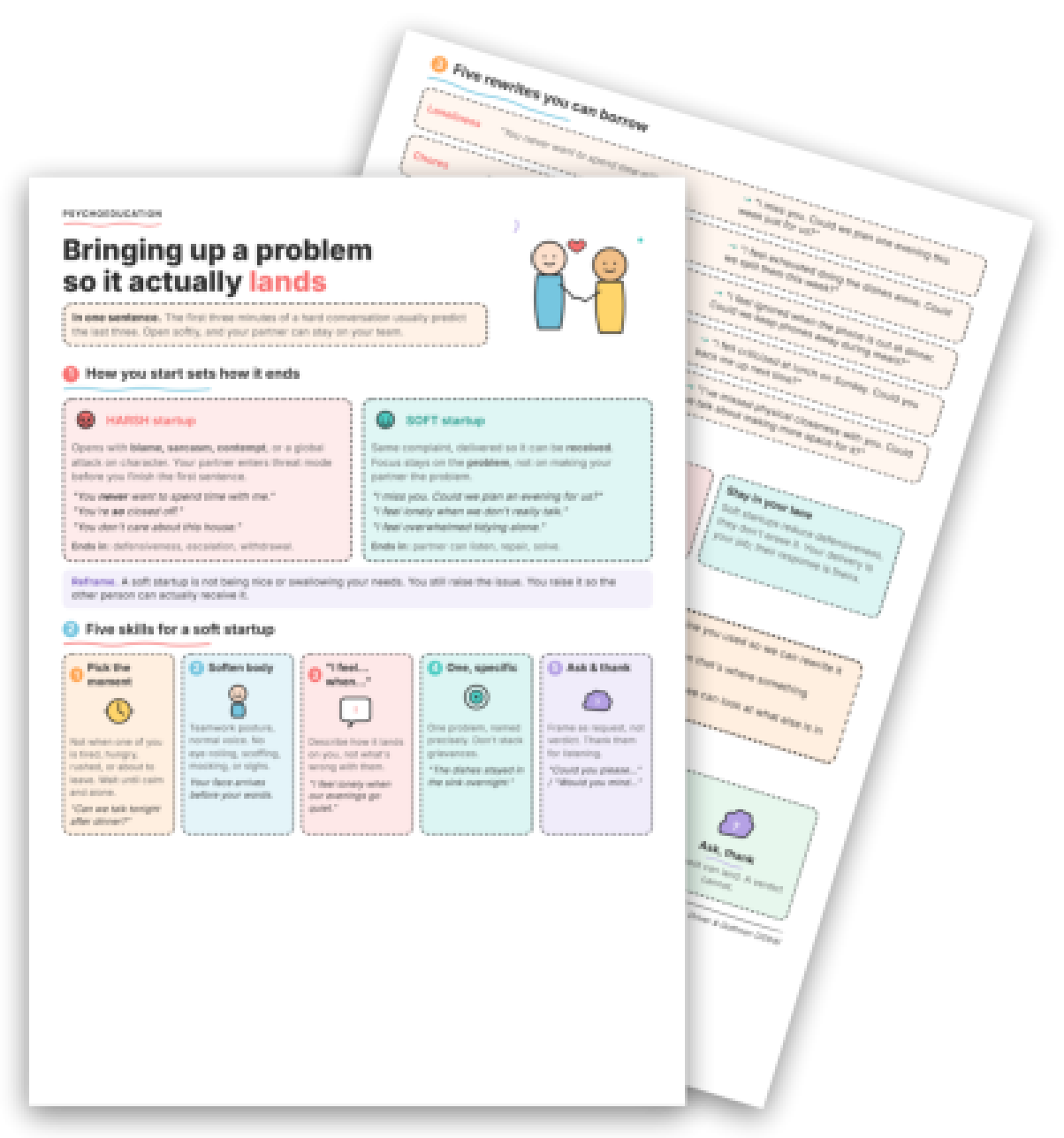
The worksheet is structured across five panels, each serving a distinct clinical function.
- Panel 1 (Harsh vs Soft): places the two startup types side by side, with matched verbatim examples across the same presenting problem. Seeing "You're so closed off" directly opposite "I feel lonely when we don't really talk" makes the structural difference visible in a way that oral explanation alone does not.
- Panel 2 (Five skills): breaks the soft startup into five discrete components: picking the moment, regulating non-verbal presentation, using the "I feel... when..." frame, naming one specific complaint rather than stacking grievances, and ending with a request rather than a verdict.
- Panel 3 (Five rewrites): provides ready-to-borrow reformulations for the most common couple conflict themes: loneliness, chores, phone use, in-laws, and intimacy. These work as springboards for NVC-informed couple conversation) work in subsequent sessions.
- Panel 4 (When it slips): covers the do-over move, flooding recognition, and the key self-responsibility boundary: "Your delivery is your job; their response is theirs." This is clinically important for the partner who completes a soft startup correctly, then catastrophises when their partner is still defensive.
- Panel 5 (To discuss in session): three prompts the couple brings back to you, including a specific instruction to bring the actual opening line from a conversation that went sideways that week.
> Key takeaway: this fiche is a visual support that facilitates the explanation of soft startups in session; it is not a questionnaire the couple fills in alone. Use it as a psychoeducation anchor during the appointment, then leave it with them as a concrete reference between sessions.
The side-by-side layout of Panel 1 earns the most clinical traction. When both partners look at the same page together, the visual symmetry communicates something a lecture cannot: the complaint is identical, only the delivery differs. This makes the intervention feel fair rather than corrective.
750+ clinical tools
A library built with and for clinicians, ready to use in session and extend between appointments.
Access all the toolsWhen and How to Introduce the Fiche
Soft startups fit naturally mid-way through a couples formulation, once you have established shared language around escalation patterns. If you work within a Gottman framework, introduce this worksheet immediately after the Four Horsemen and their antidotes). If you work systemically or with EFT's infinity loop), it pairs well with the pursuit-withdrawal dynamic once both partners can name their position.
A workable introduction: "I want to show you something about the first few seconds of a hard conversation, because that window tends to set the whole thing. This diagram maps what happens on each side." Open to Panel 1 and walk through one matched pair together before moving to their own material.
For partners who dismiss assertiveness tools as "performative," the Panel 4 framing is your ally: the fiche explicitly names flooding, the do-over move, and the limits of delivery control. This is not passive communication) nor aggressive escalation; it is a precision skill. Assertive communication using I-messages), active listening), and expressing vulnerability in relationships) make strong companion resources once this framework is established.
Use the Panel 5 prompts to structure the following session. If one partner repeatedly cannot soften the startup on a specific topic, name that directly in session: "Often that's where something tender is hiding." The fiche's own language opens the door. Pair ongoing work with a weekly couples check-in exercise) to keep the between-session practice alive.
One contraindication worth noting: where there is active coercive control, the framing of "your delivery is your job" can inadvertently reinforce compliance. Screen carefully before deploying any communication skills tool in that context.
The fiche does not replace the formulation; it makes one piece of it concrete, repeatable, and portable.
Use it with your patients
Share this tool in the mobile app and follow the work between sessions.
Sources
- Gottman, J. M., Silver, N. (1999). The Seven Principles for Making Marriage Work. Harmony Books (Crown Publishing Group).
- Gottman, J. M., Silver, N. (1994). Why Marriages Succeed or Fail: And How You Can Make Yours Last. Simon and Schuster.
- Gottman, J. S., Gottman, J. M. (2024). Fight Right: How Successful Couples Turn Conflict Into Connection. Harmony.
- The Gottman Institute. Gottman Method Couples Therapy: Softened Startup Intervention (Intervention 34 - Manage Conflict).
Your session continues in your patients' pocket
Use with a patientYour resources, available everywhere
The handouts, exercises, programs and audios above: you choose which ones to make available to your patients, in the mobile app dedicated to them.
And far more than a library
The app goes well beyond resources, to support your patients every day:
Related categories
Explore other clinical resources by category.

Relationships
Clinical worksheets and tools on relational functioning: attachment, schemas, assertiveness, and communication skills for therapists. Printable PDF resources.

Understand
Clinical hub for the therapeutic aim 'Understand': worksheets and tools to build patient insight across CBT, ACT, schema therapy and more.

Build skills
Skill-building resources for clinicians: printable worksheets and exercises for coping, assertiveness, and communication skills training in therapy.

Integrative
Integrative therapy clinical resources: worksheets, psychoeducation programs, and exercises for eclectic, multimodal practice across orientations.

Anxiety
Clinical hub for anxiety disorders: CBT and ACT worksheets, psychoeducation sheets, and exercises for assessment and treatment across the anxiety spectrum.

Trauma
Clinical hub on trauma and PTSD: assessment, differential diagnosis, treatment phases, and printable resources for practitioners. 155 chars.