
Clinical picture. M., a woman in her late thirties, presented with low-grade anxiety and persistent fatigue she attributed to her job. In session she described routinely agreeing to additional responsibilities she did not have capacity for, then working evenings to compensate, and feeling quietly resentful toward colleagues who she perceived as unburdened. The clinician introduced the passive communication handout and invited her to locate a recent interaction on the four-quadrant grid; M. recognised her pattern immediately, noting she had been operating from the 'avoiding disappointment' goal rather than any genuine agreement. She was surprised to see the relief-trap diagram, commenting that the momentary ease she felt after saying 'no problem' had always seemed like evidence she had handled the situation well. No behavioural goal was set that session; the aim was simply to make the loop visible before any change was attempted.
Passive Communication: PDF Worksheet, Tools and Exercises
A visual PDF worksheet, clinical tools and exercises to explain passive communication in session, name the relief trap, and open the path toward assertiveness.
Clinical vignettes
Chronic Acquiescence in a Work Context
Silence as Safety in a Couples Context
Clinical picture. T., a man in his mid-forties referred following a relationship crisis, described a long habit of deflecting disagreements with his partner through vague agreement, subject changes, or sudden fatigue. He framed this as being 'easygoing,' and it took several sessions before he connected the behaviour to the anxiety he felt in the seconds before any potential conflict. The clinician used the handout's 'two engines' section to distinguish a skill gap from a feared-consequence pattern; for T. the evidence pointed predominantly to the second, rooted in an early environment where disagreement had reliably produced hostility. Naming this distinction shifted the focus from social-skills rehearsal to examining the predictions he was carrying into each exchange. T. left the session with the handout and was asked only to notice, without changing anything, the moment the chest tightness preceded his next deflection.
Explaining passive communication to a patient who has spent years equating silence with safety is one of those moments where verbal description alone falls flat. The patient nods, agrees they "sometimes avoid conflict," and you both know nothing has shifted. This fiche PDF gives you a structured visual support to make the pattern tangible, name the mechanism keeping it locked in place, and open a productive clinical conversation, all within a single session.
Use this resource with your patients
Handout, exercises and materials ready to use, right inside SessionFuel.
Why Passive Communication Is Hard to Explain Without a Visual Support
The core difficulty is that passive communication feels like the absence of behavior, not a behavior in itself. Patients rarely identify it as a pattern because it generates immediate relief rather than obvious distress. From a TCC perspective, the negative reinforcement loop is the whole story: silence reduces anxiety fast, the original feared prediction is never tested, and the schema "it's safer not to express myself" consolidates untouched.
Oral psychoeducation about this tends to stay abstract. Patients hear "you avoid conflict" but cannot locate where it lives in their body, their automatic thoughts, or their moment-to-moment choices. They also tend to conflate passivity with kindness, making any challenge feel like a criticism of character rather than an invitation to examine a learned coping pattern.
This is precisely where a visual support changes the dynamic. When the mechanism is laid out spatially, patients can point to the step they recognize, which immediately shifts the conversation from therapist-led explanation to collaborative exploration.
What the Fiche Contains: Six Panels That Map the Pattern
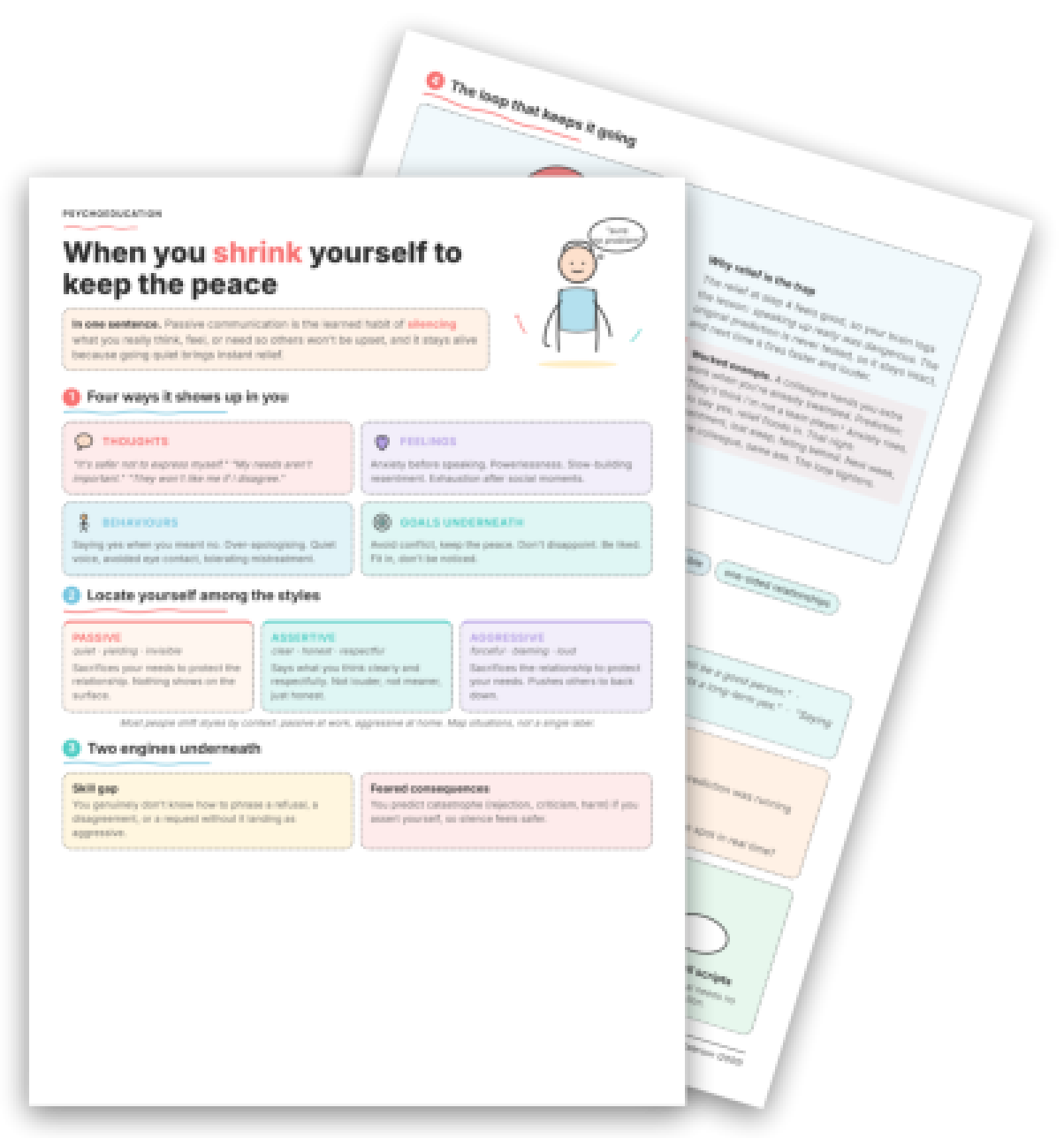
The fiche PDF is organized across six numbered sections, each targeting a distinct clinical angle.
Panel 1 externalizes the four domains where passive communication shows up: thoughts ("My needs aren't important"), feelings (anxiety before speaking, slow-building resentment), behaviours (over-apologizing, saying yes when meaning no), and the goals underneath (avoid conflict, be liked, fit in). Seeing all four columns simultaneously helps patients who can spot the behaviour but cannot connect it to the anticipatory anxiety or the hidden goal driving it.
Panel 2 positions passive communication within the three-style framework (passive, assertive, aggressive), with a key clinical nuance built in: "Most people shift styles by context: passive at work, aggressive at home." This single line defuses the labeling trap before it forms and opens a situational mapping conversation.
Panel 3 identifies the two maintaining engines: a genuine skill gap (not knowing how to phrase a refusal without it reading as aggression) and feared consequences (catastrophic predictions of rejection or harm). Distinguishing these two is clinically important, because the intervention differs: skills training for the first, cognitive work and graded exposure for the second.
Panel 4, labeled "The Relief Trap," is the structural core of the fiche. It maps a four-step loop: prediction of a negative outcome, anxiety arousal, passive behaviour, and fast relief. The caption makes the mechanism explicit: "The relief at step 4 feels good, so your brain logs the lesson: speaking up really was dangerous." A worked example involving a workplace request illustrates the loop concretely. This panel alone, shown to a patient who has never been able to explain why they keep agreeing to things they resent, tends to produce immediate recognition.
Panel 5 lists the costs of the pattern (being overlooked, somatic stress, eroded self-respect), and Panel 6 offers five reframes for loosening it, plus three clinician-ready discussion prompts to debrief the fiche directly in session.
> Key takeaway: The fiche is a visual support that facilitates the explanation of passive communication in session. It is not a questionnaire the patient fills in alone; it is a psychoeducation tool the clinician uses alongside the patient to build shared vocabulary and a common map of the maintaining mechanisms.
750+ clinical tools
A library built with and for clinicians, ready to use in session and extend between appointments.
Access all the toolsHow and When to Propose This Worksheet
The fiche fits naturally from the second or third session onward, once a baseline formulation has emerged and the alliance is sufficient for the patient to engage with a pattern-level reflection rather than feeling catalogued.
It is particularly well-suited for patients presenting with:
- Chronic people-pleasing and difficulty setting limits (link naturally to work on assertive rights in clinical practice and to the assertiveness ladder)
- Social anxiety with strong avoidance of disagreement (see also the social anxiety psychoeducation program)
- Approval-seeking schemas (the Approval-Seeking Schema worksheet pairs well here)
- Patients where passive-aggressive communication has been identified but whose primary style remains inhibited expression
To introduce it without labeling the patient, you might say: "I'd like to show you a diagram that describes something many people recognize in themselves. Tell me what you notice." This keeps agency with the patient and avoids the premature interpretation trap.
When debriefing, Panel 1 and Panel 4 usually carry the most clinical weight. Use the three discussion prompts in Panel 6 as session scaffolding, they are designed to move from intellectual recognition to personal application. From there, the natural next step is graded practice, whether through behavioral experiments for assertiveness, the DBT DEAR MAN skill, or tools for saying no. Comparing the passive and aggressive profiles in Panel 2 alongside aggressive communication patterns can also be useful when the patient oscillates between the two styles.
One limit worth noting: for patients with a strong subjugation schema or trauma-related compliance, the relief trap framing can initially activate shame. Introduce it slowly, and anchor it firmly in the panel's own language: "A pattern, not you. It was learned, which means it can be unlearned."
The fiche does not replace the clinical frame. It makes the explanation more precise, saves several minutes of abstraction, and leaves the patient with a concrete reference point to bring back the following week.
Use it with your patients
Share this tool in the mobile app and follow the work between sessions.
Sources
- Rakos, R. F. (1991). Assertive behavior: Theory, research, and training. Routledge.
- Paterson, R. J. (2022). The assertiveness workbook: How to express your ideas and stand up for yourself at work and in relationships (2nd ed.). New Harbinger Publications.
Your session continues in your patients' pocket
Use with a patientYour resources, available everywhere
The handouts, exercises, programs and audios above: you choose which ones to make available to your patients, in the mobile app dedicated to them.
And far more than a library
The app goes well beyond resources, to support your patients every day:
Related categories
Explore other clinical resources by category.
Anxiety
Clinical hub for anxiety disorders: CBT and ACT worksheets, psychoeducation sheets, and exercises for assessment and treatment across the anxiety spectrum.

Identity
Clinical resources for self-identity work in therapy: CBT, ACT, schema tools for clinicians addressing self-concept, core beliefs, and identity disruption.

Relationships
Clinical worksheets and tools on relational functioning: attachment, schemas, assertiveness, and communication skills for therapists. Printable PDF resources.

Understand
Clinical hub for the therapeutic aim 'Understand': worksheets and tools to build patient insight across CBT, ACT, schema therapy and more.

Build awareness
Clinical worksheets and tools to build awareness in therapy: cognitive distortions, schemas, emotions, ACT and CBT resources for practitioners.

CBT
CBT worksheets, cognitive restructuring exercises & behavioral tools for clinicians. Evidence-based resources for every phase of cognitive behavioral therapy.