
Clinical picture. M., a woman in her late thirties, presents with low mood and recurring conflict in her relationship; she describes herself as "not the type to make a fuss." During session, the clinician introduces the three-style framework and walks through the oscillation trap, asking M. to trace a recent argument backward. M. recognises, with some surprise, that she had said nothing about a recurring grievance for several weeks before responding to a minor comment with disproportionate anger. She agrees to map her style across three specific relationships before the next session, distinguishing where she is passive from where she tips into aggression. The exercise does not resolve the conflict, but it gives her a shared vocabulary with the clinician and a concrete target for subsequent work on assertive expression.
Three Communication Styles: PDF Worksheet, Tools and Exercises
A visual PDF worksheet clinicians can use in session to explain passive, assertive, and aggressive communication, build shared vocabulary, and anchor psychoeducation in a concrete take-home tool.
Clinical vignettes
Passive-to-Aggressive Cycle in a Couple
Context-Dependent Passivity at Work
Clinical picture. T., a man in his mid-forties referred for burnout, reports feeling respected at home yet chronically sidelined in team meetings. The clinician presents the informational sheet and invites T. to consider that communication style is not a fixed trait but often relationship-specific. T. identifies a clear pattern: assertive with his partner, passive with his direct manager, and, on reflection, occasionally sharp with junior colleagues when his needs have gone unmet for too long. Naming the passive-to-aggressive overflow as a predictable sequence rather than a character flaw noticeably reduces his self-criticism. The clinician notes this as a starting point; restructuring his workplace communication would require further targeted practice, not insight alone.
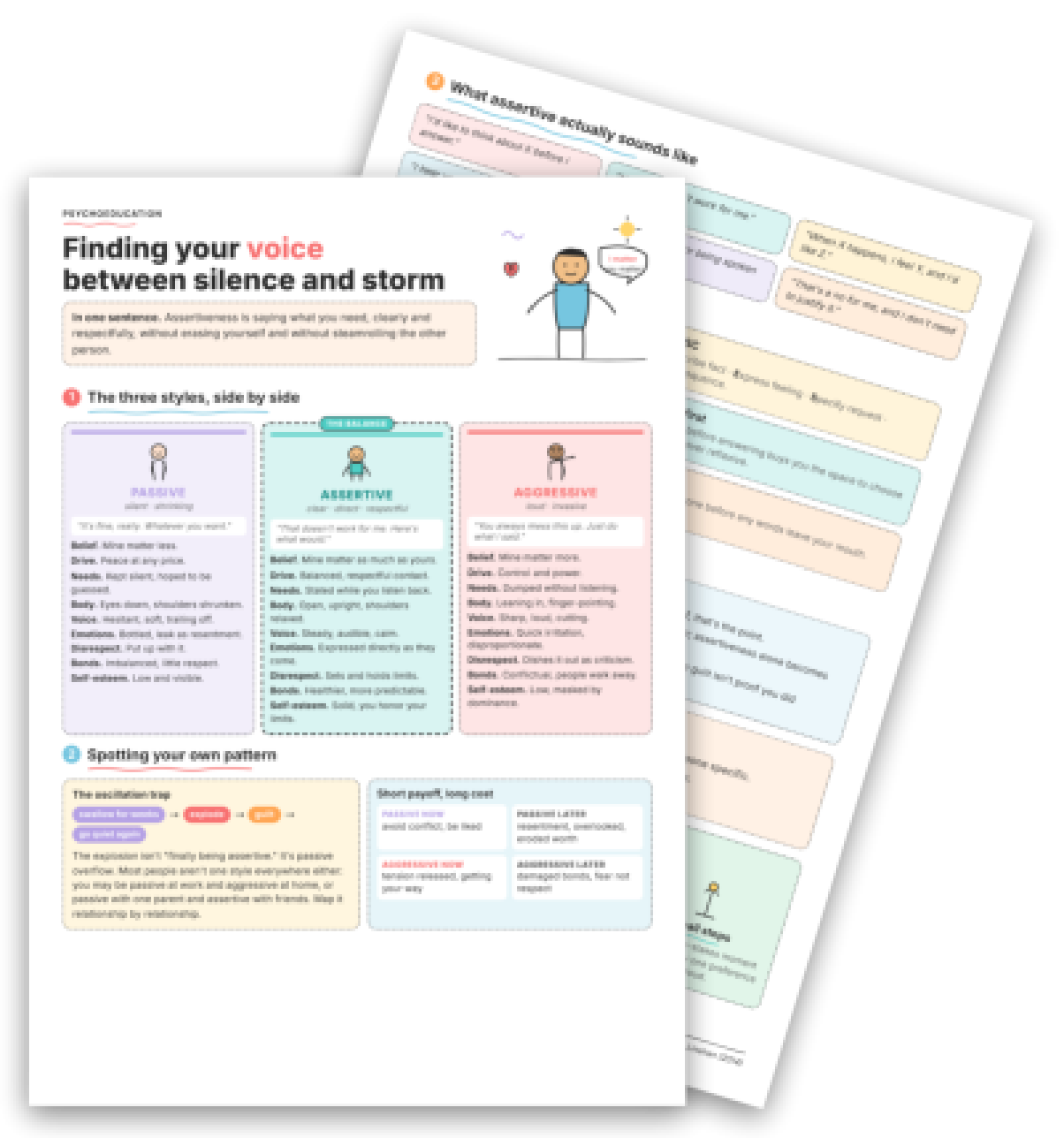
Patients who self-describe as "not assertive" often mean two clinically distinct things: habitual self-silencing on one end, barely-controlled eruptions on the other. Explaining the difference orally rarely disentangles these patterns on its own. This fiche PDF provides a structured visual support to make the distinction concrete, establish shared vocabulary, and compress what might otherwise take several sessions into a single, memorable psychoeducation anchor.
Use this resource with your patients
Handout, exercises and materials ready to use, right inside SessionFuel.
Why the three styles resist verbal explanation alone
The core difficulty is that most patients presenting with communication difficulties believe they are behaving reasonably, at least some of the time. Those locked in a passive pattern rarely label it as such, they call it being kind, keeping the peace, or picking their battles. Those who oscillate into aggressive responses often do not register those moments as aggression; they experience them as finally being heard, or as a legitimate release after weeks of restraint.
Without a structured side-by-side framework, the clinician ends up correcting each distortion separately, session after session, with no shared map the patient can consult between appointments. The problem compounds when you factor in the oscillation trap: swallowing resentment for weeks, exploding, feeling guilt, going quiet again. Patients recognize this cycle immediately when they see it laid out, yet almost never name it unprompted. Oral description rarely lands with the same precision.
This dynamic is especially salient in patients presenting with low self-esteem, chronic relational conflict, or the passive communication patterns that sustain self-sacrifice schemas.
What the fiche contains: a three-column visual map
The fiche organizes passive, assertive, and aggressive communication into a three-column comparative panel covering nine dimensions for each style: underlying belief, drive, how needs are expressed, postural signals, vocal quality, emotional expression, response to disrespect, relational impact, and self-esteem footprint. Reading "Mine matter less" next to "Mine matter as much as yours" next to "Mine matter more" on the same page makes the belief-level distinction immediately legible in a way that sequential verbal explanation simply cannot replicate.
A dedicated section maps the oscillation trap and makes one clinical point that is easy to lose in conversation: the explosion at the end of weeks of silence is not assertiveness, it is passive overflow. A paired cost matrix contrasts the short-term payoffs of passive and aggressive communication patterns against their long-term relational and self-esteem costs.
Section 3 of the fiche provides grounded assertive phrasings, "I'd like to think about it before I answer", "I hear you, and I see it differently", "That's a no for me, and I don't need to justify it", which serve both as in-session modeling anchors and as homework references. Section 4 covers five techniques: broken record, DESC (Describe, Express, Specify, Consequence), fogging, deliberate pause before responding, and body-first regulation (feet planted, shoulders down, breath out before speaking). Section 5 addresses common confusions, including the one that most reliably derails early work: assertiveness is not aggression, and guilt after a "no" is not evidence of wrongdoing.
These techniques connect naturally to complementary resources: the DBT DEAR MAN skill for structured assertive requests, assertive body language for somatic grounding work, and the broader assertiveness tools and exercises library.
> To keep in mind: this fiche is a visual support that facilitates the explanation of three communication styles in session; it is not a questionnaire patients fill out alone, but a psychoeducation anchor the clinician uses live to make a complex behavioral distinction clear, build a common language, and leave the patient with a concrete reference point.
750+ clinical tools
A library built with and for clinicians, ready to use in session and extend between appointments.
Access all the toolsWhen and how to propose it
This fiche fits naturally once anamnèse or early sessions reveal relational conflict, recurrent avoidance of direct expression, or a patient who reports "saying nothing for weeks and then losing it." It also belongs early in any work addressing beliefs that damage relationships, boundary-setting difficulties, or passive-aggressive communication patterns.
A low-activation introduction works well: "I'd like to show you a map that a lot of people find useful, it's not about judging how you communicate, it's about giving us a common vocabulary." From there, you can walk through the three columns together, pause at the dimension that resonates most (often the belief row or the oscillation trap), and ask where the patient recognizes themselves. The "Map it relationship by relationship" note in the fiche is clinically important to highlight: most patients are not one style everywhere, and that specificity makes the self-observation exercise far more productive.
For debriefing, the "To discuss in session" prompts built into the fiche point directly to the clinically actionable signals: weeks of accumulated silence, oscillation with a specific person, and the guilt response that pulls the patient back into the passive default. These cues integrate smoothly into ongoing work using active listening skills, assertive communication frameworks, or the communication styles and inner experience lens for patients who need to examine what each style costs them internally.
The fiche does not replace the therapeutic frame; it makes the explanation sharper and leaves the patient with a reference they can return to between sessions.
Use it with your patients
Share this tool in the mobile app and follow the work between sessions.
Sources
- Alberti, R. E., Emmons, M. L. (2017). Your Perfect Right: Assertiveness and Equality in Your Life and Relationships (10th ed.). New Harbinger Publications.
- Smith, M. J. (1975). When I Say No, I Feel Guilty. Bantam Books.
- Hede, J., Malouff, J., Meynadier, J. (2026). A Meta-Analysis of Randomised Controlled Trials on the Efficacy of Assertiveness Training for Social Anxiety. International Journal of Applied Positive Psychology.
Your session continues in your patients' pocket
Use with a patientYour resources, available everywhere
The handouts, exercises, programs and audios above: you choose which ones to make available to your patients, in the mobile app dedicated to them.
And far more than a library
The app goes well beyond resources, to support your patients every day:
Related categories
Explore other clinical resources by category.

Identity
Clinical resources for self-identity work in therapy: CBT, ACT, schema tools for clinicians addressing self-concept, core beliefs, and identity disruption.

Relationships
Clinical worksheets and tools on relational functioning: attachment, schemas, assertiveness, and communication skills for therapists. Printable PDF resources.

Understand
Clinical hub for the therapeutic aim 'Understand': worksheets and tools to build patient insight across CBT, ACT, schema therapy and more.

Build awareness
Clinical worksheets and tools to build awareness in therapy: cognitive distortions, schemas, emotions, ACT and CBT resources for practitioners.
CBT
CBT worksheets, cognitive restructuring exercises & behavioral tools for clinicians. Evidence-based resources for every phase of cognitive behavioral therapy.

Anxiety
Clinical hub for anxiety disorders: CBT and ACT worksheets, psychoeducation sheets, and exercises for assessment and treatment across the anxiety spectrum.