
Clinical picture. T., a woman in her late thirties, presents with low-grade dysthymia and recurring tension in her couple relationship; she describes consistently yielding to her partner's preferences and then feeling resentful afterward. During a session focused on communication patterns, the clinician introduces the informational sheet and invites T. to locate herself in the passive column, reading aloud the associated body sensations and self-talk. T. pauses at the phrase "my needs are too much" and says quietly that she has thought exactly that since adolescence. The clinician uses the reflective question from the sheet, asking what she believes she is protecting by staying silent; T. identifies a fear that voicing needs will drive her partner away. This moment of naming the protective function, rather than labeling the behavior as a flaw, opens a more productive line of inquiry for subsequent sessions.
Communication Styles and Inner Experience: PDF Worksheet, Tools and Exercises
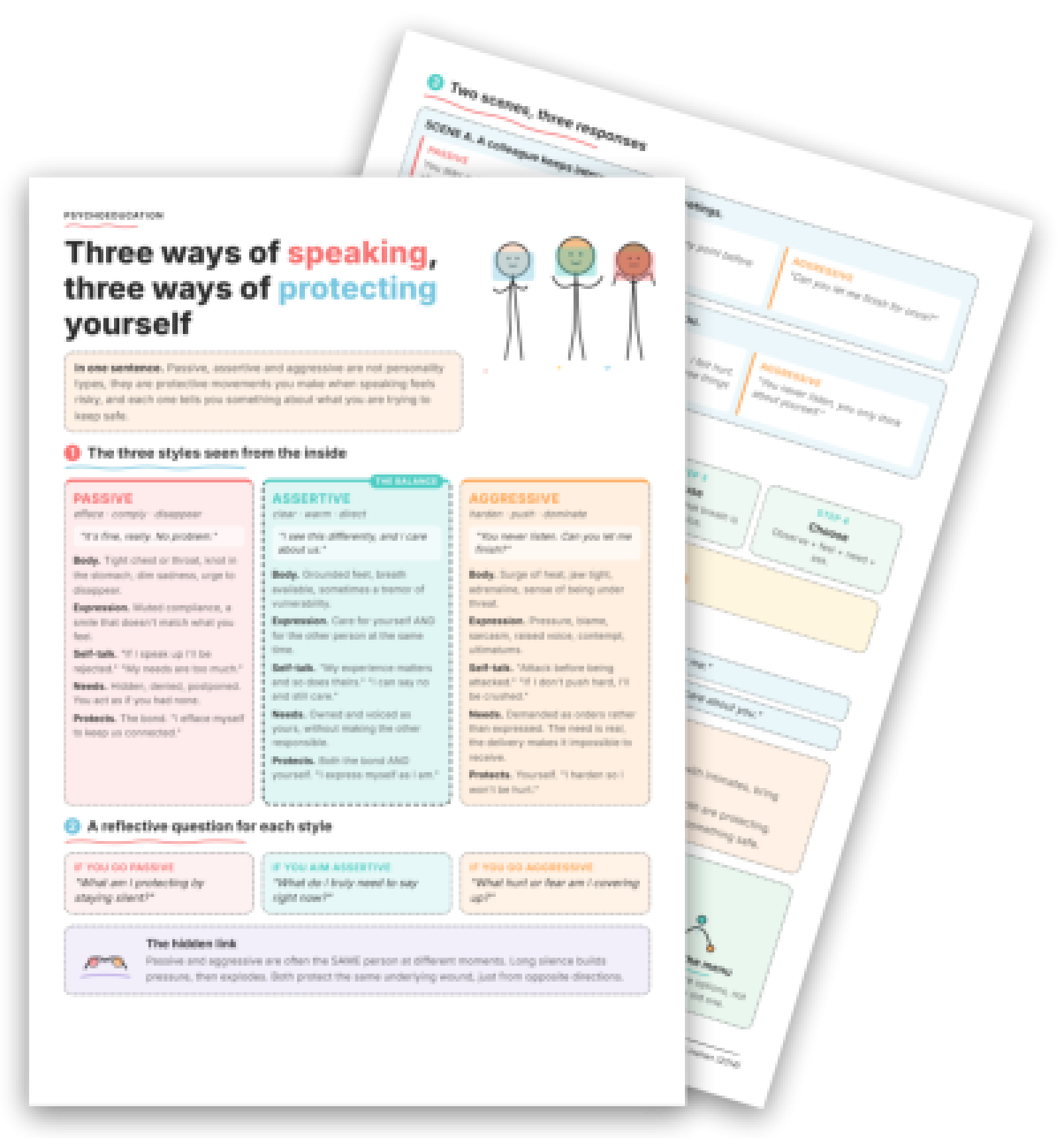
A visual psychoeducation fiche helping clinicians explain passive, assertive, and aggressive styles through the body, self-talk, and underlying needs, concrete in-session support.
Clinical vignettes
Passive Style Linked to Fear of Rejection
Aggressive Presentation Reframed as Protection
Clinical picture. M., a man in his mid-forties referred after a workplace conflict, initially describes himself as someone who "just tells the truth" and dismisses feedback about his tone. The clinician presents the three-style framework as a description of internal states rather than character labels, which reduces M.'s defensiveness enough to allow him to read the aggressive column. He recognizes the body cues listed, the jaw tension and the sense of being under threat, as familiar sensations preceding his outbursts. When the clinician poses the accompanying reflective question about what hurt or fear may lie underneath, M. connects his escalation pattern to a long-standing expectation of being dismissed or talked over. No behavioral change is claimed at this stage, but M. agrees to track the body signal before his next difficult meeting, which represents a workable first step.
Most patients have heard the words "passive," "assertive," and "aggressive" before they arrive in your office. What they have not heard is why they keep landing in the same style despite knowing better. This PDF worksheet fills that gap by anchoring communication styles in bodily sensation, self-talk, and protective function, the terrain where change actually happens.
Use this resource with your patients
Handout, exercises and materials ready to use, right inside SessionFuel.
Why Communication Styles Are So Hard to Explain Without a Visual
Telling a patient that assertiveness means "expressing yourself clearly and respectfully" lands nowhere useful. The cognitive triangle is familiar to them; what is harder to access is the somatic-motivational layer underneath each style: the tight chest that precedes compliance, the surge of heat before a sharp retort, the fragmented breath that, paradoxically, accompanies groundedness.
Without a visual scaffold, patients hear a typology. They slot themselves into a category and stop there. The classification becomes another form of self-judgment rather than a lens for self-inquiry. This is especially true when limiting beliefs around speaking up or a pervasive approval-seeking schema is at play: the patient's automatic frame filters anything you say about assertiveness through the premise that voicing needs is dangerous or selfish.
The other blind spot is the functional link between passive and aggressive communication. Few patients recognize these as two expressions of the same underlying wound. Naming it orally, once, rarely sticks. Shown as a visual, it invites reflection.
750+ clinical tools
A library built with and for clinicians, ready to use in session and extend between appointments.
Access all the toolsWhat the Fiche Contains: A Visual Map of Protection
This fiche PDF organises the three styles across five parallel dimensions: body signal, expression, self-talk, how needs are held, and what the style protects. That last column is the clinical lever. Rather than framing passive or aggressive behaviour as a deficit, the fiche reads each style as a protective movement: "I efface myself to keep us connected" versus "I harden so I won't be hurt."
The visual layout lets patients see, at a glance, that the same protective logic runs through all three columns, with only the direction of the strategy changing. For assertiveness, the fiche specifies a somatic marker worth noting with patients: "grounded feet, breath available, sometimes a tremor of vulnerability", which normalises the discomfort of direct expression.
A dedicated section pairs a reflective question with each style:
- "What am I protecting by staying silent?" (passive)
- "What do I truly need to say right now?" (assertive)
- "What hurt or fear am I covering up?" (aggressive)
Two worked scenarios follow: a colleague who interrupts repeatedly, and a partner who forgets something important. Each scenario shows all three responses side by side, which patients find more clinically legible than abstract descriptions. The fiche then gives a four-step sequence (Notice, Name, Pause, Choose) and a simple assertive structure borrowed from the CNV tradition, observe, feel, need, ask, aligned with I-messages work you may already be using. A short list of phrases to practise closes the content, alongside prompts explicitly marked "to discuss in session."
> Key point: The fiche is a visual support that facilitates explanation in session, not a self-administered questionnaire. You use it alongside the patient to build shared vocabulary; they take it home as a concrete reference point.
Use it with your patients
Share this tool in the mobile app and follow the work between sessions.
When and How to Introduce This Tool
This fiche fits naturally from the third or fourth session onward, once the presenting problem has been formulated and a working alliance is established. It is particularly indicated when:
- The patient oscillates between prolonged silence and sharp, disproportionate outbursts (the passive-aggressive oscillation the fiche makes explicit)
- Assertiveness work has stalled because the patient intellectually understands the concept but cannot self-monitor in the moment
- You are working through cognitive distortions around interpersonal risk, and a somatic anchor would consolidate what cognitive restructuring has started
- The couple context calls for shared vocabulary (the fiche integrates naturally into a communication couples program)
A useful introduction: "I'd like to show you something that maps what happens inside us when speaking feels risky. It's not a test, it's more of a mirror. Let's look at it together." Walk through the three columns yourself first, pointing to the body signals before the labels. Invite the patient to locate themselves across different relational contexts (authority figures, intimates), as the fiche explicitly suggests.
For debrief, prioritise the protection column over the style labels. Asking "what does this style keep safe for you?" moves the session into schema-level material and connects naturally to underlying need exploration or assertive rights work. If active listening skills or body language work are already on the treatment plan, this fiche provides the conceptual backbone those exercises can hang on.
One limit worth noting: with patients in an acute shame state, the comparative layout of three styles can briefly activate self-criticism before it facilitates curiosity. Slow the reading down, and foreground the "remember" frame the fiche closes on: each style once kept something safe; the goal is more options, not condemnation of the old one.
The fiche does not replace the therapeutic frame. It makes a complex, embodied concept legible in the time you actually have, and leaves the patient with something concrete to return to between sessions.
Your session continues in your patients' pocket
Use with a patientYour resources, available everywhere
The handouts, exercises, programs and audios above: you choose which ones to make available to your patients, in the mobile app dedicated to them.
And far more than a library
The app goes well beyond resources, to support your patients every day:
Related categories
Explore other clinical resources by category.

Identity
Clinical resources for self-identity work in therapy: CBT, ACT, schema tools for clinicians addressing self-concept, core beliefs, and identity disruption.

Relationships
Clinical worksheets and tools on relational functioning: attachment, schemas, assertiveness, and communication skills for therapists. Printable PDF resources.

Understand
Clinical hub for the therapeutic aim 'Understand': worksheets and tools to build patient insight across CBT, ACT, schema therapy and more.

Build awareness
Clinical worksheets and tools to build awareness in therapy: cognitive distortions, schemas, emotions, ACT and CBT resources for practitioners.
CBT
CBT worksheets, cognitive restructuring exercises & behavioral tools for clinicians. Evidence-based resources for every phase of cognitive behavioral therapy.

Humanistic
Printable clinical resources for humanistic therapy: worksheets, exercises, and psychoeducation programs for practitioners using person-centered and experiential approaches.