
Clinical picture. T., a woman in her late thirties, presents with her partner of nine years citing a sustained drop in sexual desire that both attribute to the demands of early parenthood and accumulated relational distance. The clinician introduces the psychoeducation program on sexual life, framing it as independent work the couple will complete between sessions, lesson by lesson, at their own pace. Beginning with Lesson 1, T. engages with the unit on desire and uses the guided prompt to articulate, for the first time in writing, that her desire had already begun to wane before their first child was born. This observation shifts the couple's shared narrative and opens a more productive conversation in the following session about emotional intimacy as a precondition for physical connection.
Sexual Life in Couples: A Structured Psychoeducation Program
A 4-lesson autonomous program helping patients explore intimacy, desire, communication, and relational maintenance in their sexual relationship.
Clinical vignettes
Revisiting Desire After Parenthood
Naming Communication Gaps in a Stable Couple
Clinical picture. M., a man in his mid-forties, attends individual therapy for mild depressive symptoms; he mentions almost incidentally that sexual dissatisfaction has added tension to an otherwise stable long-term relationship. The clinician suggests the sexual life psychoeducation program as structured self-guided work, noting that Lesson 2 addresses common relational difficulties including communication about needs and desires. M. completes the lesson before the next appointment and arrives having written responses to several reflective prompts, including one about unspoken preferences he had never found a way to raise with his partner. The material gave him a concrete vocabulary to begin that conversation, which he described as uncomfortable but overdue.
Use this resource with your patients
Handout, exercises and materials ready to use, right inside SessionFuel.
Why sexual life is clinically difficult to address
Sexuality in a couple is one of the areas patients most rarely raise spontaneously, and one of the most resistant to purely verbal psychoeducation. The difficulty is threefold. First, the topic carries significant shame, making it hard to name things clearly even with a trusted clinician. Second, many couples hold unexamined assumptions about desire, spontaneity, or libido that are never surfaced because no structured prompt invites them to look. Third, the intertwining of emotional intimacy and physical intimacy means that sexual difficulties are rarely isolated: they reflect the broader relational system, including communication patterns, attachment styles, and unmet emotional needs.
A structured program that the patient works through on their own, step by step, creates the distance and the structure that an oral conversation alone rarely provides.
750+ clinical tools
A library built with and for clinicians, ready to use in session and extend between appointments.
Access all the toolsWhat this program contains
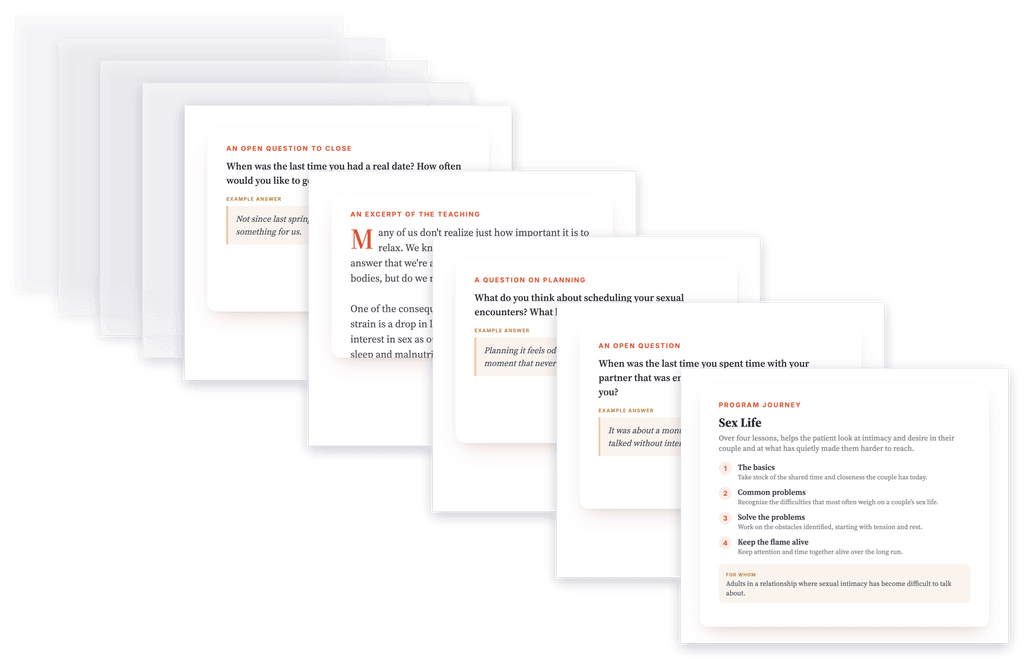
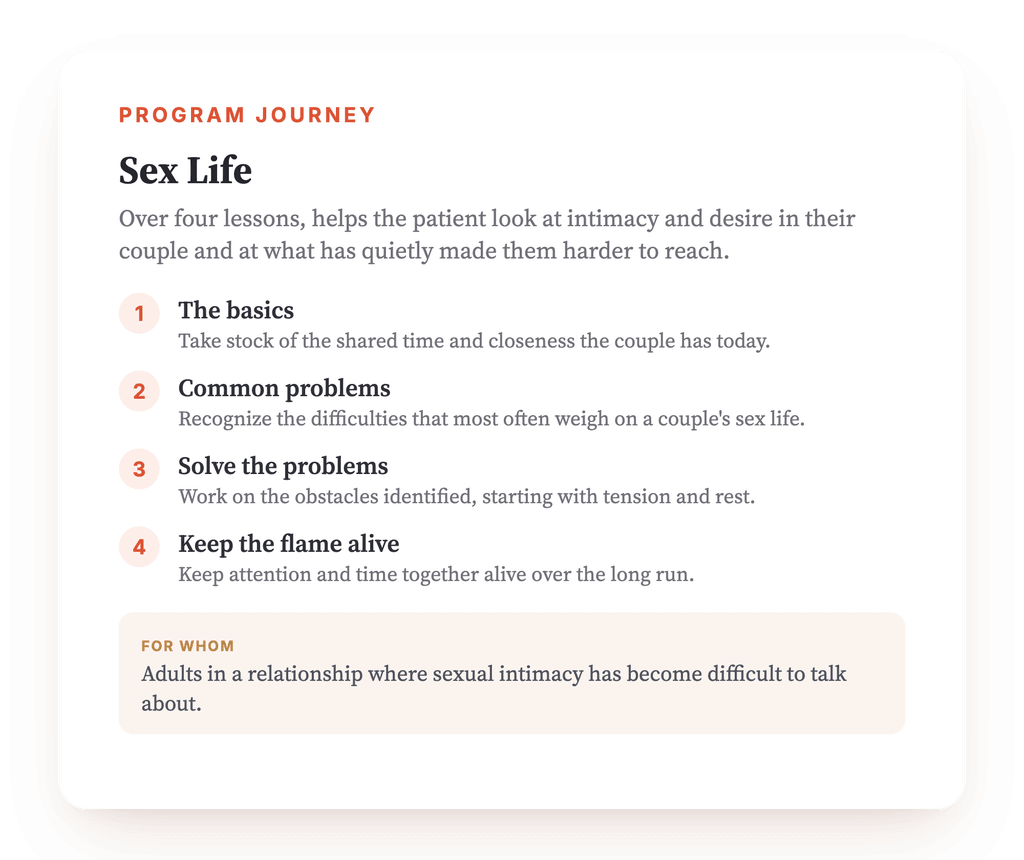
The program unfolds across four progressive lessons, each building on the previous one.
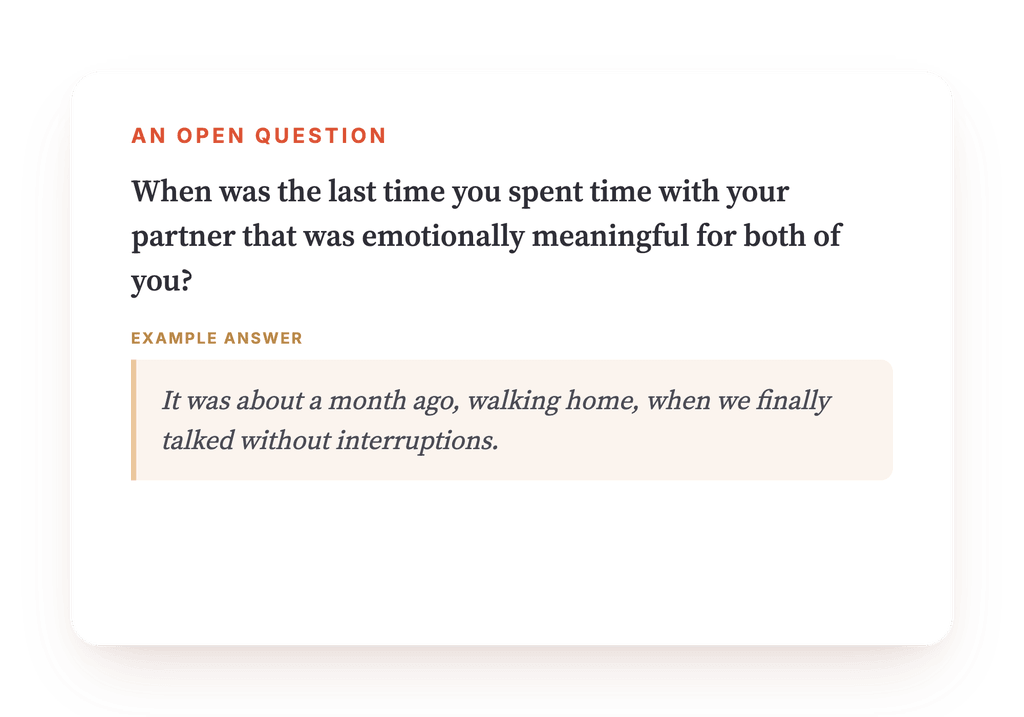
Lesson 1 (Foundations) opens the conceptual ground: emotional and sexual intimacy, the role of skills and practice, the natural evolution of desire over the course of a relationship, and the value of experimentation beyond the comfort zone. Guided prompts invite the patient to reflect on recent meaningful time with their partner, their satisfaction with mutual competencies, and how their level of desire has shifted over time. This mirrors the broader work clinicians do when exploring relationship maintenance behaviors or secure attachment.
Lesson 2 (Common problems) maps the most frequent relational sticking points: mismatched libido, the spontaneity-versus-planning tension, and the lack of communication about sexual needs and preferences. A multiple-choice question on sexual frequency gives patients a concrete, low-threshold way to locate themselves. This pairs naturally with work on nonviolent communication for couples or soft startups when patients struggle to voice needs without triggering defensiveness.
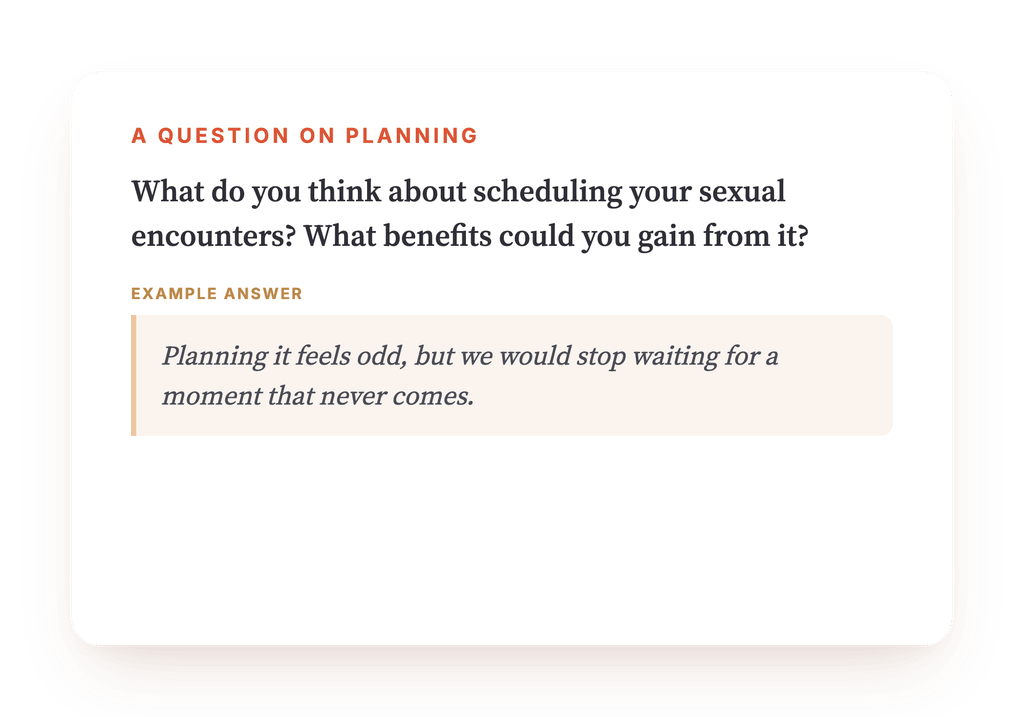
Lesson 3 (Solving problems) moves from description to action: the impact of rest and energy on libido, how intentional scheduling of intimacy can be liberating rather than clinical, and how to begin voicing fantasies and preferences to a partner. The prompts are concrete and personal, asking what the patient actually wants their partner to know and how they might phrase it. This step connects directly to assertive communication skills and the Expressing Vulnerability in Relationships worksheet.
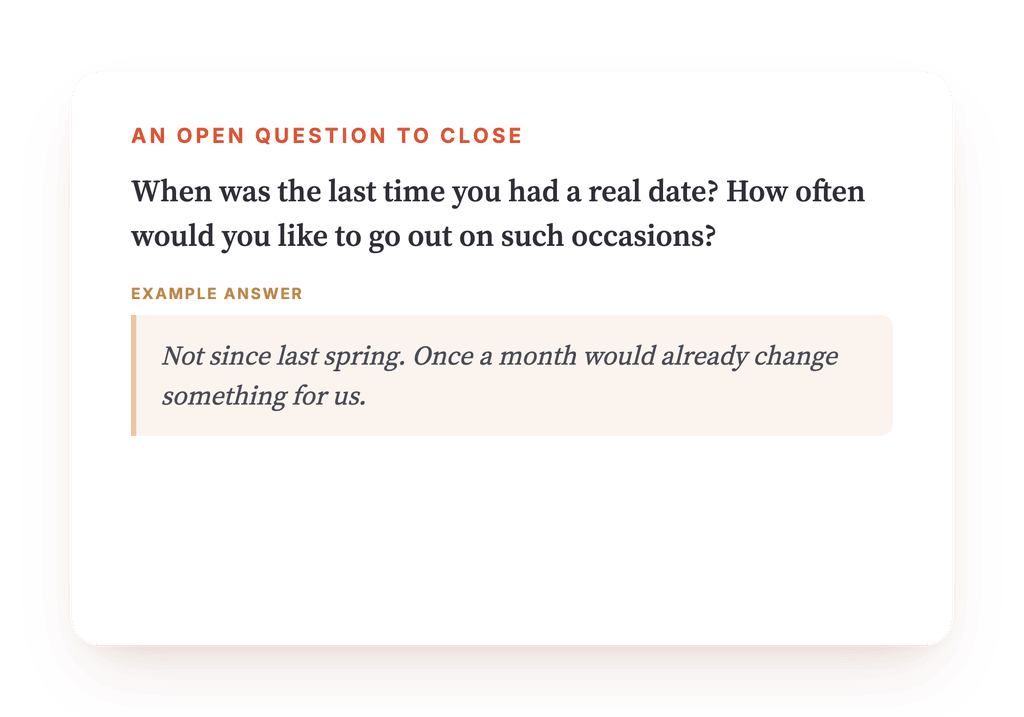
Lesson 4 (Keeping the flame) addresses relational maintenance over time: date rituals, the quality of shared connection, gratitude as a daily relational practice, and the self-knowledge required to communicate desire honestly. This final lesson makes clear that sexual wellbeing cannot be separated from the health of the relationship as a whole, echoing what clinicians working on relationship rituals or the five love languages already know well.
The program overview map and the sample lesson cards embedded here show only a few excerpts. These aperçus represent a small fraction of the complete program, which contains many more lesson steps, guided prompts, psychoeducation texts, and reflection questions than what is visible in the previews.
Key insight: Sexual difficulties almost always signal something broader: a deficit in emotional closeness, an absence of shared language, or a gradual erosion of intentional connection. This program addresses all three layers in sequence, giving patients a structured framework they can work through in private, before bringing what they discover back to the consultation.
This program is available to patients through the mobile application that is the dedicated patient-side interface of SessionFuel: the clinician assigns it directly from their SessionFuel account, and the patient then completes each lesson autonomously on their phone, between appointments.
Use it with your patients
Share this tool in the mobile app and follow the work between sessions.
How to integrate this program into your practice
This program suits couples in therapy as well as individuals working on relational and sexual difficulties in individual treatment. It is assigned as autonomous homework to complete between two consultations, not during the consultation itself.
To introduce it, a simple frame works well: "Between now and our next appointment, I'd like you to work through the first two lessons of a structured program on sexual life in couples. There are no right or wrong answers; the prompts are there to help you put words to things we haven't yet named together." This reduces performance anxiety and frames the work as exploratory.
At the next appointment, what the patient has written in their guided prompts becomes the clinical material. You can open with: "What came up for you that surprised you?" or "Was there anything you found hard to answer?" The program's structure on communication about sexual needs, desire patterns, and gratitude practices generates specific, textured material that is far harder to access through direct questioning alone. For patients who also struggle with assertiveness or expressing vulnerability, the program creates a natural bridge toward that parallel work. The Weekly Couples Relationship Check-In exercise can be assigned alongside Lesson 4 to reinforce the relational maintenance habits it introduces.
Your session continues in your patients' pocket
Use with a patientYour resources, available everywhere
The handouts, exercises, programs and audios above: you choose which ones to make available to your patients, in the mobile app dedicated to them.
And far more than a library
The app goes well beyond resources, to support your patients every day:
Related categories
Explore other clinical resources by category.

Relationships
Clinical worksheets and tools on relational functioning: attachment, schemas, assertiveness, and communication skills for therapists. Printable PDF resources.

Understand
Clinical hub for the therapeutic aim 'Understand': worksheets and tools to build patient insight across CBT, ACT, schema therapy and more.

Build skills
Skill-building resources for clinicians: printable worksheets and exercises for coping, assertiveness, and communication skills training in therapy.

Integrative
Integrative therapy clinical resources: worksheets, psychoeducation programs, and exercises for eclectic, multimodal practice across orientations.

Solution-focused
Clinical hub for Solution Focused Therapy resources: worksheets, exercises and programs for goal-oriented, strengths-based practice across individual and couple work.

Anxiety
Clinical hub for anxiety disorders: CBT and ACT worksheets, psychoeducation sheets, and exercises for assessment and treatment across the anxiety spectrum.