
Clinical picture. M., a woman in her mid-fifties, was referred following an abrupt medical retirement from a nursing career she had held for nearly three decades. She presented with low mood and a persistent sense of erasure, describing herself flatly as "a nurse who can no longer nurse." The clinician introduced the identity worksheet, inviting her to work through the eight-box exercise between sessions. M. initially struggled to name parts of herself outside the professional role, yet by the third box she had written "grandmother," "allotment grower," and "the one who remembers family stories." In the following session she noted, with some surprise, that losing the nurse thread felt genuinely painful but no longer total: other threads had become visible. The work did not resolve her grief, but it created enough ground for her to begin planning with something wider than loss.
Identity Exploration: PDF Worksheet, Tools and Exercises for Clinical Practice
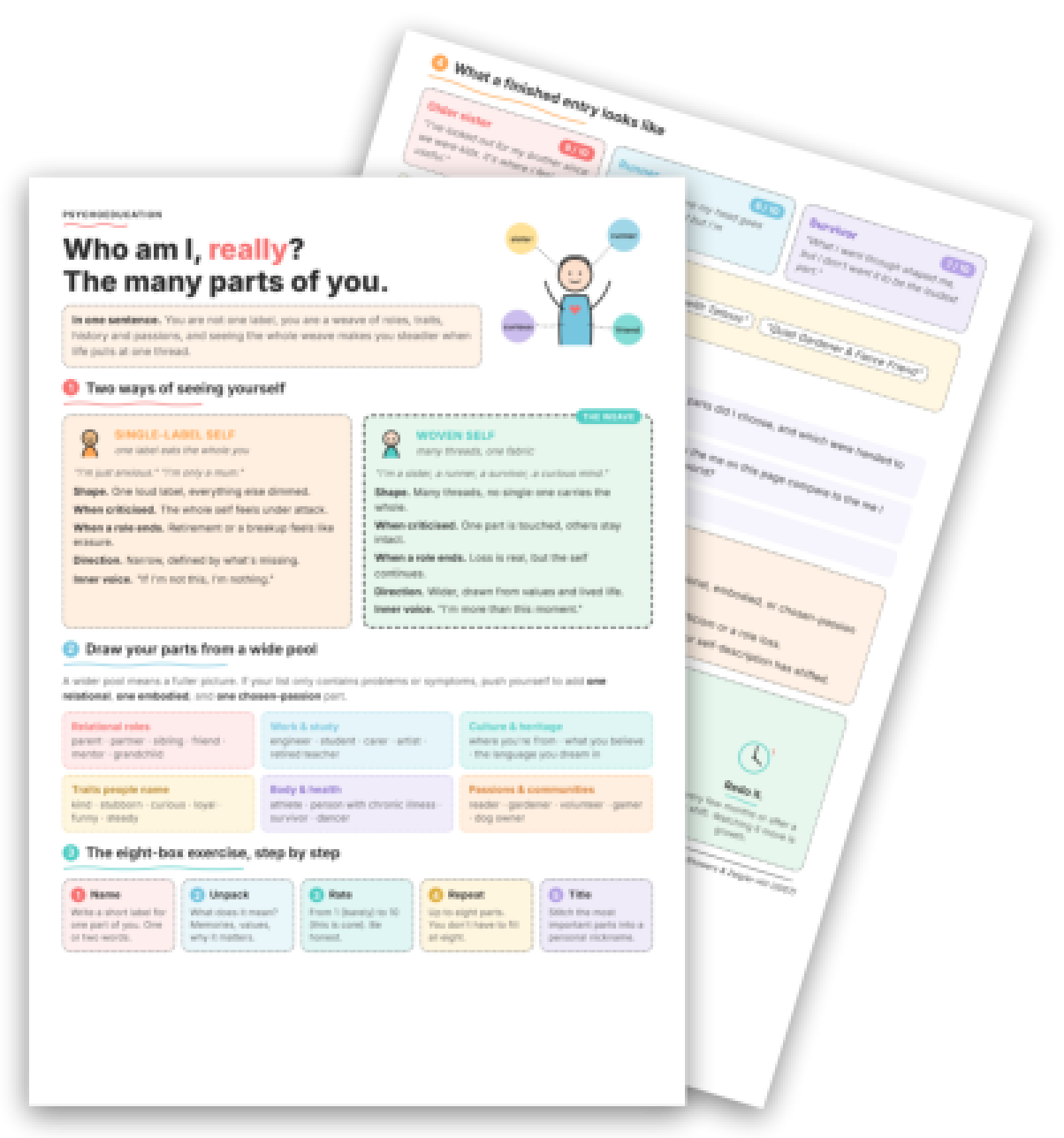
A printable PDF tool with a side-by-side identity comparison, a structured eight-box exercise, and reflection prompts clinicians can use in session to help patients build a richer, more resilient self-concept.
Clinical vignettes
Role Loss After Early Retirement
Symptom Label Dominating Self-Concept
Clinical picture. T., a man in his early thirties, had carried a diagnosis of OCD for several years and had organised much of his self-description around it, opening most sessions with "as someone with OCD, I..." The clinician offered the worksheet not as a correction but as a broadening exercise, drawing attention to the single-label versus woven-self distinction on the psychoeducation sheet. T. completed the pool exercise at home and returned having listed eight parts, including "brother," "distance runner," "person who reads history," and "stubborn in a useful way." He rated the OCD-related part a six for salience but gave "runner" and "brother" eights. The shift was modest and he remained symptomatic, yet he began framing setbacks as touching one thread rather than confirming a total identity.
When a patient's self-concept collapses into one label, "I'm just anxious," "I'm only a mum," verbal reframing rarely dislodges it. The problem is structural, not semantic. This identity exploration fiche PDF gives you a visual scaffold to map self-complexity alongside the patient, in real time, rather than talking around it.
Use this resource with your patients
Handout, exercises and materials ready to use, right inside SessionFuel.
Why Identity Stays Stuck After Oral Explanation
Linville's self-complexity model (1985, updated in McConnell, 2011) is the clinical backbone here: the narrower the self-structure, the greater the spillover of distress when any single role or trait is criticised or lost. You see the mechanism clearly at retirement, after a breakup, after a diagnosis. The patient who says "If I'm not this, I'm nothing" is not catastrophising. They are accurately describing a self built around one thread.
Explaining this concept verbally tends to produce intellectual agreement without recognition. Patients nod, then continue to speak as though the single label covers everything. The risk is compounded when that label is a symptom or disorder: enmeshment with an undeveloped self and fusion with a diagnosis both follow the same structural logic. So does the low self-esteem presentation where any criticism of a role reads as a verdict on the entire person.
A side-by-side visual breaks that loop. That is exactly what the fiche provides.
What the Fiche Contains: A Visual Support for In-Session Explanation
The fiche opens with a direct two-column comparison the clinician can use to show, not just describe, the difference between a "single-label self" and a "woven self." Each column covers the same four dimensions: shape, response to criticism, response to role loss, and inner voice. The single-label column carries the prompt "one label eats the whole you"; the woven-self column shows "many threads, no single one carries the whole." Showing these in parallel on paper does what a spoken explanation cannot: the patient sees both positions simultaneously and can locate themselves on the page.
> Key clinical takeaway: This fiche is a visual support that facilitates the explanation of identity complexity in session. It is not a questionnaire patients complete alone; it is a psychoeducation tool clinicians use to make an abstract structural concept legible, and to leave the patient with a concrete reference they can return to between sessions.
Section 2 provides a pool of six identity domains (relational roles, work and study, culture and heritage, traits, body and health, passions and communities) presented as brief labelled clusters. This is clinically useful precisely because patients under distress draw almost exclusively from one domain. The visual layout makes the gaps visible instantly. It connects naturally to values clarification work and to personal strengths exploration.
Section 3 walks through the eight-box exercise in five numbered steps: Name (a short label), Unpack (memories, values, why it matters), Rate (1 to 10), Repeat (up to eight parts), then Title (a personal nickname stitched from the most important parts). Section 4 shows what a completed entry looks like, with three worked examples at different ratings. Section 5 closes with five reflection questions including "Which parts did I choose, and which were handed to me?" and a clearly marked "To discuss in session" block with three specific clinical triggers.
This structured visual layout makes it far easier to introduce self-as-context work from ACT, or to connect to a life narrative exercise, without having to build the conceptual scaffolding from scratch each time.
750+ clinical tools
A library built with and for clinicians, ready to use in session and extend between appointments.
Access all the toolsWhen and How to Introduce It
The fiche fits naturally from the second or third session onward, once the presenting problem is established and you want to situate it within the broader self-structure. It is particularly indicated for patients facing role transitions (retirement, separation, bereavement, diagnosis), for those whose self-description consists almost entirely of symptoms, and in schema therapy work involving the enmeshment schema or subjugation patterns.
A low-resistance introduction: "I'd like to show you something that might help us look at this from a slightly different angle, not just the part that's been hurting, but the whole picture." Then point to the two-column comparison and ask where they recognise themselves.
Debrief by noting which domains the patient avoided, whether the rating task revealed any surprise, and whether the personal nickname lands as genuine or forced. The nickname is a useful anchor: it connects to work on a richer self-image, complements the "I Am Unique" self-worth exercise, and can be revisited after major life events to track how the self-description has shifted.
One clinical limit: with patients in acute crisis or with a highly fragmented sense of self (dissociative presentations, complex trauma), the exercise may feel overwhelming before sufficient stabilisation. In those cases, begin with grounding and present-moment work before attempting a full identity mapping.
The fiche does not replace the therapeutic frame. It makes one difficult concept clear on paper, leaves the patient a concrete reference, and saves you from rebuilding the same explanation session after session.
Use it with your patients
Share this tool in the mobile app and follow the work between sessions.
Sources
- Schwartz, R. C., Sweezy, M. (2019). Internal Family Systems Therapy (2nd ed.). Guilford Press.
Your session continues in your patients' pocket
Use with a patientYour resources, available everywhere
The handouts, exercises, programs and audios above: you choose which ones to make available to your patients, in the mobile app dedicated to them.
And far more than a library
The app goes well beyond resources, to support your patients every day:
Related categories
Explore other clinical resources by category.

Identity
Clinical resources for self-identity work in therapy: CBT, ACT, schema tools for clinicians addressing self-concept, core beliefs, and identity disruption.

Build awareness
Clinical worksheets and tools to build awareness in therapy: cognitive distortions, schemas, emotions, ACT and CBT resources for practitioners.

Engage & motivate
Clinical hub: printable worksheets and exercises to build therapeutic engagement and motivation across ACT, CBT, and integrative practice. For clinicians.

Humanistic
Printable clinical resources for humanistic therapy: worksheets, exercises, and psychoeducation programs for practitioners using person-centered and experiential approaches.

IFS
Printable IFS clinical resources for practitioners: worksheets, psychoeducation sheets, and guided audio for Internal Family Systems therapy across trauma, anxiety, and more.

Integrative
Integrative therapy clinical resources: worksheets, psychoeducation programs, and exercises for eclectic, multimodal practice across orientations.