
Internal Family Systems (IFS): Clinical Resources for Practitioners
Internal Family Systems (IFS), also referred to as parts-based therapy or the IFS model, is a structured psychotherapeutic approach that conceptualises the psyche as a multiplicity of sub-personalities organised around a stable, compassionate core Self. This page is intended for clinicians who already work within, or are integrating, the IFS framework into individual, couple, or group treatment. Here you will find printable worksheets, psychoeducation sheets, exercises, and guided audio resources designed to support IFS-informed sessions across a range of presentations and care-plan stages.

The Parts System: Managers, Firefighters, and Exiles
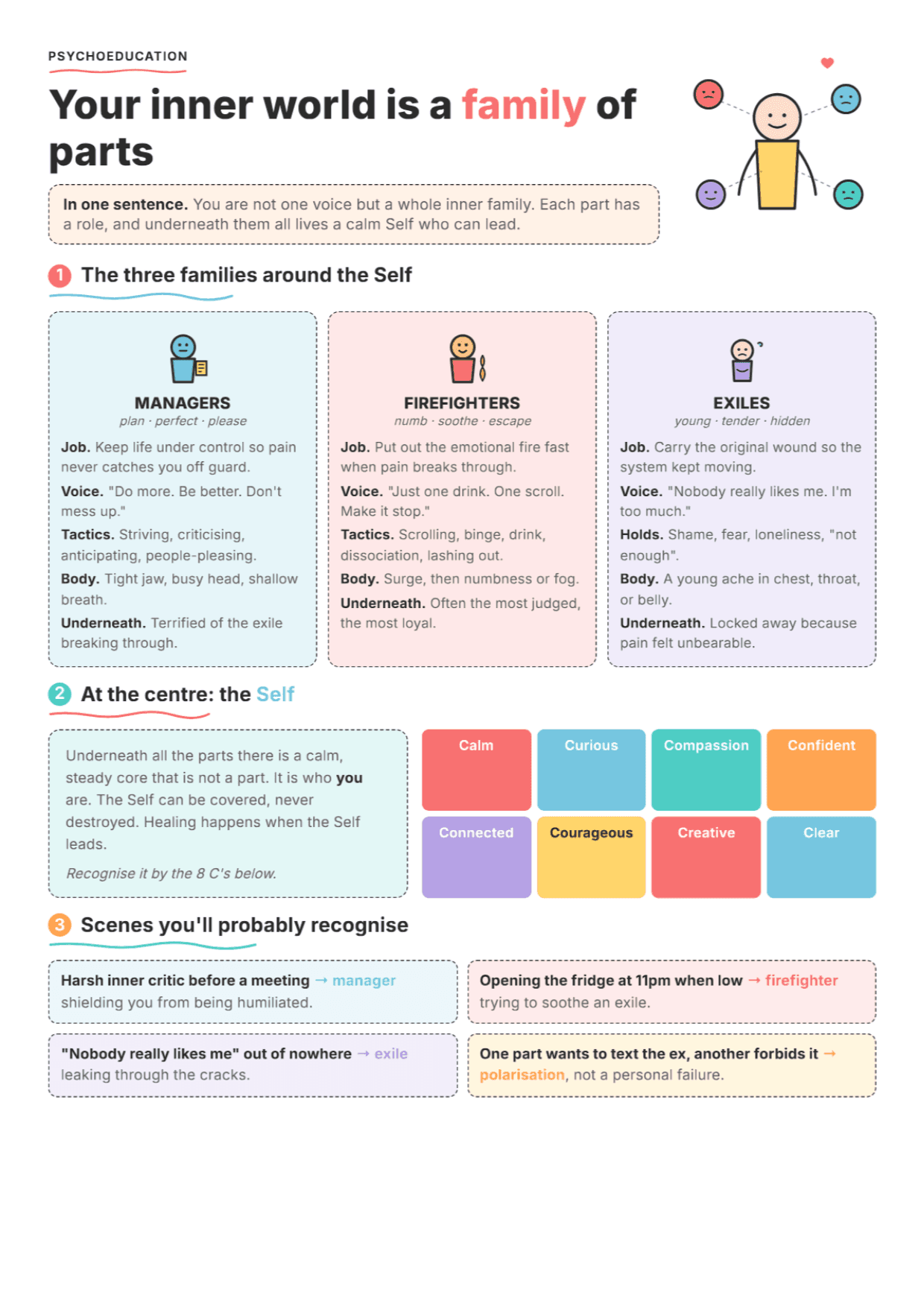
<cite>IFS conceptualises the psyche as comprising distinct internal parts, each embodying unique roles, emotions, and beliefs formed through developmental experiences, particularly those involving trauma.</cite> Schwartz's original typology distinguishes three functional categories: managers, who operate proactively to maintain control and prevent pain from surfacing; firefighters, who mobilise reactively when exiled material breaks through; and exiles, the vulnerable, often traumatised parts that carry the affective and somatic burdens of early adverse experience.
Understanding this architecture is clinically essential before deploying any IFS resource. A worksheet targeting protective parts, for instance, will land differently depending on whether the client is primarily engaged with managerial or firefighter functioning. Mapping the system early in treatment allows you to sequence interventions with greater precision.
The Self as Therapeutic Agent
<cite>IFS posits the existence of a core Self in every person, characterised by qualities such as compassion, clarity, and calm, which is inherently intact and capable of leading the internal system.</cite> This is not an aspirational construct; it is the active therapeutic vehicle. <cite>Therapeutic change involves increasing the leadership skills of the core Self, building trusting relationships among parts and the core Self, and unburdening vulnerable parts so they can assume more adaptive roles, supporting improved emotion regulation and well-being.</cite>
In session, Self-energy is recognisable by the eight Cs (curiosity, compassion, calm, clarity, confidence, courage, creativity, connectedness) and the five Ps. Clinicians track the ratio of Self to parts-dominated responding as a live process indicator, not merely as an intake variable.
Clinical Presentations and Indicators for IFS Work
Trauma Spectrum and Dissociative Features
<cite>IFS is frequently applied in the treatment of complex post-traumatic stress disorder (C-PTSD), anxiety, and depression.</cite> Its non-pathologising stance, which reframes symptoms as the protective activity of parts rather than deficits in the person, tends to reduce shame and increase engagement, particularly with clients who have found symptom-focused approaches alienating.
<cite>IFS may provide an alternative to purely cognitive and exposure-based methods, in that it utilises a comprehensive, mindful, and compassion-based approach to the treatment of traumatic sequelae.</cite> That said, the model does not bypass stabilisation. Working with exiles before adequate unblending is established carries real clinical risk; the sequencing of parts-work mirrors the phased logic of trauma treatment.
Affect Dysregulation, Personality Pathology, and Somatic Presentations
<cite>A 2013 randomised controlled trial published in the Journal of Rheumatology demonstrated statistically significant reductions in pain, physical impairment, and depressive symptoms in rheumatoid arthritis patients receiving IFS therapy compared to a control group.</cite> This finding positions IFS as relevant beyond purely psychiatric presentations, including in chronic pain populations where the affective load of persistent somatic experience is substantial.
IFS also shows utility in borderline personality organisation, where the rapid oscillation between idealising and devaluing states maps naturally onto the parts framework. Parts carrying shame, rage, or abandonment panic can be approached with curiosity rather than confrontation, reducing the rupture risk that more directive methods sometimes produce.
Differential Considerations and Contraindications
When Parts Language Complicates Rather Than Clarifies
<cite>IFS may not be appropriate for patients with severe mental illnesses involving psychosis or paranoia, such as schizophrenia; describing a person as having "parts" may be unproductive or harmful for those patients.</cite> The ambiguity between an internal dialogue framing and actual hallucinated voices demands careful differential assessment before introducing parts-based language.
Similarly, clients with limited reflective capacity, significant alexithymia, or active dissociative identity disorder presentations require clinical adaptation of standard IFS protocol. Standard unburdening sequences assume a minimal baseline of mindsight and affect tolerance that not all clients possess at outset.
Overlap with Adjacent Models
IFS shares conceptual terrain with ego-state therapy, structural dissociation theory, and object relations approaches. The clinical distinctions matter when communicating with colleagues, writing formulations, or transitioning clients between providers. IFS differs from ego-state approaches primarily in its explicit insistence on the Self as a distinct, non-part entity, and from structural dissociation models in its non-hierarchical reading of internal organisation.
<cite>Informed by insight-oriented therapeutic lineages including family systems, relational, object relations, and attachment theory, IFS holds that every individual carries an innate capacity for curiosity, care, mindfulness, acceptance, and love.</cite> This theoretical pluralism is both a strength and a source of definitional imprecision in the literature.
Using IFS Resources In Session: A Practical Framework
Sequencing Worksheets Within the U-Turn Process
The core IFS move is the U-turn: redirecting attention from external events or from another person inward, toward the parts that are activated. Psychoeducation sheets introduced early in treatment serve to normalise multiplicity and lower the client's alarm at discovering internal conflict. They are most effective when reviewed collaboratively in session rather than assigned as homework without context.
Once the client has some familiarity with their parts landscape, structured exercises support direct access, the technique of speaking to a part without necessarily achieving full unblending. Structured parts-mapping worksheets scaffold this process, particularly for clients who find the open-ended quality of imagery-based work destabilising.
Guided Audio as an Access Route to Parts
For clients who struggle with the purely verbal, cognitively mediated aspects of parts-work, guided visualisation offers a sensory and somatic entry point. The Inner Guides Visualization: Guided Audio for Clinicians supports this phase of the work: it can be used in session as a facilitated exercise or reviewed by the clinician beforehand to prepare for guided imagery sequences with specific clients.
Audio-based resources are particularly well-suited to the trailhead phase, when the clinician is helping the client locate a part by following a bodily sensation, image, or emotional charge rather than a named belief. The pacing and tone of the audio matters considerably; always preview any audio resource before deploying it clinically.
Integration into the Care Plan: Step-by-Step Approach
The following sequence reflects how IFS-oriented resources typically slot into a treatment arc:
- Psychoeducation on the parts model: introduce the multiplicity framework, normalise internal conflict, and establish shared vocabulary before any parts-work begins.
- Parts mapping: use structured mapping exercises to inventory protector parts, note their somatic correlates, and identify initial trailheads toward exiled material.
- Unblending work with protectors: offer dedicated worksheets or in-session dialogue structures to help managers and firefighters differentiate from the Self; build the trust that allows protective parts to relax their vigilance.
- Direct access and witnessing: guided audio or structured inquiry exercises facilitate the client's Self approaching an exile, witnessing its experience, and beginning to metabolise its burden.
- Unburdening and retrieval: this phase is rarely supported by paper-based resources alone; worksheets here serve as post-session consolidation tools rather than in-session scripts.
- Integration and legacy mapping: structured reflection exercises help the client and clinician track shifts in the system and identify residual protective patterns that warrant continued attention.
Comorbidities and Interaction with Pharmacotherapy
IFS in Complex, Multi-Diagnoses Presentations
<cite>A 2025 scoping review identified IFS as a "promising therapeutic approach" for conditions such as PTSD, depression, and chronic pain, noting significant symptom reduction in pilot trials.</cite> In practice, IFS is rarely deployed as a standalone treatment in complex presentations; it is more commonly integrated with stabilisation protocols, somatic approaches, or attachment-focused work.
<cite>In IFS, the focus is not directly on the narrative specifics of the trauma, symptom management, or reducing substance use; instead, IFS incorporates elements of present- and past-focused models through non-directed inquiry-based methods including internal narrative dialogue, contemplative practice, and visual imagery.</cite> This makes it a useful complement to more structured, protocol-driven interventions rather than a replacement for them.
Pharmacotherapy and the Parts System
Some clients present with concerns that psychotropic medication is silencing or numbing their parts. This is a clinically meaningful observation, not a resistance to be bypassed. Framing pharmacotherapy within the parts model, as a support that reduces the activation of overwhelmed firefighters, often allows the client to engage with medication decisions with more nuance and less ambivalence.
Points of Vigilance and Clinical Limits
The Evidence Base: What It Does and Does Not Support
<cite>Early randomised trials and quasi-experimental studies suggest that IFS may benefit patients with depression and PTSD, including consistent improvements in self-compassion; however, the evidence base remains small and more condition-specific research is needed.</cite> Clinicians should communicate this with appropriate nuance when discussing treatment rationale with clients and when writing medico-legal documentation.
Boundaries of the Practitioner Role
IFS work with exiles, particularly in unburdening sequences, activates intense affect rapidly. Clinicians without specific IFS training should limit their use of these resources to psychoeducation and protector-level work. Working with exiles without a secure therapeutic alliance and adequate training carries genuine decompensation risk.
Finally, the non-pathologising language of IFS, while therapeutically valuable, should not translate into diagnostic minimisation. Parts carrying psychotic content, severe dissociation, or active suicidality require rigorous clinical risk assessment regardless of how they are named within the model.
Tools in this category

Handout
Exploring a Non-Activated IFS Part: PDF Worksheet, Tools and Exercises
A visual clinical tool to help patients meet inner parts while calm, build Self-leadership, and prepare for therapeutic encounters with protector and exile parts in IFS practice.
Self & identityTrauma & PTSD
Handout
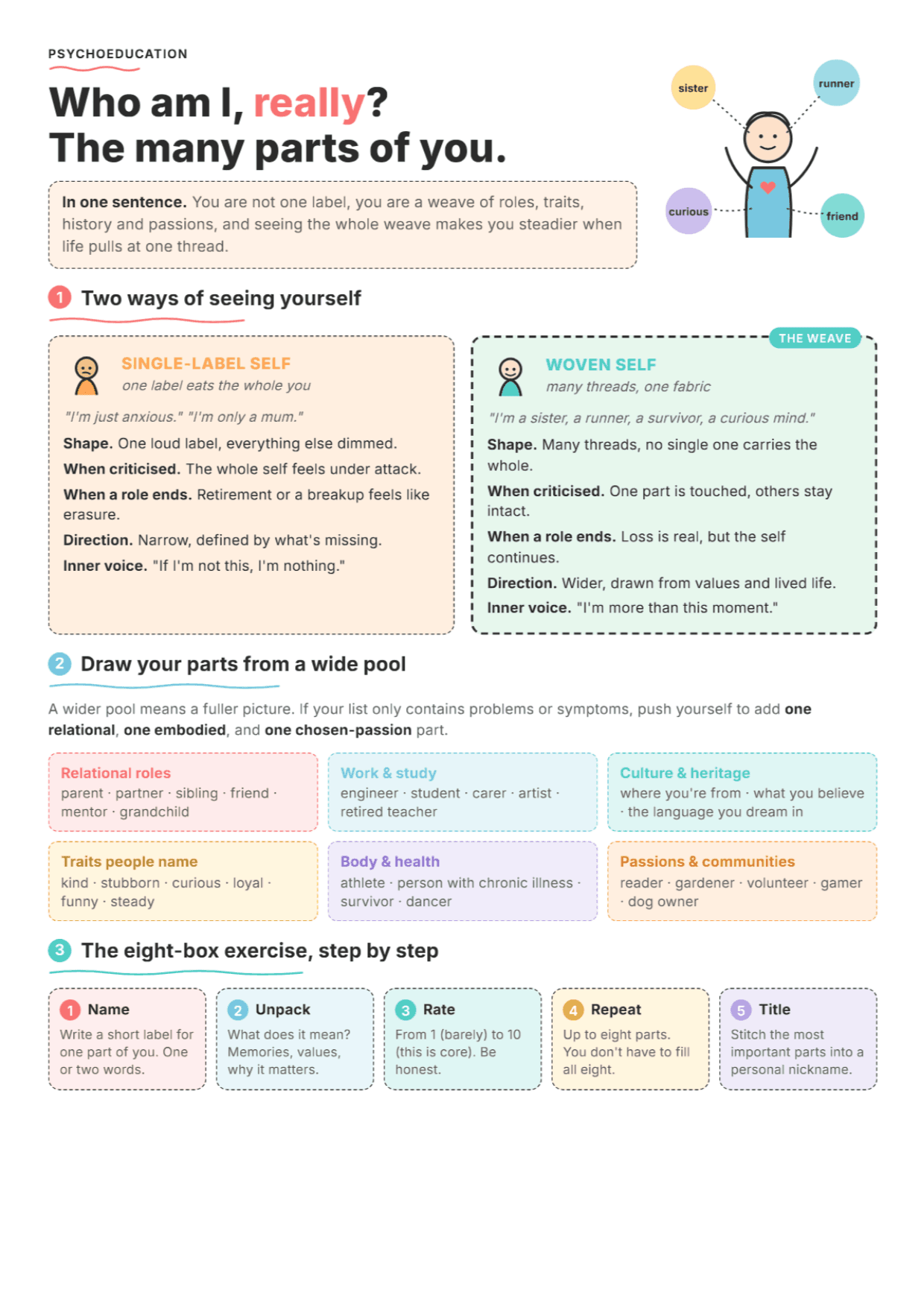
Identity Exploration: PDF Worksheet, Tools and Exercises for Clinical Practice
A printable PDF tool with a side-by-side identity comparison, a structured eight-box exercise, and reflection prompts clinicians can use in session to help patients build a richer, more resilient self-concept.
Self & identity

Handout
IFS Trailhead: PDF Worksheet, Tools and Exercises for Clinical Practice
A printable PDF worksheet, tools and exercises to help clinicians introduce the trailhead concept, guide unblending in session, and give patients a concrete map for parts work.
Self & identityTrauma & PTSD
Handout
Internal Family Systems (IFS) Therapy: PDF Worksheet, Tools and Exercises
A printable PDF worksheet, clinical tools, and psychoeducation exercises to explain IFS parts, the Self, and inner multiplicity clearly in session.
Trauma & PTSDMood & depression

Handout
Noticing an Exile (IFS): PDF Worksheet, Tools and Exercises
A visual psychoeducation tool and structured exercises to help clinicians introduce exiles, protectors, and Self-energy in IFS-informed sessions.
Trauma & PTSDAnxiety