
Clinical picture. A is a 38-year-old solicitor referred for generalised anxiety, reporting relentless self-criticism and an inability to delegate at work. In the third session, the clinician introduced basic IFS psychoeducation and invited A to notice the inner voice repeating 'you'll fall short' before client presentations. Rather than challenging the thought as a cognitive distortion, the clinician asked A to get curious about that part: what job was it doing, and what was it afraid would happen if it stopped? A identified, with some surprise, that the critical voice felt like a guard posted at a door, convinced that relaxing vigilance even briefly would expose him to humiliation. By the end of the session A was using the language 'a part of me is worried' rather than 'I am a failure', which created enough distance to observe the pattern without immediately fusing with it.
Internal Family Systems (IFS) Therapy: PDF Worksheet, Tools and Exercises
A printable PDF worksheet, clinical tools, and psychoeducation exercises to explain IFS parts, the Self, and inner multiplicity clearly in session.
Clinical vignettes
Recognising a Manager in Session
Late-Night Eating as Firefighter Activity
Clinical picture. R is a 44-year-old teacher who described recurring episodes of eating large amounts of food late at night, which she found shameful and puzzling given that she was not physically hungry. The clinician introduced the firefighter concept from IFS, framing the behaviour not as a character flaw but as a rapid-response strategy a part had adopted to extinguish emotional pain before it became overwhelming. R was initially sceptical, yet when asked what the urge typically followed, she identified a consistent pattern: evenings when she had felt dismissed or unseen during the day. Shifting the clinical focus toward the underlying exile, rather than the eating behaviour itself, reduced R's self-condemnation noticeably and allowed her to approach the pattern with curiosity rather than shame. No resolution was reached in that session, but R reported that simply understanding the structure made the behaviour feel less alien and less defining.
The IFS model, presented verbally, tends to produce a curious nod followed by a quiet return to fused self-language: "I feel anxious" rather than "a part of me is anxious." The shift from a unitary self to an inner multiplicity of parts rarely takes hold through explanation alone. This IFS PDF worksheet gives you a visual anchor to make the architecture of the inner world immediately legible in session, and to establish a shared vocabulary before the therapeutic work proper begins.
Use this resource with your patients
Handout, exercises and materials ready to use, right inside SessionFuel.
Why IFS Is Hard to Convey Orally
The core theoretical move of Internal Family Systems (Schwartz, 1995) is straightforward in principle: the mind is not monolithic. Managers, Firefighters, and Exiles each carry their own logic, affect, and protective function. The Self stands entirely apart from all three, calm and available to lead. Patients rarely resist the idea. They simply cannot hold the map.
When you describe a manager's striving and an exile's shame in the same oral explanation, the patient tracks neither reliably. The concept of polarisation, which the fiche describes as "one part wants to text the ex, another forbids it," dissolves without a visual anchor. The 8 Cs of Self become another list. And with cognitive defusion still incomplete, patients tend to collapse the whole framework back into "I am," losing the therapeutic leverage that parts-language is designed to create.
What the Fiche Contains, and Why a Visual Layout Helps
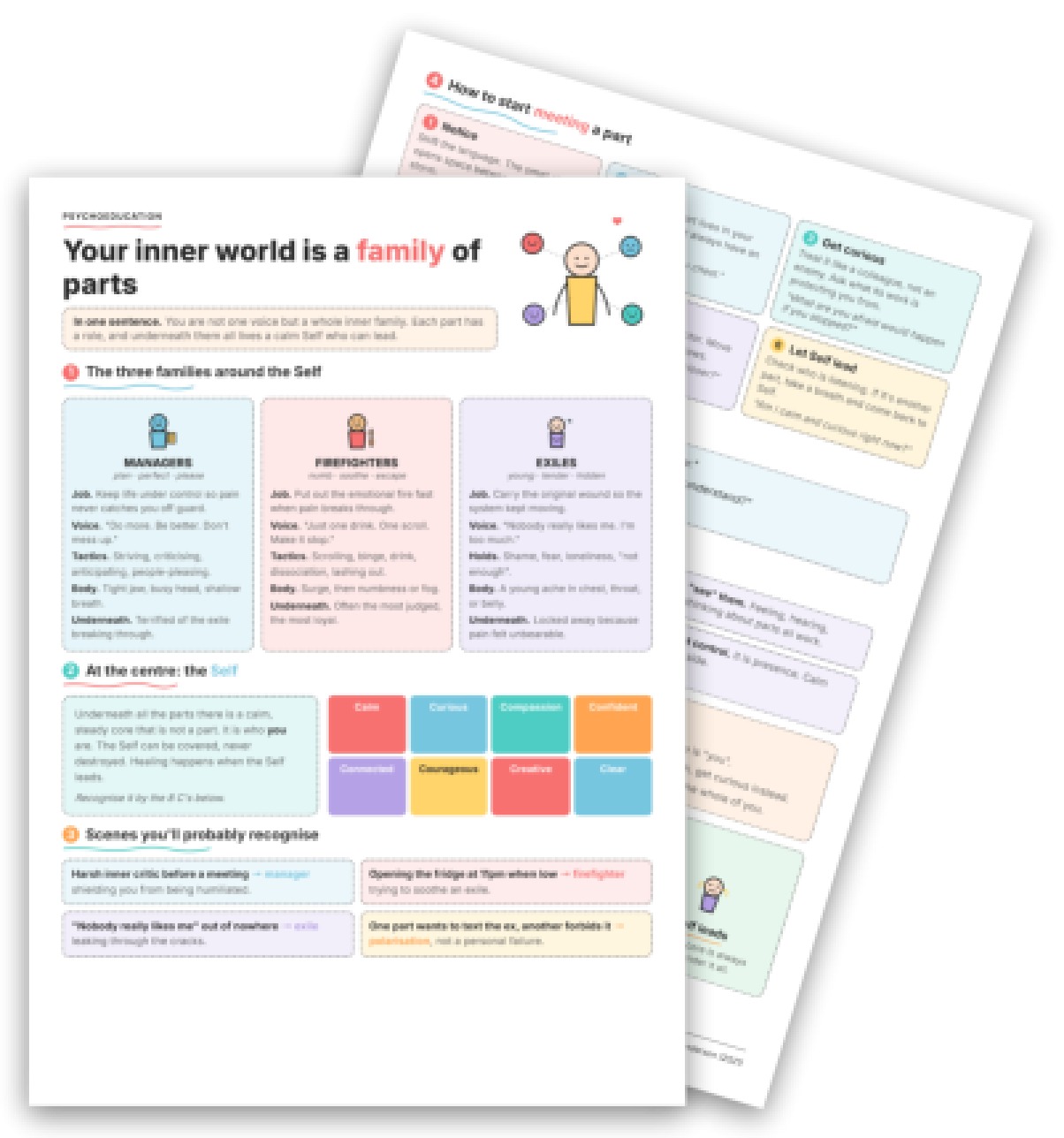
The fiche is organized across six structured panels plus a closing discussion prompt and four clinical reminders, all on a single printable page.
Panel 1 places the three part families side by side: Managers ("plan, perfect, please"), Firefighters ("numb, soothe, escape"), and Exiles ("young, tender, hidden"). Each family is described by its job, its internal voice, its tactics, its body signature, and what lies underneath the protective role. Seeing "Tactics. Scrolling, binge, drink, dissociation, lashing out" under Firefighters, next to "surge, then numbness or fog," maps the function of adaptive and maladaptive coping strategies in a single glance. No oral summary achieves that compression.
Panel 2 grounds the Self through the 8 Cs (Calm, Curious, Compassion, Confident, Connected, Courageous, Creative, Clear) arranged around the central concept. The visual layout lets a patient check in real time whether they are speaking from Self or from a part.
Panel 3 offers four recognizable clinical vignettes: the harsh inner critic before a meeting, opening the fridge at 11pm when low, the sudden thought "nobody really likes me," and the pull toward a former partner. Naming each as a part with a protective function, rather than a character flaw, reframes how early experience shapes present reactivity without requiring a lengthy formulation.
Panel 4 details a six-step meeting-a-part sequence: Notice, Locate, Get Curious, Thank, Ask Permission, Let Self Lead. Each step includes a concrete verbal prompt: "What are you afraid would happen if you stopped?" and "Am I calm and curious right now?" This panel is the most useful debriefing tool after a session where a protector was activated.
Panels 5 and 6 supply three inner phrases to borrow and four common confusions to clear up (parts are not dissociative identities; the goal is not to eliminate a part but to free it from a forced role). The closing "To discuss in session" section gives patients a focused autonomous task between appointments.
> Key point: this fiche is a visual psychoeducation support you use alongside the patient in session, not a questionnaire to complete alone. The parallel layout of the three part families, complete with body-sensation descriptors, conveys in one glance what oral explanation takes ten minutes to approximate.
750+ clinical tools
A library built with and for clinicians, ready to use in session and extend between appointments.
Access all the toolsWhen and How to Introduce the Fiche
This PDF worksheet fits naturally after the first or second session, once the presenting picture is clear. It is particularly well placed when you observe entrenched self-sacrifice patterns (a manager who has been running the system for decades), prominent shame and defectiveness content, or abandonment-driven reactivity that reads clinically as an exile breaking through.
A low-burden introduction: "I want to show you a map of how the mind organizes itself under pressure. See if anything here sounds familiar from what you described." Avoid labeling the patient's parts before they have seen the framework. The visual layout invites the patient to do the recognizing, which lands differently than a clinician-generated interpretation.
Debrief by anchoring to the body-sensation column: "When you read the Firefighter description, where do you feel that?" Keeping the work somatic rather than purely cognitive prevents intellectualization. The fiche pairs naturally with IFS Trailhead exploration and work with a non-activated part as the therapy deepens. When a patient is ready to approach wound material directly, Noticing an Exile offers a structured next step. Between sessions, the My Inner Guides visualization audio supports continued parts-contact autonomously.
One contraindication to bear in mind: patients with a significant dissociative history may find parts-language activating rather than organizing. Delay the fiche in those cases until the therapeutic alliance is robust and window-of-tolerance work is already consolidated.
The fiche does not substitute for the relational container IFS requires; it makes the map explicit, so patients begin using the language before they can fully inhabit the model.
Use it with your patients
Share this tool in the mobile app and follow the work between sessions.
Sources
- Schwartz, R. C., Sweezy, M. (2019). Internal Family Systems Therapy, Second Edition. The Guilford Press.
- Schwartz, R. C. (2021). No Bad Parts: Healing Trauma and Restoring Wholeness with the Internal Family Systems Model. Sounds True.
- Schwartz, R. C. (1995). Internal Family Systems Therapy. Guilford Press.
- IFS Institute. What is Internal Family Systems?.
Your session continues in your patients' pocket
Use with a patientYour resources, available everywhere
The handouts, exercises, programs and audios above: you choose which ones to make available to your patients, in the mobile app dedicated to them.
And far more than a library
The app goes well beyond resources, to support your patients every day:
Related categories
Explore other clinical resources by category.

Trauma
Clinical hub on trauma and PTSD: assessment, differential diagnosis, treatment phases, and printable resources for practitioners. 155 chars.

Mood
Evidence-based worksheets and clinical tools for mood disorders: CBT, ACT, and positive psychology resources for psychologists and therapists.

Identity
Clinical resources for self-identity work in therapy: CBT, ACT, schema tools for clinicians addressing self-concept, core beliefs, and identity disruption.

Behaviours
Clinical hub for behaviors in therapy: worksheets and tools for coping, eating disorders, CBT formulation, and maladaptive behavioral patterns.

Understand
Clinical hub for the therapeutic aim 'Understand': worksheets and tools to build patient insight across CBT, ACT, schema therapy and more.

IFS
Printable IFS clinical resources for practitioners: worksheets, psychoeducation sheets, and guided audio for Internal Family Systems therapy across trauma, anxiety, and more.