
Clinical picture. M., a woman in her late thirties, presented with chronic low-grade depression and a pattern of paralysis around routine tasks, which she described as laziness and proof of her inadequacy. During a session, she mentioned sitting motionless in front of a sink of unwashed dishes for nearly an hour the previous evening. The clinician introduced the trailhead worksheet, inviting her to locate that heaviness in her body rather than explain it. She placed a hand on her sternum and, with some prompting, described a grey, dense shape about the size of a fist. When asked how she felt toward it, she paused and said, quietly, "A little sorry for it, actually," marking a shift from fusion to a stance workable enough to continue. No dramatic insight followed, yet she returned the next week noting the episode felt less like a character flaw and more like something that had happened to her.
IFS Trailhead: PDF Worksheet, Tools and Exercises for Clinical Practice
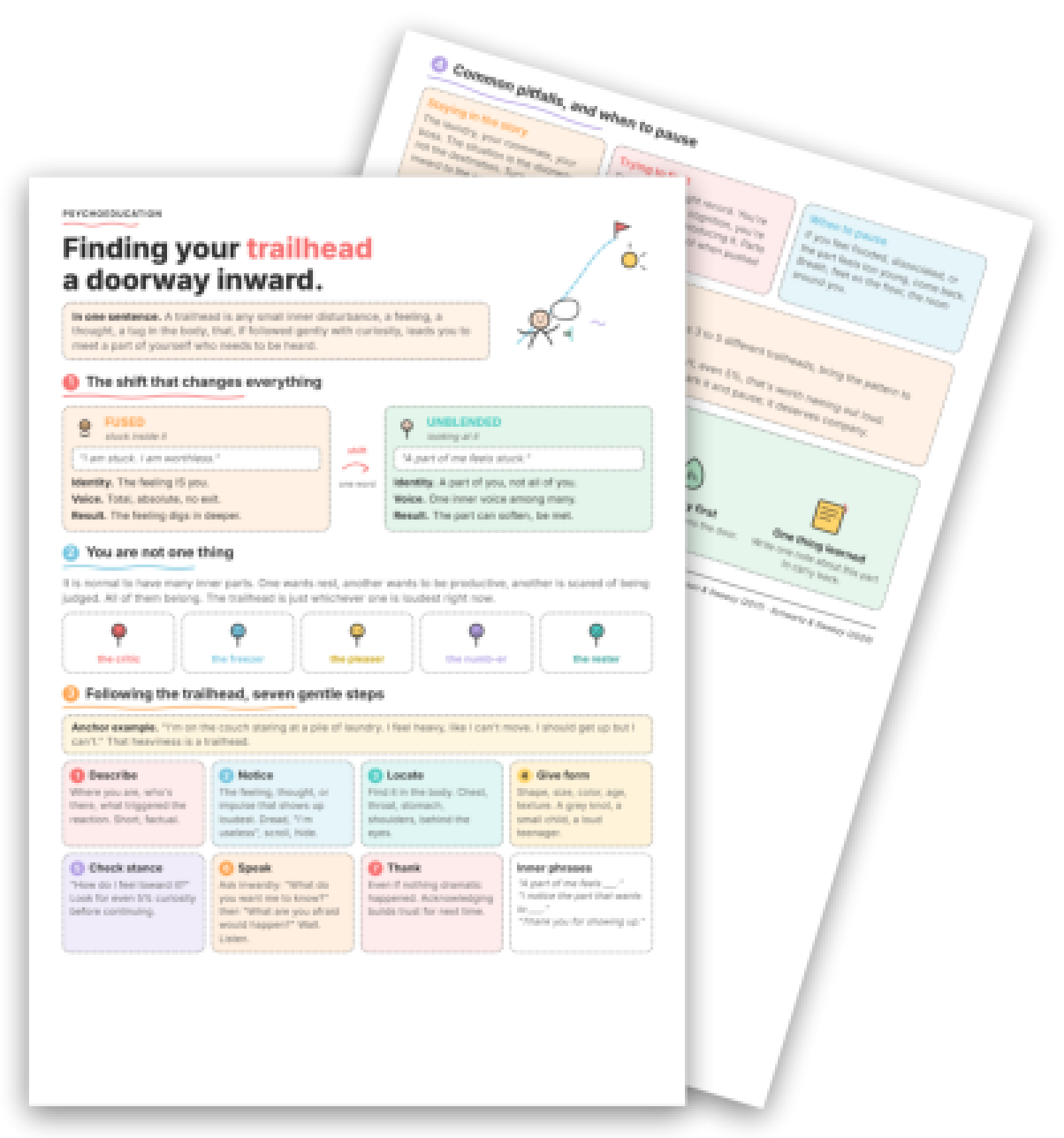
A printable PDF worksheet, tools and exercises to help clinicians introduce the trailhead concept, guide unblending in session, and give patients a concrete map for parts work.
Clinical vignettes
Unblending a Freeze Response
Working With an Inner Critic
Clinical picture. T., a man in his mid-forties with generalised anxiety and a long history of self-critical rumination, often arrived at sessions restating the same condemning narrative about his professional performance. The clinician offered the trailhead sheet as a between-session practice, specifically the reframe from "I am worthless" to "a part of me feels worthless." In the following session T. reported that, while completing step two on his own, he had noticed the critical voice seemed to live in his jaw and upper chest, a detail that surprised him enough to slow the spiral. He described the part tentatively as a tense, older teenager who expected punishment for any mistake. The exercise did not silence the critic, but T. began referencing it as a distinct voice rather than as objective truth, which opened a more useful line of inquiry in subsequent sessions.
In IFS-informed practice, the trailhead concept tends to collapse in the room: patients hear the instructions, locate a feeling, and then narrate the situation around it rather than turning toward the part. Explaining unblending verbally, without a shared reference point, produces intellectual agreement and little actual inner contact. This fiche PDF gives you a concrete visual anchor to make that shift legible and repeatable in session.
Use this resource with your patients
Handout, exercises and materials ready to use, right inside SessionFuel.
Why the Trailhead Concept Resists Explanation in Session
The pivotal move is the linguistic one: from "I am stuck" to "a part of me feels stuck." Stated aloud, the gap sounds trivial to patients. They nod, then immediately return to fusion, narrating the laundry pile, the boss, the conflict, without ever making contact with the part reacting to it. The blended state pulls attention outward toward the story; only a concrete visual contrast tends to redirect it inward.
The difficulty compounds when you introduce multiplicity. Patients raised on a unitary self-concept find it genuinely disorienting to accept that a critic, a pleaser, and a freezer can coexist without any one of them being the "real" self. An oral explanation lands as metaphor. A page where those parts are named side by side lands as structure. That distinction matters for pacing: you cannot use the trailhead productively until the patient has genuinely internalized that none of their parts speaks for the whole.
There is also a specific clinical risk here. Patients with trauma histories, or those prone to dissociative responses tied to autonomic dysregulation, can flood during unstructured inner inquiry. The fiche addresses this directly, and walking through its "when to pause" section together before any inner contact begins functions as a co-constructed safety protocol rather than an afterthought.
What the Fiche Contains: A Visual Support for Unblending Work
The fiche opens with a fused versus unblended contrast: two columns comparing identity, voice quality, and clinical outcome in each state. The layout is immediate, most patients point to the fused column before you finish the sentence, which gives you a live relational entry into the work.
Section 2 names five common protective parts (the critic, the freezer, the pleaser, the numb-er, the rester), normalizing multiplicity before any inner contact is attempted. This moves the conversation away from pathology and toward the organizing principle that all parts belong. For patients already working with early maladaptive schemas, the naming of the critic or pleaser accelerates mode-mapping work, since the vocabularies translate cleanly.
Section 3 walks through seven sequential steps for following a trailhead: describe, notice, locate in the body, give form, check stance, speak, thank. The anchor example, "I'm on the couch staring at a pile of laundry. I feel heavy, like I can't move", gives patients a concrete reference rather than an abstract procedure. The body-location step ("find it in the body, chest, throat, stomach") connects naturally to any somatic awareness work you have already introduced.
The fiche closes with a pitfalls panel ("staying in the story," "trying to fix it") and three explicit "to discuss in session" prompts: the same protective part appearing across three to five different trailheads, inability to access even 5% curiosity toward a part, and a part that feels too young to meet alone. This architecture clarifies what belongs in autonomous practice and what belongs inside the therapeutic relationship.
> To retain: The fiche is a visual support that facilitates the explanation of the trailhead and unblending concepts in session; it is not a self-help handout the patient completes alone, but a shared reference the clinician uses to make a complex inner shift concrete and repeatable.
750+ clinical tools
A library built with and for clinicians, ready to use in session and extend between appointments.
Access all the toolsWhen and How to Introduce the Fiche
The fiche fits naturally once you have laid a basic IFS psychoeducation foundation and the patient shows some capacity to step back from a dominant emotional state. A second or third session within a parts-work module is often the right moment: after you have named multiplicity conceptually but before you run a full unblending sequence.
A low-stakes introduction: "I want to show you a map of what we're about to do together. Nothing to fill in, just something to look at so we share the same vocabulary." For patients already familiar with ACT cognitive defusion techniques, the blended/unblended contrast maps directly onto fusion versus defusion, and naming that parallel shortens the learning curve considerably. For those working on distancing and decentering from thought content, the fiche adds the somatic and relational dimension that purely cognitive frameworks leave implicit.
Where the patient carries significant shame or defectiveness-related parts, the naming of the "freezer" or "numb-er" often produces immediate recognition and reduces the isolation that silent, unnamed parts tend to generate. The behavior, emotion, underlying need framework can serve as a useful bridge here, since parts communicate through behavior and emotion precisely because they have unmet needs.
Exercise caution with patients actively dissociating or those with limited interoceptive access: the "locate it in the body" step may need sensory grounding work before it becomes available. Point to the "when to pause" panel explicitly, and treat it as shared rather than prescriptive. Between sessions, the companion resource Exploring a Non-Activated IFS Part builds on the vocabulary the fiche establishes and extends the work into a quieter, non-activated register.
The fiche does not replace the clinical container; it makes the explanation sharper and leaves the patient with a concrete reference they can return to when a trailhead appears between appointments.
Use it with your patients
Share this tool in the mobile app and follow the work between sessions.
Sources
- Schwartz, R. C., & Sweezy, M. (2019). Internal Family Systems Therapy (2nd ed.). Guilford Press.
- Schwartz, R. C. (2021). No Bad Parts: Healing Trauma and Restoring Wholeness with the Internal Family Systems Model. Sounds True.
- Schwartz, R. C. (2001). Introduction to the Internal Family Systems Model. Trailheads Publications.
- Shadick, N. A., Sowell, N. F., Frits, M. L., Hoffman, S. M., Hartz, S. A., Booth, F. D., Sweezy, M., Rogers, P. R., Dubin, R. L., Atkinson, J. C., Friedman, A. L., Augusto, F., Iannaccone, C. K., Fossel, A. H., Quinn, G., Cui, J., Losina, E., & Schwartz, R. C. (2013). A randomized controlled trial of an internal family systems-based psychotherapeutic intervention on outcomes in rheumatoid arthritis: A proof-of-concept study. The Journal of Rheumatology.
- IFS Institute. Research - IFS Institute.
Your session continues in your patients' pocket
Use with a patientYour resources, available everywhere
The handouts, exercises, programs and audios above: you choose which ones to make available to your patients, in the mobile app dedicated to them.
And far more than a library
The app goes well beyond resources, to support your patients every day:
Related categories
Explore other clinical resources by category.

Anxiety
Clinical hub for anxiety disorders: CBT and ACT worksheets, psychoeducation sheets, and exercises for assessment and treatment across the anxiety spectrum.
Trauma
Clinical hub on trauma and PTSD: assessment, differential diagnosis, treatment phases, and printable resources for practitioners. 155 chars.

Mood
Evidence-based worksheets and clinical tools for mood disorders: CBT, ACT, and positive psychology resources for psychologists and therapists.

Identity
Clinical resources for self-identity work in therapy: CBT, ACT, schema tools for clinicians addressing self-concept, core beliefs, and identity disruption.

Cognition
Printable cognitive therapy worksheets and clinical tools for therapists: CBT, ACT, schema work, defusion, distortions, and belief restructuring.

Build awareness
Clinical worksheets and tools to build awareness in therapy: cognitive distortions, schemas, emotions, ACT and CBT resources for practitioners.