
Clinical picture. A, a 34-year-old woman, presented with recurrent conflict in her relationship, describing episodes where a neutral comment from her partner triggered intense withdrawal and shame that lasted hours. During a session focused on a recent argument, the clinician invited her to slow down and notice what had moved through her body in the moment her partner used a flat, distracted tone. She identified a tight knot below her sternum and a fleeting sense of being "too much," which she recognised as distinct from her adult distress. The clinician named this as a possible exile surfacing, and A sat with it briefly rather than redirecting to problem-solving. She left with a short noticing prompt to use between sessions, and the following week reported less self-criticism after similar moments, describing a nascent ability to observe the younger feeling without immediately acting from it.
Noticing an Exile (IFS): PDF Worksheet, Tools and Exercises
A visual psychoeducation tool and structured exercises to help clinicians introduce exiles, protectors, and Self-energy in IFS-informed sessions.
Clinical vignettes
Disproportionate Reaction, Childhood Origin
Blank Episode During Ordinary Feedback
Clinical picture. M, a man in his early forties, sought consultation after noticing he would "go blank" each time his manager offered even mild corrective feedback, recovering only well after the conversation had ended. The clinician introduced the three-layer framework from the worksheet, and M quickly identified a critical inner voice telling him to "get it together" as the most familiar layer. When asked what lay underneath that voice, he paused and described a sudden image of himself at around age eight, alone after a school incident, carrying a quiet certainty of being fundamentally bad. The clinician did not press further but helped M name the sequence: trigger, protector response, and then the exile briefly visible beneath it. Over the following two sessions M began logging these moments using the six-step noticing practice, which gave him enough distance from the exile to stay present during feedback without dissociating.
In IFS-informed work, naming an exile to a patient who has never encountered parts-based thinking tends to produce polite nodding and immediate confusion. The concept requires holding three simultaneous layers, understanding how they relate, and locating oneself somewhere outside all of them. Explaining that orally, in a 50-minute session, leaves little space for the patient to actually feel the model rather than just hear it. This PDF worksheet gives you a concrete visual to anchor the conversation.
Use this resource with your patients
Handout, exercises and materials ready to use, right inside SessionFuel.
Why "Exile" Resists Oral Explanation
The core difficulty is not vocabulary, it is simultaneity. Your patient needs to grasp that a protector (the snapping, the scrolling, the shutting down) is not the problem but the guard; that underneath it sits a young, wounded part carrying old shame or loneliness; and that a calm, curious Self can be accessed to sit beside that part without trying to fix it. Each layer makes sense alone. The three together, with their dynamic logic, typically do not land until the patient can see them mapped in relation to each other.
A second friction point is somatic anchoring. Patients regularly say "I feel triggered" without connecting the throat tightness or chest knot to a specific part. They also tend to identify with the part rather than notice it, which is exactly what IFS trailhead work tries to address progressively. The worksheet builds that distinction from the first glance. Without a visual, the difference between "I am worthless" and "a part of me carries worthlessness" stays theoretical. With one, it becomes spatially legible.
This is especially worth noting for patients carrying abandonment-related schemas, defectiveness and shame patterns, or emotional deprivation histories, where exile material surfaces frequently and often floods the session before the patient has the vocabulary to name what is happening.
What the Worksheet Contains
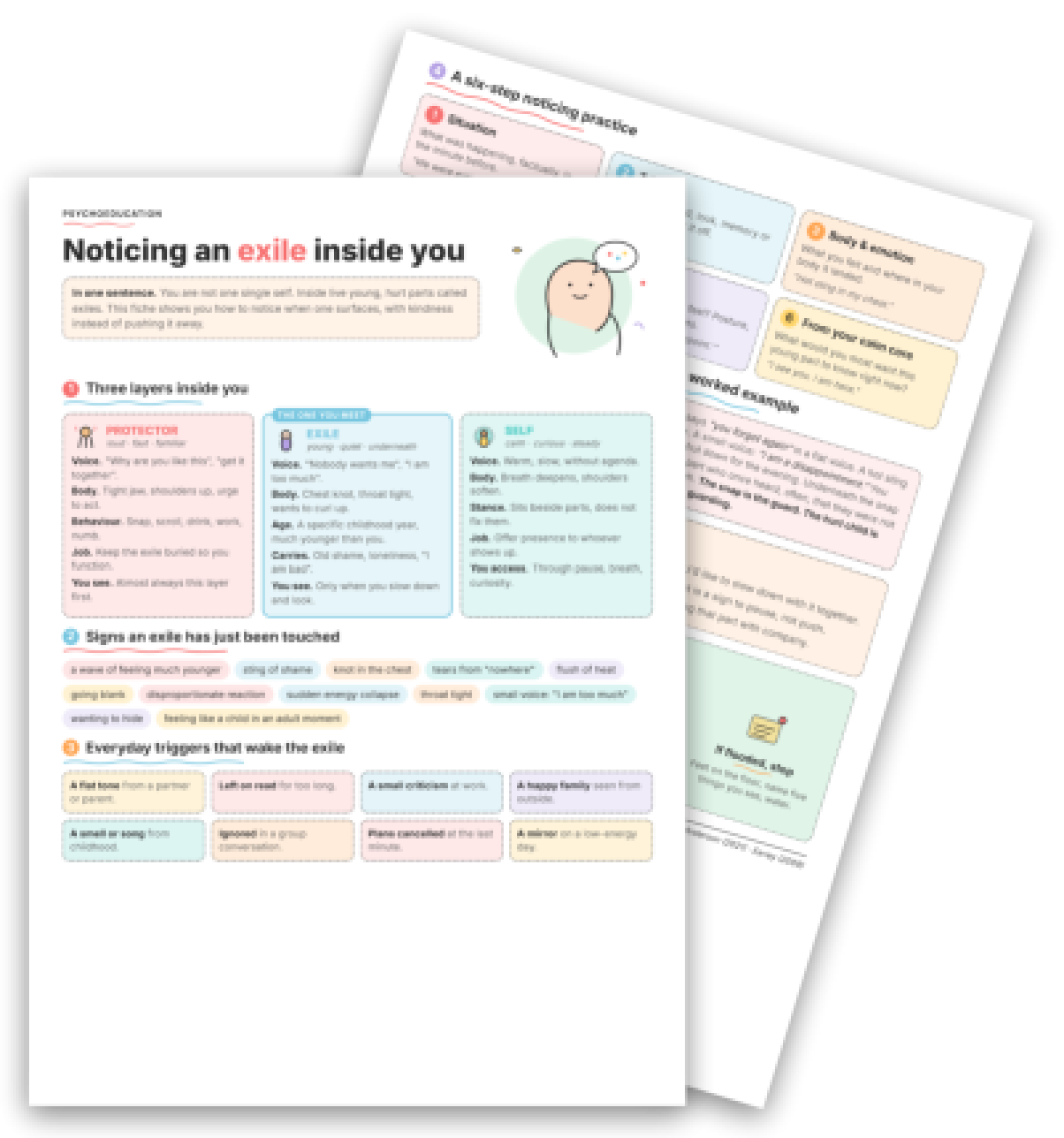
The fiche PDF is structured across six panels, each serving a distinct clinical function.
- Panel 1: Three layers inside you. A side-by-side visual of Protector, Exile, and Self. Each column lists the layer's voice, body sensation, behaviour, and clinical function. This is the spine of the whole sheet. The contrast between "Why are you like this" (Protector) and "Nobody wants me" (Exile) is shown together, which oral explanation rarely achieves cleanly.
- Panel 2: Signs an exile has just been touched. Twelve somatic and behavioural markers, including "a wave of feeling much younger", sudden energy collapse, throat tightening, and disproportionate reactivity. Patients can scan this list and recognise their own presentation, often with visible relief.
- Panel 3: Everyday triggers. Eight concrete relational scenarios (a flat tone from a partner, being left on read, a small criticism at work) that show the exile is activated by ordinary moments, not only major events.
- Panel 4: A six-step noticing practice. A structured sequence moving from Situation → Trigger → Body & emotion → Protective response → The exile → From your calm core. Each step carries a worked prompt. This is the primary between-session exercise you can assign once the patient understands the three-layer map.
- Panel 5: Phrases to try inwardly. Short Self-to-part statements ("You don't have to hide from me", "I am here now, you are not alone") that bridge psychoeducation into practice.
- Panel 6: Worked example and session prompts. A brief vignette (partner says "you forgot again," shame floods, the patient snaps or withdraws) and three explicit markers for when to slow down with the practice in session rather than independently.
> Key point: The worksheet is a visual support that facilitates the explanation in session, not a self-administered questionnaire. The three-layer layout makes the exile visible as a position in a system, not just a metaphor the clinician describes. That shift from heard to seen makes a measurable difference in how quickly patients can begin to work with the distinction.
The visual logic also complements other parts-based tools on the same trajectory: see Exploring a Non-Activated IFS Part for when the patient is ready to approach a part outside of activation.
750+ clinical tools
A library built with and for clinicians, ready to use in session and extend between appointments.
Access all the toolsWhen and How to Introduce It in Session
The worksheet fits best after one or two sessions of anamnesis, once you have a working hypothesis that the patient's reactive patterns (avoidance, snapping, numbness) are protecting something younger. You do not need to have named IFS explicitly beforehand.
A low-threshold introduction: "I want to show you a map that some people find helpful for making sense of why certain moments hit harder than they seem like they should. You don't have to agree with any of it, just tell me what feels true for you." Then open Panel 1 together and ask which column the patient usually sees first in themselves.
For patients with trauma histories, past attachment wounds, or active post-traumatic presentations, move slowly through Panel 2 before reaching the six-step practice. Watch for flooding. The sheet itself signals this: "If you find yourself getting flooded each time you try the practice alone, that is a sign to pause, not push." Having grounding techniques already in place before assigning the six-step practice between sessions is not optional, it is the clinical prerequisite.
The sheet also pairs naturally with shame-focused work. If you are using a shame-focused exercise or exploring how past experiences shape present patterns, the exile framework gives patients a structural language for what those tools are addressing. The Inner Guides Visualization can serve as a somatic complement once Self-energy is beginning to feel accessible.
The worksheet does not replace the therapeutic relationship or the case formulation. It makes a complex structural concept visible in the room, gives the patient a reference point to return to between sessions, and saves you the ten minutes of whiteboard sketching that the three-layer model otherwise requires.
Use it with your patients
Share this tool in the mobile app and follow the work between sessions.
Sources
- Schwartz, R. C., & Sweezy, M. (2020). Internal Family Systems Therapy, Second Edition. Guilford Press.
- Schwartz, R. C. (2021). No Bad Parts: Healing Trauma and Restoring Wholeness with the Internal Family Systems Model. Sounds True.
- Schwartz, R. C. (1995). Internal Family Systems Therapy. Guilford Press.
Your session continues in your patients' pocket
Use with a patientYour resources, available everywhere
The handouts, exercises, programs and audios above: you choose which ones to make available to your patients, in the mobile app dedicated to them.
And far more than a library
The app goes well beyond resources, to support your patients every day:
Related categories
Explore other clinical resources by category.
Anxiety
Clinical hub for anxiety disorders: CBT and ACT worksheets, psychoeducation sheets, and exercises for assessment and treatment across the anxiety spectrum.

Trauma
Clinical hub on trauma and PTSD: assessment, differential diagnosis, treatment phases, and printable resources for practitioners. 155 chars.

Mood
Evidence-based worksheets and clinical tools for mood disorders: CBT, ACT, and positive psychology resources for psychologists and therapists.

Identity
Clinical resources for self-identity work in therapy: CBT, ACT, schema tools for clinicians addressing self-concept, core beliefs, and identity disruption.

Behaviours
Clinical hub for behaviors in therapy: worksheets and tools for coping, eating disorders, CBT formulation, and maladaptive behavioral patterns.

Build awareness
Clinical worksheets and tools to build awareness in therapy: cognitive distortions, schemas, emotions, ACT and CBT resources for practitioners.