
Clinical picture. M., a woman in her mid-thirties, presents with a six-year history of contamination fears that have progressively narrowed her daily life; she stopped using public transport two years ago and now avoids most shared spaces. At the second session, the clinician introduces the informational sheet on exposure therapy, walking through the avoidance loop diagram before any hierarchy work begins. M. recognises the pattern immediately, noting that her brief relief after washing her hands has always been followed by a stronger urge the next time. By the end of the session she can articulate, in her own words, why staying with discomfort is mechanistically necessary, and she agrees to begin building a fear ladder the following week. This shared conceptual grounding reduces her initial reluctance to engage with in vivo tasks.
Exposure Therapy: PDF Worksheet, Tools and Exercises for Clinical Practice
A printable visual support clinicians can use in session to explain the rationale, fear ladder, and common pitfalls of exposure therapy clearly and efficiently.
Clinical vignettes
Psychoeducation Before a First Ladder
Reframing a Stalled Treatment
Clinical picture. T., a man in his late forties, was referred after two previous attempts at CBT for health anxiety that he describes as unhelpful; he reports having been told simply to "face his fears" without further explanation. The clinician uses the informational sheet to revisit the rationale, focusing on the habituation curve and the concept of SUDS, neither of which T. had encountered before. Seeing that anxiety drops on its own within a predictable window, and that repetition flattens the curve, reframes his earlier experiences as insufficiently prolonged rather than as evidence that exposure cannot work for him. He agrees to a graded hierarchy starting at a SUDS level of around 35, with explicit criteria for when to climb to the next rung. Engagement in subsequent sessions is noticeably more consistent than in his prior treatment contacts.
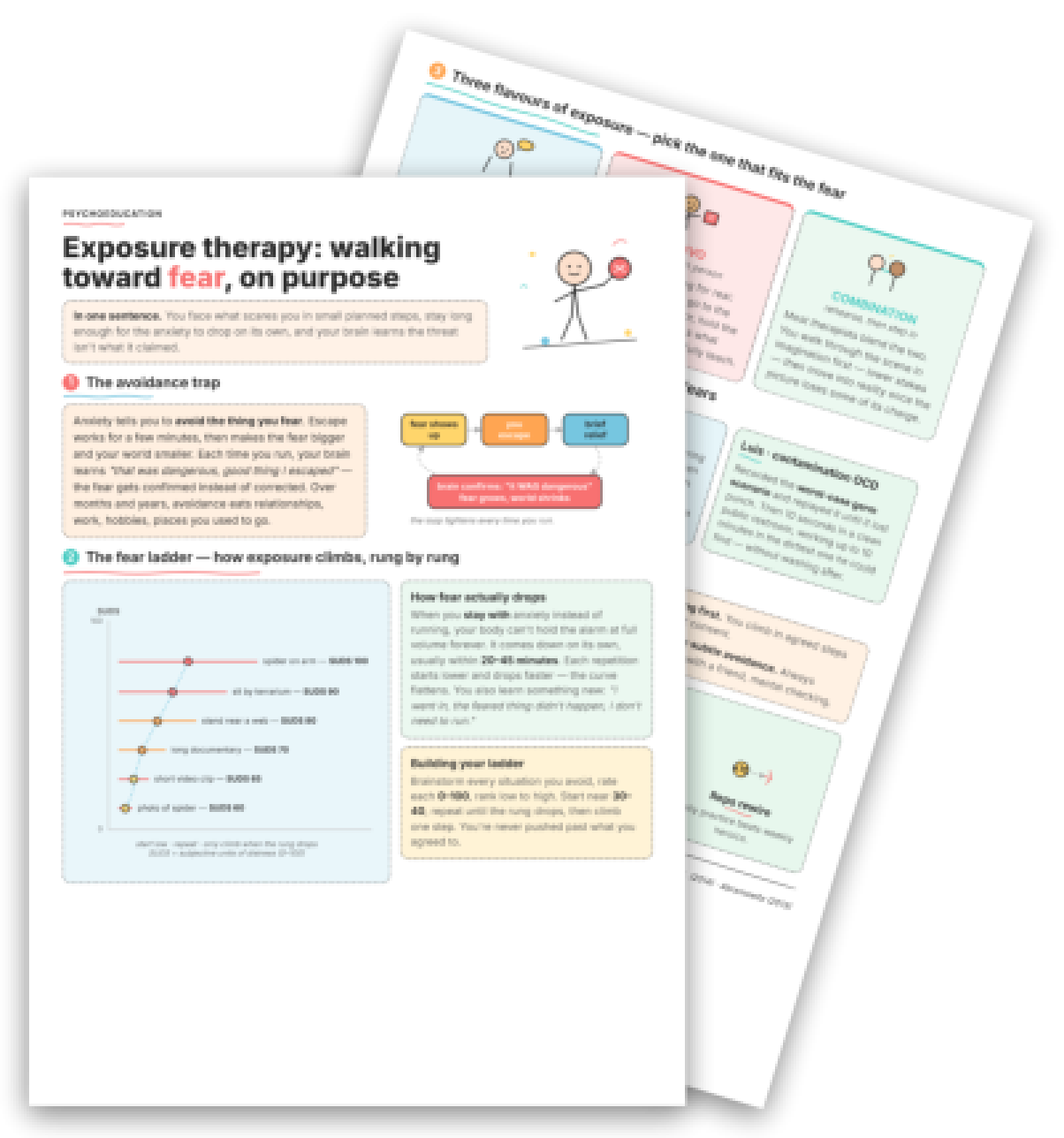
Describing the rationale for exposure therapy verbally tends to produce a familiar response: the patient nods, says they understand, and then avoids the first assignment. The concept is straightforward in theory and genuinely hard to internalize in practice. This fiche PDF gives you a visual anchor to work from in session, one that shows the avoidance loop, the fear ladder, and the physiological curve of habituation in a single printable page.
Use this resource with your patients
Handout, exercises and materials ready to use, right inside SessionFuel.
Why Exposure Is So Hard to Explain Without a Visual
The core mechanism, that voluntary prolonged contact with the feared stimulus corrects the associative threat prediction rather than merely suppressing it, requires patients to understand something counterintuitive: the discomfort is not a sign that something dangerous is happening, it is the signal that learning is occurring. Oral explanation often collapses that distinction. Patients hear "face your fear" and map it onto two equally unhelpful frameworks: white-knuckling through pain, or being pushed past their limits.
What gets lost in speech alone is the maintenance loop. Each escape attempt delivers brief relief, and that relief is the reinforcer. Without seeing the closed loop drawn out, patients rarely grasp why their avoidance has grown over months rather than stabilized. The same applies to safety behaviours: patients don't spontaneously identify always carrying water, checking their pulse, or texting a friend mid-exposure as subtle forms of escape. A visual makes those patterns nameable in a shared vocabulary.
What the Fiche Contains: Five Sections You Can Work Through Together
The fiche opens with a one-sentence orienting frame, "You face what scares you in small planned steps, stay long enough for the anxiety to drop on its own, and your brain learns the threat isn't what it claimed", which you can read aloud and revisit as a compass throughout the session.
From there, five clearly labelled sections build the clinical picture:
- The avoidance trap: a diagram showing the full maintenance loop, fear → escape → brief relief → brain confirms danger → fear grows. Pointing to this loop on paper is faster and more precise than reconstructing it verbally.
- The fear ladder: a concrete SUDS-anchored hierarchy (the fiche uses a spider phobia as a worked example, starting at SUDS 60 for a photo and ending at SUDS 100 for a spider on the arm), with the instruction to "start low, repeat only, climb when the rung drops."
- How fear actually drops: a brief explanation of the habituation curve, noting that anxiety comes down on its own within 20-45 minutes when the patient stays present, and that each repetition starts lower and flattens faster. This directly addresses the patient's most common fear about exposure: that anxiety will keep rising indefinitely.
- Three modalities: imaginal, in vivo, and combination, described plainly with their respective clinical indications, including the note that imaginal exposure is the entry point for memories, intrusive thoughts, and scenarios that cannot be staged in vivo.
- What people get wrong: a punchy final panel naming the four most common errors, including distraction during exposure ("phone, chatter, looking away all kill the learning") and subtle safety behaviours.
> Key takeaway: This fiche is a visual support for in-session explanation, not a self-directed workbook. You control the pace, you annotate it together, and the patient leaves with a concrete reference that holds the rationale between appointments.
750+ clinical tools
A library built with and for clinicians, ready to use in session and extend between appointments.
Access all the toolsWhen and How to Introduce It in Practice
The fiche fits naturally in the psychoeducation phase, typically sessions two or three once the formulation is sketched and the patient's specific avoidance pattern is on the table. It pairs well with the avoidance cycle resource used in an earlier session, and with the habituation fiche for patients who need more detail on the physiological mechanism.
For the introduction, a straightforward framing works better than clinical labelling: "I want to show you how fear actually works as a learned system, and why the way your mind has been managing it has made sense in the short term but costs you over time." Then work through sections one and two together before moving to the ladder.
The three clinical stories on the fiche (spider phobia, social anxiety, contamination OCD) give you worked examples to anchor abstract principles without requiring you to generate them in the moment. They also signal to the patient that the method applies across very different presentations, which is useful when they assume their fear is uniquely untreatable.
One limit to flag: patients with active PTSD or high dissociation will need more groundwork before the in vivo sections feel safe to discuss. The fiche's frame sits within standard TCC without trauma-specific adaptations, so pair it with the PTSD treatment guide or the Ehlers and Clark model in those cases. For patients starting to build their own hierarchy, the exposure hierarchy worksheet and the fear ladder generator extend the work directly. Between sessions, the exposure debriefing exercise helps patients consolidate each attempt, while the safety behaviours fiche addresses the subtle avoidance patterns the fiche flags but does not unpack in depth. For clinicians running a more structured programme, the graded exposure psychoeducation programme and the personal exposure list exercise are natural complements.
The fiche does not replace the therapeutic frame, but it makes the explanation faster, cleaner, and easier for the patient to return to when anxiety tells them to cancel the next session.
Use it with your patients
Share this tool in the mobile app and follow the work between sessions.
Sources
- Abramowitz, J. S., Deacon, B. J., & Whiteside, S. P. H. (2019). Exposure Therapy for Anxiety: Principles and Practice (2nd ed.). Guilford Press.
- American Psychological Association (APA). What Is Exposure Therapy?.
- Society of Clinical Psychology, APA Division 12. Exposure Therapies for Specific Phobias.
Your session continues in your patients' pocket
Use with a patientYour resources, available everywhere
The handouts, exercises, programs and audios above: you choose which ones to make available to your patients, in the mobile app dedicated to them.
And far more than a library
The app goes well beyond resources, to support your patients every day:
Related categories
Explore other clinical resources by category.

Anxiety
Clinical hub for anxiety disorders: CBT and ACT worksheets, psychoeducation sheets, and exercises for assessment and treatment across the anxiety spectrum.

Trauma
Clinical hub on trauma and PTSD: assessment, differential diagnosis, treatment phases, and printable resources for practitioners. 155 chars.

Understand
Clinical hub for the therapeutic aim 'Understand': worksheets and tools to build patient insight across CBT, ACT, schema therapy and more.

Exposure
Exposure therapy clinical resources for practitioners: worksheets, hierarchies, and psychoeducation tools for anxiety, PTSD, OCD, and avoidance-based presentations.

CBT
CBT worksheets, cognitive restructuring exercises & behavioral tools for clinicians. Evidence-based resources for every phase of cognitive behavioral therapy.

Mood
Evidence-based worksheets and clinical tools for mood disorders: CBT, ACT, and positive psychology resources for psychologists and therapists.